Capabilities
Expert Conversion Rate Optimization Services
Data-driven experimentation built for the compliance realities and patient acquisition goals of behavioral health treatment centers.
Why Conversion Rate Optimization Matters for Treatment Centers
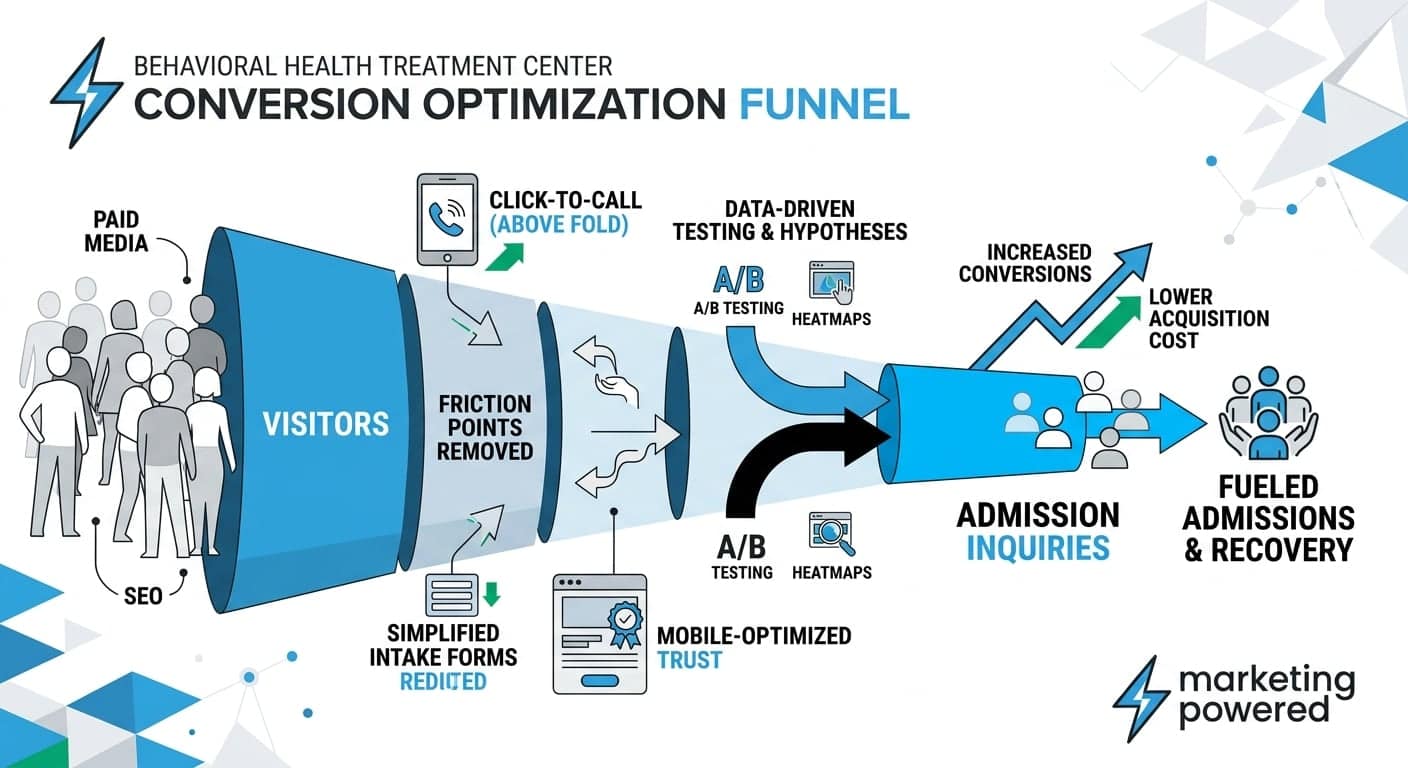
Most treatment centers invest heavily in paid media and SEO without examining what happens after the click. Traffic arrives, but admissions do not scale proportionally. Conversion rate optimization closes that gap by systematically improving the percentage of visitors who complete the action you need: a phone call, a form submission, or a verified admission inquiry.
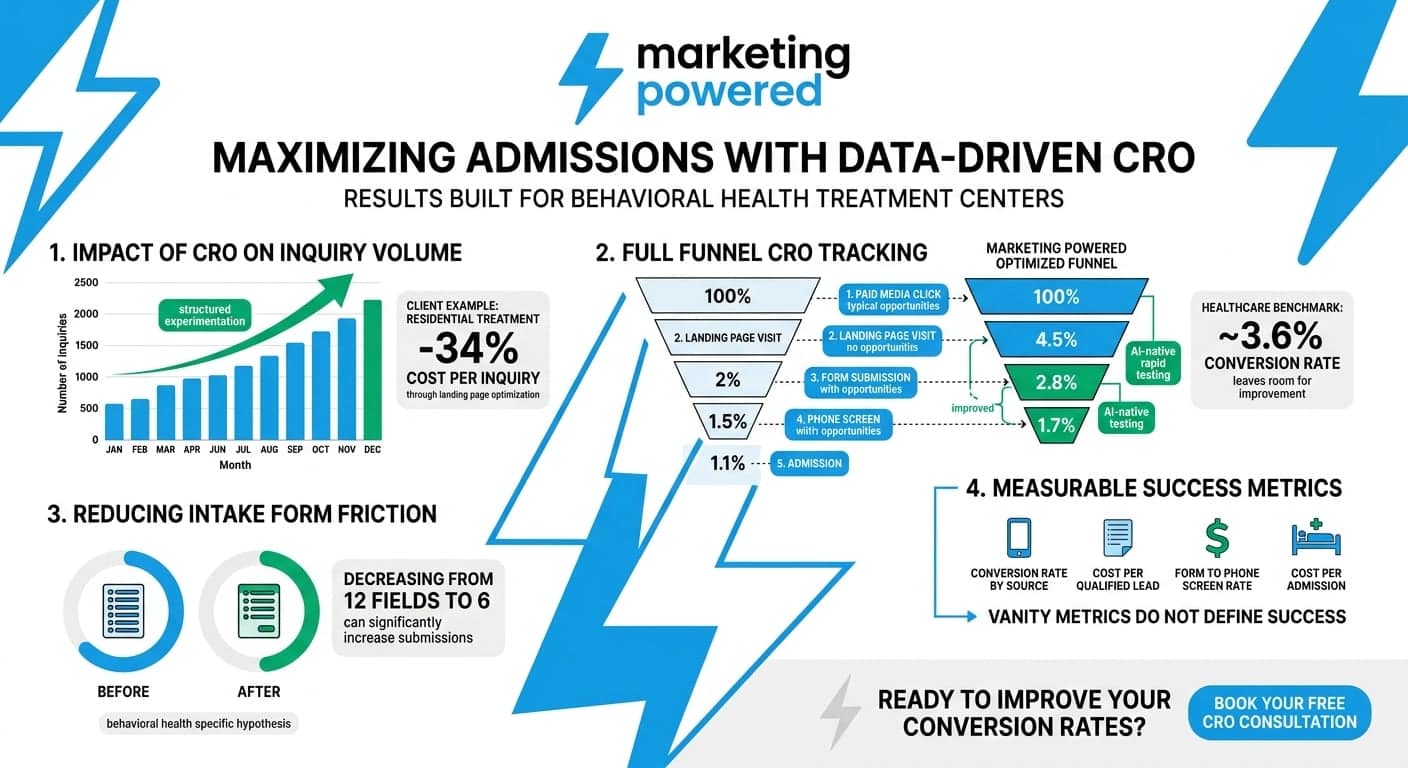
The assumption that CRO belongs only to e-commerce is outdated. Healthcare websites convert at roughly 3.6% on average according to industry benchmarks, leaving substantial room for improvement. For behavioral health centers operating in a sensitive healthcare vertical, every percentage point increase in conversion rate translates directly to more families finding care and more beds filled without increasing media spend.
Marketing Powered has managed over $50M in behavioral health and mental health media. That scale taught us where conversions break down in this vertical: intake forms that ask too much too soon, phone prompts buried below the fold, trust signals missing from mobile layouts, and landing pages that speak to an algorithm instead of the person in crisis searching at 2 a.m.
Conversion rate optimization tailored specifically for behavioral health addresses these friction points with discipline. We test hypotheses, measure outcomes, and iterate. The result is a website that works harder for the budget you already spend.
Core Capabilities of a Specialized CRO Agency
A qualified CRO agency brings structured experimentation to your digital properties. Core capabilities include A/B testing, multivariate testing, user behavior analysis through heatmaps and session recordings, and site performance optimization. Each capability targets a specific conversion barrier.
At Marketing Powered, we layer these standard services with behavioral health expertise. We understand that your visitors are often in emotional distress. They need clear pathways to help, not clever design tricks. Our testing protocols account for the sensitivities of addiction and mental health audiences, ensuring that experiments respect the user's state while still generating statistically valid data.
We also integrate CRO with attribution tracking that follows leads through to admission. Many agencies stop at form submissions. We track the full funnel because a form fill that never converts to an admission call is not a win. This attribution discipline, built from managing $1.5M to $2M monthly in Google Ads across treatment center accounts, separates our CRO services from generalist providers who lack vertical context.
- A/B and multivariate testing designed for healthcare compliance constraints
- Heatmap and session recording analysis to identify friction points
- Landing page optimization aligned with LegitScript and Google Ads sensitive vertical policies
- Funnel analysis connecting website behavior to admission outcomes
- Mobile-first testing, given that crisis searches often happen on phones
Our CRO Services: A Repeatable Four-Phase Framework
Our approach follows a repeatable framework refined across dozens of behavioral health engagements. We do not guess. We measure, hypothesize, test, and validate.
Phase 1: Baseline Audit. We analyze your current site performance using Google Analytics, call tracking data, and CRM admission records. We identify where visitors drop off, which pages generate qualified leads, and which traffic sources deliver patients who actually admit. This baseline gives us the denominator for every improvement we measure.
Phase 2: Hypothesis Development. Based on the audit, we built a prioritized list of testable hypotheses. Examples include moving the phone number above the fold on mobile to increase calls, or shortening the intake form from twelve fields to six to increase submissions without decreasing lead quality. Each hypothesis ties to a measurable outcome.
Phase 3: Experimentation. We deploy tests using tools like Google Optimize, VWO, or Optimizely, depending on your tech stack. Tests run until statistical significance, not until we see a result we prefer. We respect the math.
Phase 4: Implementation and Iteration. Winning variants become the new control. Losing variants teach us what does not work for your audience. We document findings, update the hypothesis backlog, and continue the cycle. CRO is not a project; it is a practice.
Free Audit
Want a straight read on where your budget is leaking?
Proof of Performance: Results Built on Accountability
Marketing Powered's founder helped scale a multi-location behavioral health organization through a multi-location expansion, supporting substantial revenue growth. That growth required relentless attention to conversion at every stage: ad click to landing page, landing page to form, form to phone screen, phone screen to admission. CRO was embedded in every decision.
Across our past client engagements, we have seen consistent patterns. Treatment centers that commit to structured experimentation typically see measurable lifts in qualified lead volume within 90 days. One residential treatment client reduced cost per admission inquiry by 34% through landing page optimization alone, without changing media spend.
Our court-certified expert witness credentials in advertising strategy reflect the depth of accountability we bring. We have testified on marketing practices in legal proceedings, which means our methods withstand scrutiny beyond the boardroom. When we say a test result is valid, we stand behind the data.
CRO Management Services Integrated with Your Full Growth Strategy
Conversion rate optimization delivers the strongest returns when integrated with your broader digital marketing strategy. A high-converting landing page means little if traffic quality is poor. A well-optimized site underperforms if it ranks on page three.
Marketing Powered offers paid media management, SEO, and web development alongside CRO. Our team coordinates these disciplines so that conversion optimization strategies inform keyword targeting, ad creative, and site architecture. When we learn that a specific headline increases form submissions by 22%, we feed that insight back into ad copy and organic content.
For behavioral health centers operating under Google Ads healthcare restrictions and LegitScript certification requirements, this integration matters. We ensure that CRO experiments do not inadvertently violate platform policies or introduce compliance risk. Our AI-native infrastructure, in place since 2022, supports rapid testing cycles while maintaining the data governance standards that healthcare demands.
If you are ready to discuss how CRO fits within a broader growth strategy, book a discovery call, and we will walk through your current funnel together.
Ready to Improve Your Conversion Rates?
Let's examine your current funnel together. We will identify the friction points costing you admissions and outline a testing roadmap built for behavioral health compliance realities. No obligation, just a focused conversation about what is possible.
Questions, Answered.
Conversion rate optimization is a methodical approach to improving website performance by increasing the percentage of visitors who complete a desired action, such as submitting an inquiry form or calling your intake line. It relies on data analysis, hypothesis testing, and iterative experimentation rather than guesswork. For treatment centers, effective CRO means more families find help without increasing your advertising budget.
A CRO agency provides structured experimentation services, including A/B testing, user behavior analysis through heatmaps and session recordings, and landing page optimization. The agency identifies where visitors drop off, develops hypotheses about why, tests changes against a control, and implements winning variants. Marketing Powered applies these practices specifically to behavioral health, ensuring tests respect both compliance requirements and the emotional state of visitors seeking treatment.
Behavioral health centers face unique conversion challenges: visitors often search during crisis moments, intake processes require sensitive information, and compliance restrictions limit certain marketing tactics. CRO addresses these realities by optimizing the path from ad click to admission inquiry. The result is a more efficient use of marketing budget and more qualified leads reaching your intake team.
Results vary based on your starting baseline, traffic volume, and testing velocity. Treatment centers that commit to structured experimentation typically see measurable improvements in conversion rates within 60 to 90 days. The key variable is testing cadence: more tests per month compound into larger gains over time. Our team sets realistic expectations during the initial audit phase based on your specific funnel data.
We measure CRO success through metrics that connect to business outcomes: conversion rate by traffic source, cost per qualified lead, form submission to phone screen rate, and ultimately cost per admission. Vanity metrics like time on page or bounce rate inform our analysis, but do not define success. For behavioral health centers, the goal is more admissions at sustainable acquisition costs, and our measurement framework reflects that priority.
Ready to see what AI-native marketing can do for your treatment center?
Request a free audit of your paid media, landing pages, attribution, and compliance posture. You'll get a straight assessment of where the opportunities are.
or email us at info@marketingpowered.ai