Capabilities
Revolutionize Your Advertising with ChatGPT
AI-native advertising strategies built by operators who understand behavioral health compliance, attribution, and scale.
Understanding ChatGPT as a Marketing Channel
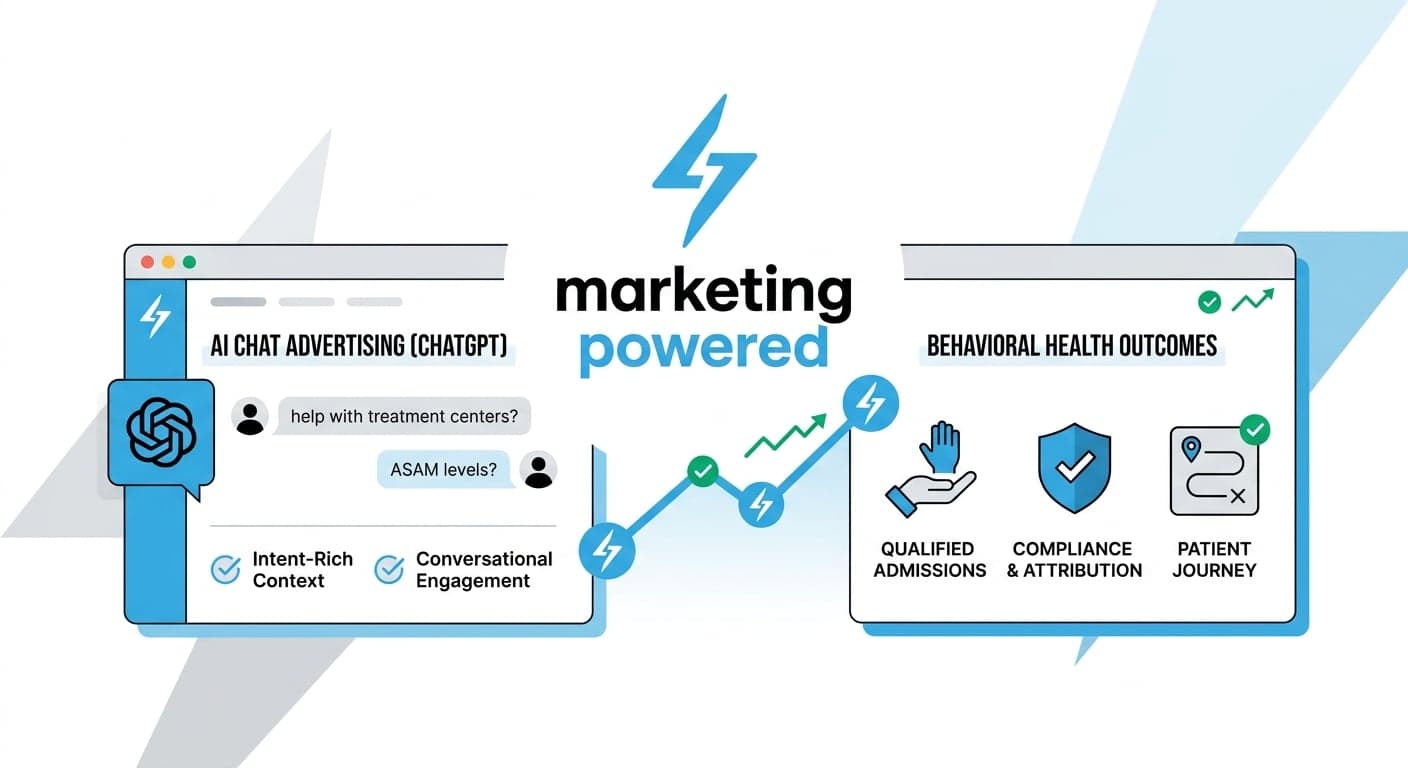
ChatGPT advertising represents a fundamental shift in how brands connect with audiences. Unlike traditional display or search advertising, ChatGPT creates a conversational environment where users actively seek information, recommendations, and solutions. This intent-rich context makes it a compelling channel for behavioral health providers who need to reach people at critical decision points.
The platform's reach continues to expand rapidly. According to OpenAI's usage data, ChatGPT serves hundreds of millions of users monthly, many of whom are researching health topics, treatment options, and provider comparisons. For treatment centers, this presents an opportunity to appear in conversations where prospective patients and their families are already seeking guidance.
What separates ChatGPT from legacy advertising platforms is the depth of engagement. Users are not scrolling past banner ads or skipping pre-roll video. They are actively conversing, asking follow-up questions, and spending meaningful time with responses. This creates a higher-quality touchpoint than impression-based advertising typically delivers.
For behavioral health marketing, this matters because the path to admission is rarely linear. Families research treatment options across multiple sessions, often returning to trusted information sources. ChatGPT advertising positions your brand within that research process, not alongside it.
Strategizing Effective ChatGPT Ads
Effective ChatGPT ads require a different creative approach than traditional paid media. The conversational format rewards clarity, specificity, and genuine helpfulness over promotional language. Messages that feel like sales pitches underperform compared to content that actually answers the user's underlying question.
Start with intent mapping. Identify the questions your ideal patients and their families ask during the research phase. What are they worried about? What do they not understand about treatment levels of care? What objections do they have about cost, insurance, or outcomes? Your ChatGPT advertising content should address these directly.
Structure your messaging around three layers:
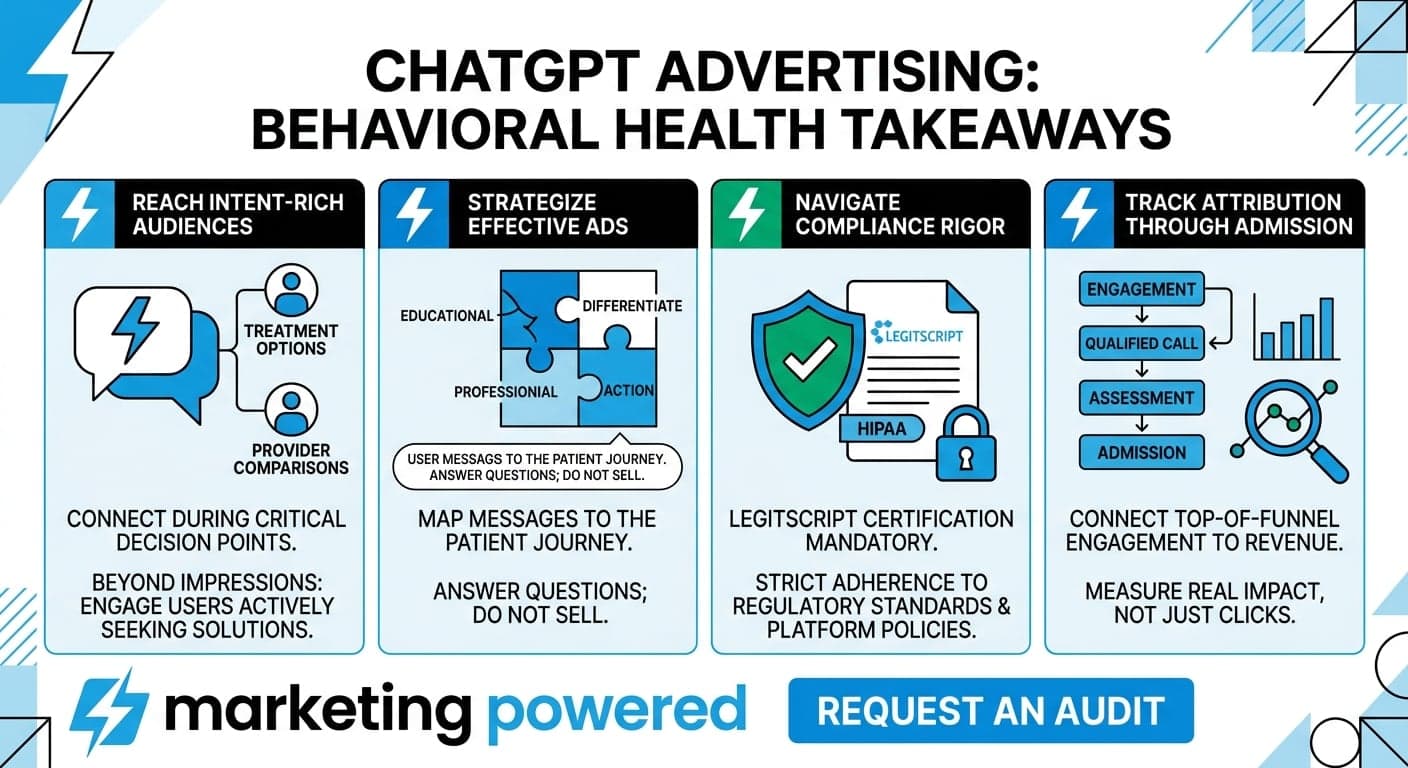
- Educational content that establishes expertise without selling. Explain ASAM levels of care, insurance verification processes, or what to expect during intake.
- Differentiate content that positions your facility's specific approach. Clinical programming, staff credentials, family involvement, and aftercare support.
- Action content that provides a clear next step. Confidential assessments, insurance verification, or direct conversation with your admissions team.
Matching Message to Moment
The most effective campaigns we have built match message specificity to where the user is in their journey. Early-stage researchers need educational content. Users comparing providers need differentiation. Users ready to act need friction-free paths to conversation.
Marketing Powered brings AI advertising expertise developed since 2022, including experience with conversational AI platforms, prompt engineering, and attribution modeling for non-traditional channels. This is not theoretical knowledge. Our team has managed $50M+ in behavioral health and mental health media spend, giving us pattern recognition for what works in sensitive verticals.
Free Audit
Want a straight read on where your budget is leaking?
Compliance and Best Practices
Advertising on ChatGPT for behavioral health requires the same compliance discipline as any other channel, plus additional considerations unique to AI-driven platforms. The conversational format can feel more informal, but the regulatory requirements remain strict.
LegitScript certification remains the gold standard for addiction treatment advertising. Even on emerging platforms like ChatGPT, demonstrating third-party verification of your facility's legitimacy builds trust with both the platform and prospective patients. Marketing Powered maintains deep familiarity with LegitScript certification requirements and builds campaigns that align with their standards.
HIPAA considerations extend to your advertising content and landing page infrastructure. Any information collection, chat functionality, or form submission must occur within a HIPAA-compliant environment. This means encrypted connections, proper business associate agreements, and clear privacy disclosures. Our infrastructure is built with HIPAA-conscious practices throughout the stack.
Google's healthcare and medicines policy prohibits retargeting for addiction treatment advertising. While ChatGPT operates outside Google's ad ecosystem, maintaining a consistent compliance posture across channels protects your brand and simplifies audits. We apply the same no-retargeting discipline to all behavioral health campaigns regardless of platform.
Platform-specific compliance factors
ChatGPT's content policies continue to evolve. Staying current requires active monitoring of OpenAI's usage policies and advertising guidelines. Marketing Powered tracks these changes as part of our digital marketing services and adjusts campaign parameters accordingly.
Transparency matters in AI-assisted advertising. Users should understand when they are interacting with sponsored content. Misleading representations or attempts to disguise advertising as organic responses create compliance risk and erode trust. Our campaigns prioritize clear disclosure and authentic value delivery.
Case Studies: Success with ChatGPT
Our experience with AI-native advertising builds on a foundation of behavioral health marketing performance. While the ChatGPT advertising channel is emerging, our operational patterns translate directly from proven campaigns.
Multi-location growth trajectory: We supported the organization's growth through a multi-location expansion, building the marketing infrastructure that supported geographic expansion. This required attribution discipline that tracked marketing spend through to actual admissions, not just leads. The same attribution methodology applies to ChatGPT advertising: connecting top-of-funnel engagement to bottom-of-funnel outcomes.
Multi-account management at scale: Our team currently manages $1.5M to $2M monthly in Google Ads across 11+ behavioral health accounts. This volume creates pattern recognition for what messaging resonates, what compliance issues emerge, and how to optimize campaigns across different treatment modalities. ChatGPT campaigns benefit from this accumulated knowledge.
Attribution through to admission: The behavioral health buying cycle is complex. Families research, compare, reconsider, and often take weeks to move from initial inquiry to admission. Our attribution models track this full journey, assigning appropriate credit to each touchpoint. For ChatGPT advertising, this means understanding how conversational engagement contributes to eventual conversion, not just measuring clicks or impressions.
Strategy
Ready to map a growth plan built for your vertical?
Early results and learnings
ChatGPT advertising is nascent, which creates both opportunity and uncertainty. Early campaigns show higher engagement rates than traditional display advertising, with users spending more time with sponsored content. Lead quality metrics are encouraging, though sample sizes remain small.
The treatment centers seeing the strongest early results share common characteristics: clear clinical differentiation, strong landing page experiences, and intake teams capable of handling informed, research-stage callers. ChatGPT advertising tends to attract users who have already done significant research, which requires a different intake approach than impulse-driven traffic.
View our broader case studies for detailed performance data from established channels. The operational discipline demonstrated there forms the foundation for our ChatGPT advertising approach.
Getting Started with ChatGPT Advertising
Beginning with ChatGPT, advertising requires foundational readiness before media spend. The channel amplifies whatever strengths or weaknesses exist in your current marketing infrastructure.
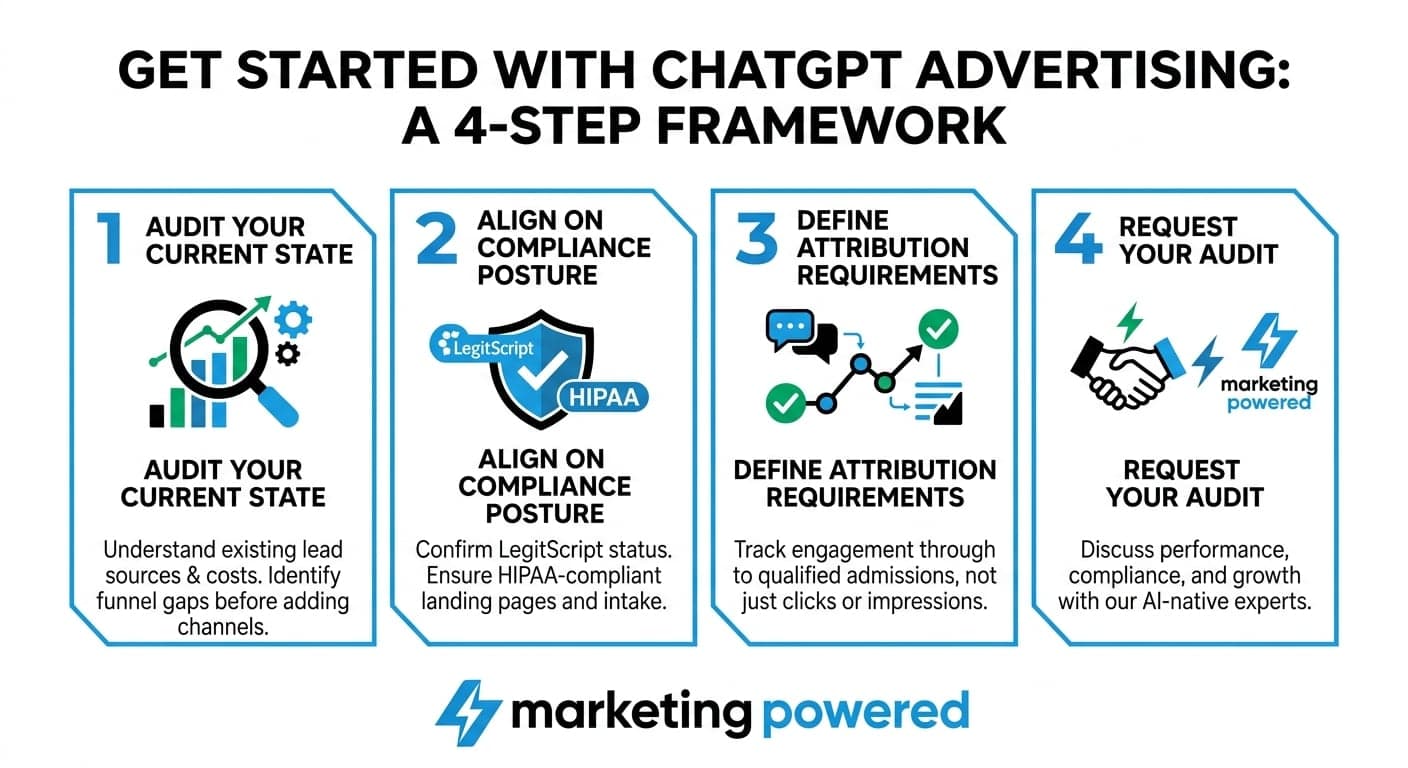
Audit your current state: Before adding a new channel, understand what is working and what is not. Where are your current leads coming from? What is your cost per admission by channel? Where do prospects drop off in the intake process? Marketing Powered's audit process examines your full funnel, not just advertising metrics.
Align on compliance posture: Confirm your LegitScript certification status. Review your landing page infrastructure for HIPAA compliance. Ensure your intake team understands sensitive vertical advertising restrictions. These fundamentals must be solid before expanding into new channels.
Define attribution requirements: How will you measure ChatGPT advertising success? Impressions and clicks are insufficient for behavioral health. You need visibility into which engagements generate qualified calls, which calls convert to assessments, and which assessments result in admissions. Our attribution modeling connects these dots.
Working with Marketing Powered
We are AI-native since 2022, with proprietary infrastructure built for sensitive vertical advertising. Our founder holds court-certified expert witness credentials in advertising strategy, which reflects the depth of operational and regulatory knowledge we bring to client engagements.
ChatGPT advertising fits within a broader marketing strategy for health centers that includes paid media, content development, and conversion optimization. We do not recommend isolated channel experiments. Every campaign should connect to your overall growth objectives and attribution framework.
The next step is a conversation. Request an audit to discuss your current marketing performance, compliance posture, and growth objectives. We will assess whether ChatGPT advertising makes sense for your facility and, if so, how to structure a campaign that delivers qualified admissions, not just impressions.
Email Us
Prefer to talk it through over email?
Start with an Audit
ChatGPT advertising offers a new path to qualified admissions, but success requires compliance discipline, attribution infrastructure, and vertical expertise. Request an audit to assess your readiness and explore whether this channel fits your growth objectives. We will review your current performance, compliance posture, and marketing infrastructure to determine the right next step.
Questions, answered.
Behavioral health marketing requires vertical-specific strategies that account for compliance restrictions, longer decision cycles, and sensitive audience targeting. ChatGPT advertising offers a unique opportunity to engage families during the research phase with educational content that builds trust. Combined with traditional paid search and content marketing, conversational AI platforms can extend your reach to audiences actively seeking treatment information. The most effective strategies integrate multiple channels with unified attribution modeling to track performance through to admission.
ChatGPT advertising operates in a conversational context rather than a display or search environment. Users are actively engaged in dialogue, asking questions and seeking detailed responses. This creates deeper engagement than impression-based advertising but requires different creative approaches. Messages must provide genuine value and answer user questions rather than simply promoting your facility. The interactive nature allows for more nuanced messaging that can address specific concerns about treatment, insurance, or outcomes.
Behavioral health advertising on ChatGPT requires the same compliance rigor as any other platform. LegitScript certification remains essential for addiction treatment advertising credibility. HIPAA compliance must extend to all landing pages and data collection mechanisms. Consistent with Google's healthcare policies, we apply no-retargeting discipline to all behavioral health campaigns. Additionally, OpenAI's content and usage policies govern what can appear on the platform, requiring ongoing monitoring as guidelines evolve.
ChatGPT advertising works best as part of a multi-channel strategy rather than a standalone effort. The conversational engagement complements search advertising by reaching users during research phases when they may not be ready to click on an ad. Unified attribution modeling tracks how ChatGPT touchpoints contribute to eventual conversions across channels. Landing page infrastructure, intake team training, and compliance protocols should be consistent regardless of traffic source, making integration straightforward for facilities with mature marketing operations.
Ready to see what AI-native marketing can do for your treatment center?
Request a free audit of your paid media, landing pages, attribution, and compliance posture. You'll get a straight assessment of where the opportunities are.
or email us at info@marketingpowered.ai