Capabilities
AI Discovery Optimization Services for Enhanced Visibility
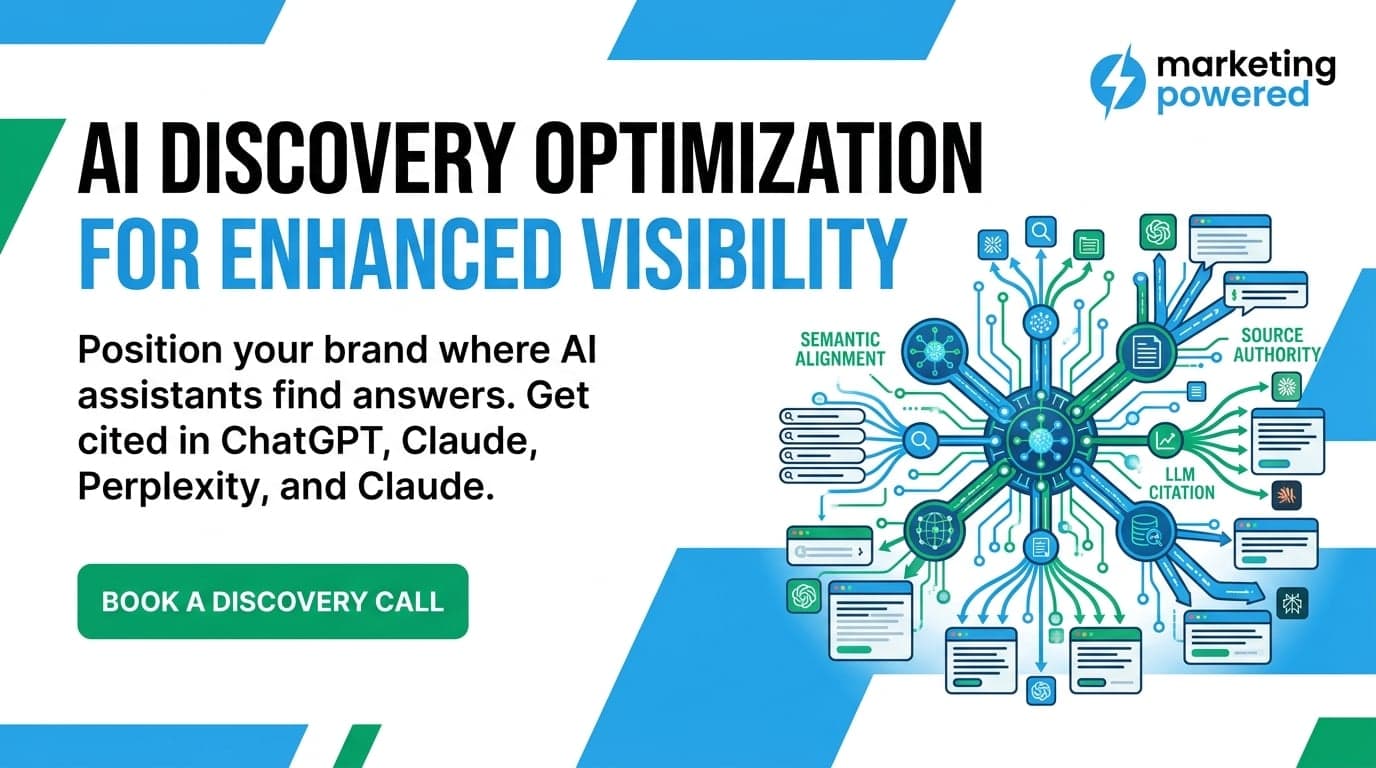
Position your brand where AI assistants find answers. Get cited in ChatGPT, Perplexity, and Claude responses before your competitors figure out the game.
Understanding AI Discovery Optimization
The shift from ranking to citation changes everything about visibility
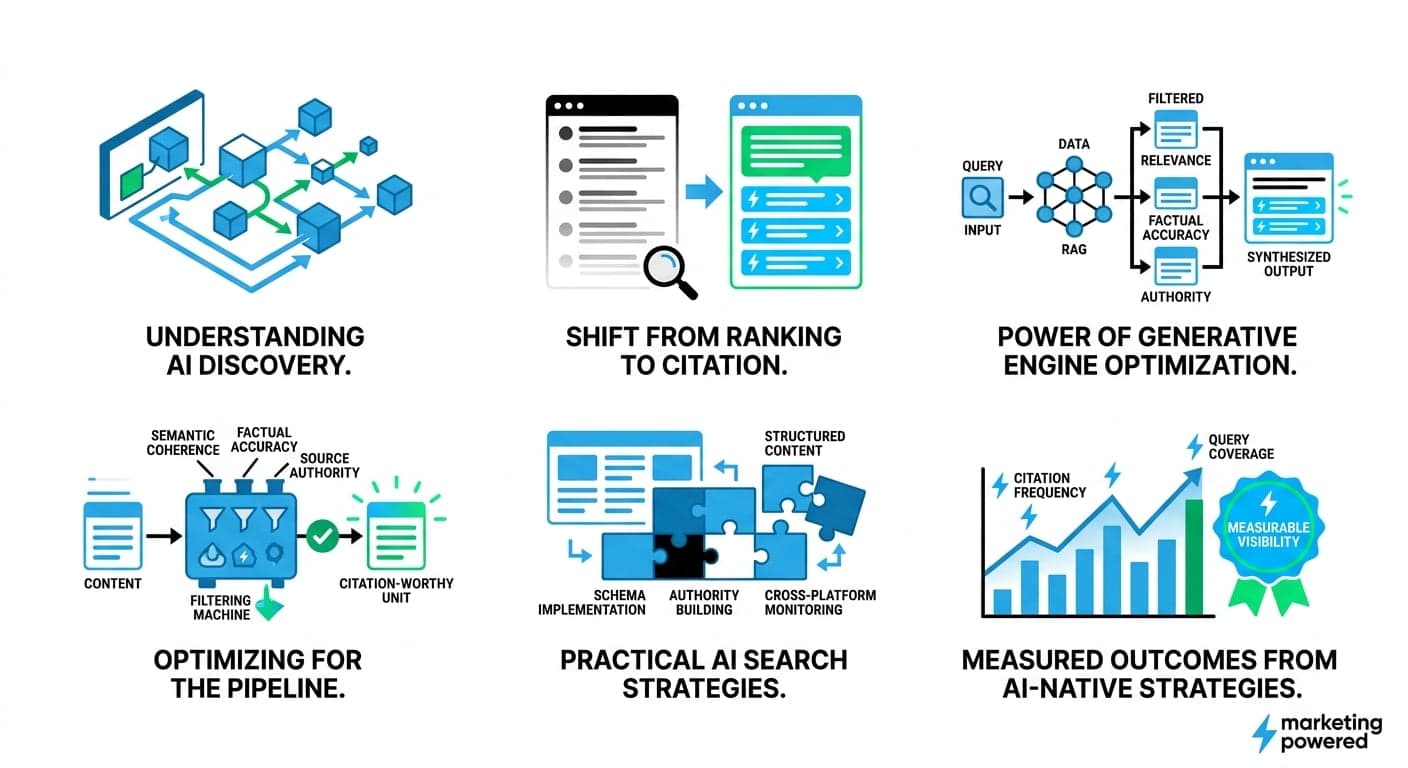
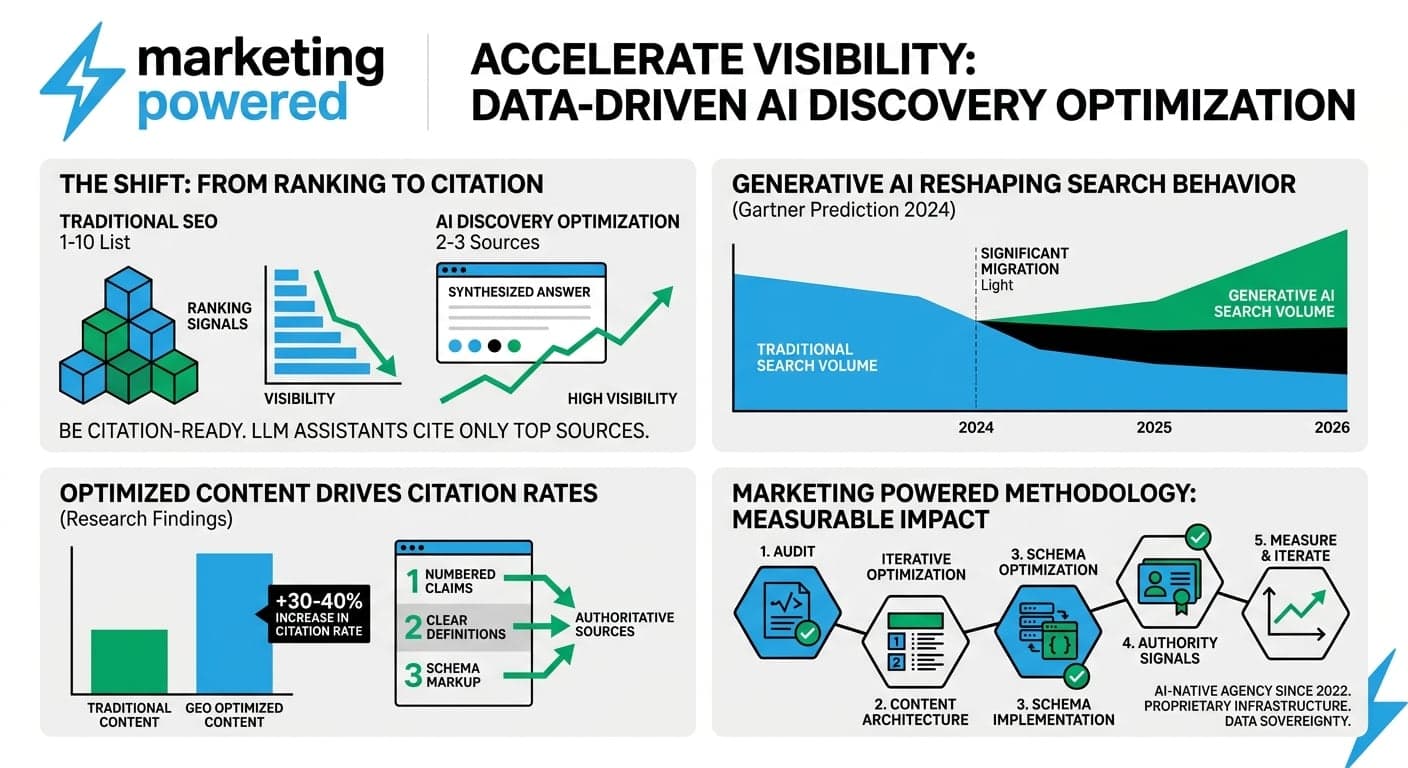
Traditional SEO optimizes for a ranked list of blue links. AI discovery optimization operates on a different premise: when someone asks ChatGPT, Perplexity, or Claude a question, will your brand appear in the synthesized answer? The distinction matters because AI assistants do not serve ten results and let the user choose. They construct a single response, often citing only two or three sources. If your content is not structured, authoritative, and semantically aligned with the query, you are invisible.
This shift represents a fundamental change in how information surfaces online. According to Gartner's 2024 predictions, generative AI will reshape search behavior significantly by 2026, with traditional search volume declining as users migrate to conversational interfaces. The company's positioning now will own the citation layer when that migration accelerates.
AI discovery optimization is the discipline of structuring content, building authority signals, and aligning semantic context so that large language models cite your brand when answering relevant queries. It combines elements of traditional SEO, structured data implementation, and content architecture designed specifically for LLM comprehension. At Marketing Powered, we have operated as an AI-native agency since 2022, building the infrastructure and methodology to address this emerging channel before most agencies acknowledged it existed.
The Power of Generative Engine Optimization
Free Audit
Want a straight read on where your budget is leaking?
How LLMs decide what to cite and how to position for inclusion
Generative engine optimization (GEO) focuses on the mechanics of how AI models retrieve, evaluate, and synthesize information. Unlike traditional search algorithms that rely heavily on backlink profiles and keyword density, LLMs prioritize semantic coherence, factual accuracy, and source authority within their training data and retrieval systems.
The retrieval-augmented generation (RAG) architecture that powers most commercial AI assistants works in stages. First, the system identifies potentially relevant content from its index or live web access. Then it evaluates that content for relevance, authority, and alignment with the user's query. Finally, it synthesizes an answer and decides which sources to cite. Your content must pass each filter.
Optimizing for this pipeline requires a different approach than traditional SEO. Content needs clear, citation-worthy statements positioned early in the document. Structured data must be comprehensive and accurate. The semantic relationship between your content and your claimed expertise must be explicit and consistent across your digital presence. According to research from Princeton and Georgia Tech, content optimized for generative engines can see citation rates increase by 30 to 40 percent compared to content optimized only for traditional search.
Marketing Powered builds GEO strategies on proprietary AI infrastructure that allows us to test how different content structures perform across multiple LLM platforms. We do not guess at what works. We run controlled experiments and measure citation frequency directly.
Implementing AI Search Optimization Strategies
Practical approaches that translate to measurable visibility
AI search optimization requires coordinated execution across content, technical infrastructure, and authority building. Each component reinforces the others.
Content architecture for LLM visibility starts with how information is structured on the page. Numbered claims with inline citations perform better than narrative prose for factual queries. Clear definitions early in the content increase the likelihood of citation for definitional queries. FAQ sections with schema markup provide discrete, citable answer units that LLMs can extract cleanly.
Technical implementation includes comprehensive structured data (Article, FAQPage, Organization, and service-specific schema types), clean semantic HTML, and explicit authorship signals that connect content to identifiable experts. According to Schema.org guidelines, well-implemented structured data helps machines understand content context, which extends directly to LLM comprehension.
Authority building for AI discovery differs from traditional link building. LLMs evaluate expertise signals, including author credentials, publication history, and cross-referencing from other authoritative sources. Our approach includes:
The integration of these components creates a compounding effect. Each improvement in one area strengthens performance in the others, building a defensible position in AI-assisted search results.
- Structured content audits identifying citation optimization opportunities
- Schema implementation covering all relevant entity types
- Authority signal development through strategic content placement
- Cross-platform monitoring of citation frequency and context
- Iterative optimization based on measured performance data
Strategy
Ready to map a growth plan built for your vertical?
Case Studies: Success with AI Discovery Optimization
Measured outcomes from AI-native strategies
The principles behind AI discovery optimization emerge from the same strategic foundation that has driven results across our core verticals. While our deepest expertise lies in behavioral health marketing and mental health marketing, the technical methodology translates directly to AI visibility challenges.
In behavioral health, we have managed over $50M in media spend while scaling operations through multi-market growth for clients for multi-location behavioral health organizations. That growth required sophisticated attribution tracking through to admission, not vanity metrics. The same attribution discipline applies to AI discovery: we measure actual citation frequency, not proxy metrics.
Our team manages $1.5M to $2M monthly in paid media across 11+ accounts, giving us direct visibility into how AI-assisted search is shifting user behavior in real time. We see the query patterns changing. We watch click-through rates on traditional results decline for certain query types. This operational data informs our AI discovery optimization methodology.
The founder credential matters here: court-certified expert witness status in advertising strategy reflects the depth of technical and strategic expertise we bring to emerging channels. We approached AI discovery optimization with the same rigor we apply to any marketing investment, building measurement frameworks before scaling execution.
For brands entering the AI discovery space, the case studies in our results section demonstrate the outcome-focused approach we bring to every engagement. The channel is new. The discipline is the same.
Getting Started with AI Discovery Optimization
Email Us
Prefer to talk it through over email?
A structured path from assessment to measurable visibility
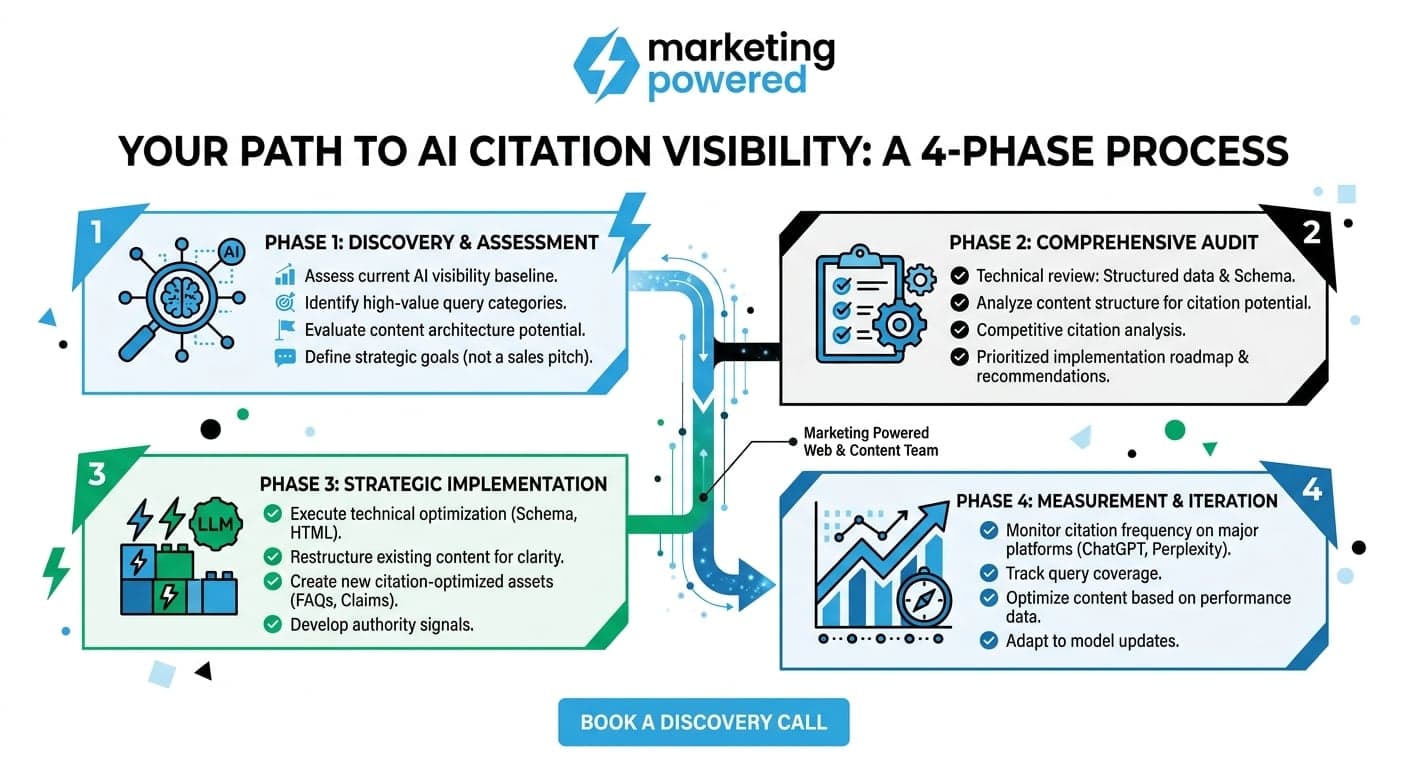
Beginning AI discovery optimization requires an honest assessment of your current position. Most brands have no visibility into how often (or whether) AI assistants cite them. We start there.
The engagement process follows a defined sequence:
Phase one is the discovery call. We assess your current AI visibility baseline, identify high-value query categories where citation would drive business outcomes, and evaluate your content architecture for LLM optimization potential. This call is strategic, not a sales pitch. If AI discovery optimization is not the right priority for your situation, we will tell you.
Phase two is the audit. We conduct a comprehensive technical review covering structured data implementation, content structure, authority signals, and competitive citation analysis. You receive a prioritized roadmap with specific recommendations and projected impact.
Phase three is implementation. Depending on your internal resources, we either execute directly or guide your team through the optimization process. Our web development team handles technical implementation. Our content strategists restructure existing assets and create new citation-optimized content.
Phase four is measurement and iteration. We monitor citation frequency across major AI platforms, track query coverage, and continuously optimize based on performance data. AI discovery is not a one-time project. It requires ongoing attention as models update and competitive dynamics shift.
Marketing Powered has operated as an AI-native agency since 2022, building proprietary infrastructure for exactly this type of emerging channel. We run local AI systems on owned hardware, maintaining data sovereignty and the technical depth to understand how these models actually work, not just what the marketing materials claim.
Start with a Discovery Call
AI discovery optimization is moving from an emerging opportunity to a competitive necessity. The brand's positioning will now own the citation layer when the migration to AI-assisted search accelerates. We will assess your current visibility baseline, identify high-value query categories, and determine whether AI discovery optimization is the right priority for your situation. The call is strategic, not a pitch.
Questions, answered.
AI discovery optimization is the practice of structuring content and building authority signals so that AI assistants (ChatGPT, Perplexity, Claude, and similar platforms) cite your brand when answering relevant queries. Unlike traditional SEO, which focuses on ranking in a list of links, AI discovery optimization focuses on being included in synthesized answers. The discipline combines content architecture, structured data implementation, and authority building, designed specifically for LLM comprehension.
Generative AI changes the optimization target from ranking algorithms to retrieval and synthesis systems. LLMs evaluate content for semantic coherence, factual accuracy, and source authority before deciding what to cite. Optimizing for generative AI requires clear, citation-worthy statements, comprehensive structured data, and explicit expertise signals. Research indicates content optimized for generative engines can achieve 30 to 40 percent higher citation rates than content optimized only for traditional search.
AI search optimization strategies include content architecture redesign (numbered claims, early definitions, FAQ sections with schema), technical implementation (comprehensive structured data, semantic HTML, authorship signals), and authority building (expert credentials, strategic content placement, cross-platform consistency). Effective implementation requires coordination across all three areas, with ongoing measurement of citation frequency to guide iteration.
Marketing Powered has operated as an AI-native agency since 2022, building proprietary AI infrastructure before most agencies acknowledged the category existed. We run local AI systems on owned hardware, providing the technical depth to understand how LLMs actually work. Our team has managed over $50M in media spend with sophisticated attribution tracking, bringing the same measurement discipline to AI discovery optimization. The founder holds court-certified expert witness status in advertising strategy.
AI discovery optimization is an emerging discipline, but the underlying methodology produces measurable outcomes. Academic research demonstrates that GEO-optimized content achieves significantly higher citation rates in AI responses. Our approach applies the same attribution discipline we use in paid media management, where we track $1.5M to $2M monthly across 11+ accounts, to measure AI citation frequency and coverage directly rather than relying on proxy metrics.
Ready to see what AI-native marketing can do for your treatment center?
Request a free audit of your paid media, landing pages, attribution, and compliance posture. You'll get a straight assessment of where the opportunities are.
or email us at info@marketingpowered.ai