Capabilities
Healthcare Digital Marketing Services for Provider Growth
A provider can have a tidy report of clicks, form fills, and calls while remaining unable to identify which campaigns produced scheduled appointments or admissions. This gap is where most healthcare marketing budgets lose their accountability because the reporting stops at activity rather than outcome.

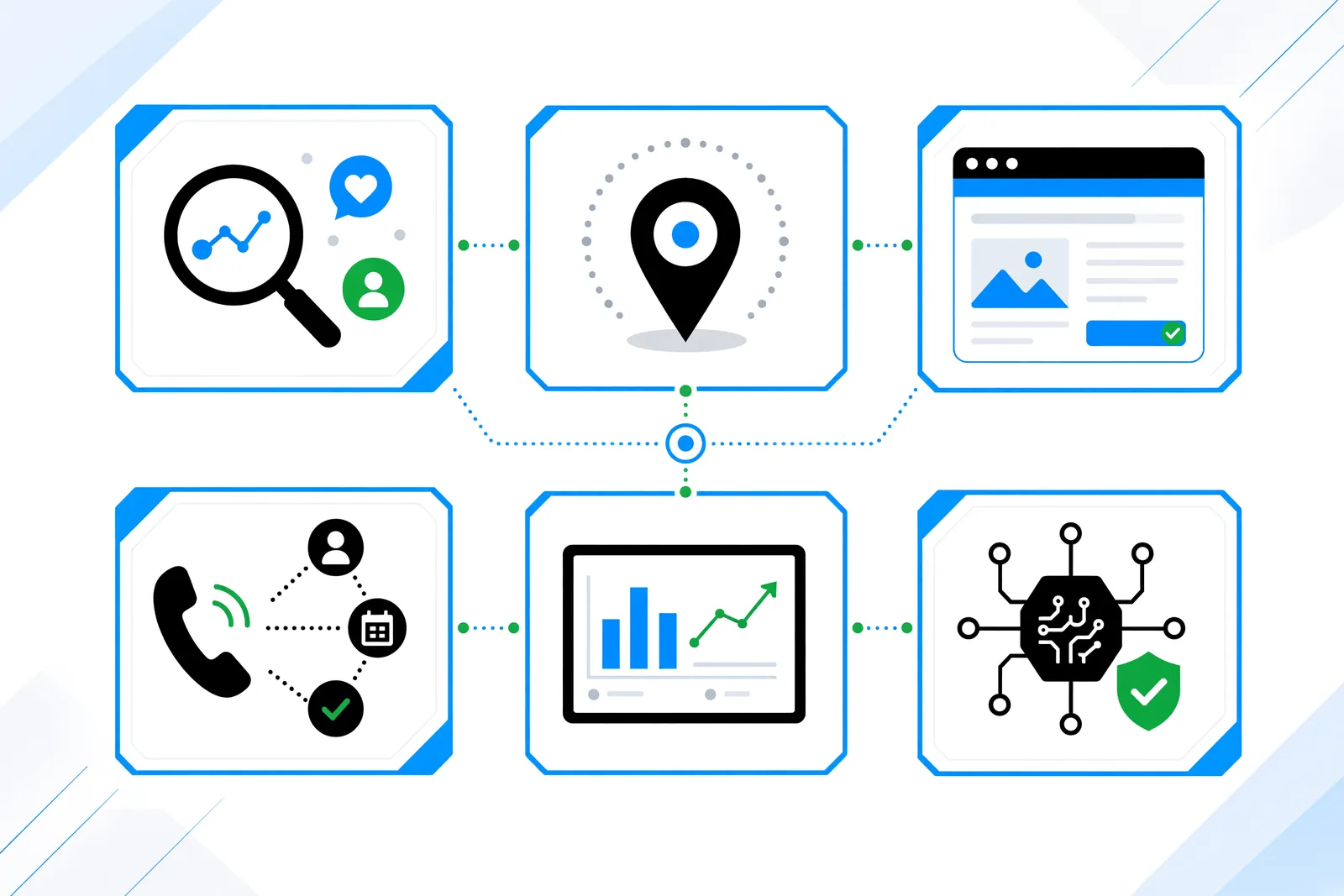
What healthcare digital marketing services include
Healthcare digital marketing services should connect search demand to qualified inquiries, verified intakes, and scheduled care wherever your authorized data allows that view. This page outlines what those services include, how to judge them, and where measurement depends on your internal systems and policies.
A provider should expect a connected set of services organized by the question each one answers, rather than a simple menu of channels. This structure ensures every element supports the commercial objective of generating verified patient demand.
- Paid search and paid social: Identifies who is searching with intent and determines how to reach them within platform rules for sensitive health categories.
- Technical and local SEO: Ensures the right facility and service-line pages are found in each market you serve, supporting organic discovery over time.
- Web and landing page conversion: Reviews what happens when a prospective patient or family member arrives, ensuring the page provides enough information to act without collecting unnecessary data upfront.
- Call tracking and CRM integration: Records what happens to an inquiry in the minutes and days after it arrives, linking source data to disposition status.
- Analytics and attribution: Determines which inquiries became care by connecting marketing data to outcome stages. Detailed methods are available on our analytics and attribution page.
- AI operations: Provides governed workflow support with human review, scoped per engagement to improve efficiency without compromising control or compliance.
When a provider needs a healthcare marketing firm
Most buyers reach this decision when their current setup fails to connect spend to patient volume. The following situations indicate that a specialized approach is required.
Reporting activity but not outcomes
Calls and leads rise in the report, yet admissions or scheduling staff cannot confirm which sources produce patients. This disconnect prevents accurate budget allocation.
Rising spend with unclear quality
Paid search costs increase while no one can reliably separate qualified inquiries from wrong-fit calls, job seekers, insurance mismatches, or out-of-area searches.
Multi-location complexity
Hospital and health-system teams need comparable reporting by facility and service line, not a single blended total that masks underperforming locations.
Siloed operations
Marketing, intake, and compliance work in separate lanes. Fixes stall because the people who can change the landing page, phone script, and tracking setup do not share a unified plan.
Agency evaluation without criteria
Leadership has opinions about the current agency but lacks written selection criteria to compare vendors objectively.
Behavioral health and addiction treatment are areas where our founder-led operating experience is deepest. The intake dynamics in these sectors are detailed on our behavioral health page. The same discipline applies to mental health providers, hospitals, and other healthcare organizations seeking accountable growth systems.
How the system works from first search to scheduled care
The work runs in one chain where each link needs a clear owner. This linear progression ensures that data flows from initial interest to final commercial outcome without loss or ambiguity.
- Demand capture: Paid and organic search, plus paid social where appropriate, reach people with a defined need in a defined geography.
- Conversion path: Landing pages and forms are written for sensitive decisions. They set expectations, offer multiple contact methods, and avoid collecting more information than the first step requires.
- Inquiry handling: Call tracking and CRM or intake automation record the source, route the inquiry, and capture its disposition in a standardized format.
- Outcome stage: Where authorized data supports it, qualified inquiries are matched to verified intakes, scheduled appointments, or admissions.
- Decision: Budget moves based on what happened at the outcome stage, not on the last click before conversion.
Steps one and two are fully visible to marketing teams. Steps three to five depend on how your intake team records information, what your systems export, and what your policies permit regarding data sharing between departments.
Free Audit
Want a straight read on where your budget is leaking?
Measuring against qualified calls or admissions
Measure healthcare digital marketing as a funnel with agreed definitions at each stage, not as a single cost figure. This method allows teams to identify exactly where the process breaks down.
- Inquiry. Definition: Any call, form, or chat initiated by a prospective patient. Primary Owner: Marketing.
- Qualified inquiry. Definition: Fits service, geography, and payer criteria. Primary Owner: Marketing and Intake.
- Verified intake. Definition: Intake confirms a real, reachable prospect. Primary Owner: Intake or Admissions.
- Scheduled or admitted. Definition: The commercial outcome that matters for revenue. Primary Owner: Operations, within data-access limits.
Three rules keep this measurement honest. First, write the "qualified" definition with the intake team before reporting begins and keep it stable throughout the campaign period. Second, report each stage by source, campaign, and facility so weak stages remain visible in monthly reviews. Third, label every number as measured or estimated. Where outcome data is unavailable, state that clearly and report the last verifiable stage rather than inferring results.
Sensitive information should not flow into ad platforms or analytics tools unless your privacy and legal teams have approved the specific setup. Outcome matching often happens inside your CRM or reporting environment rather than in an ad platform, preserving data integrity while maintaining regulatory alignment.

Governance and policy dependencies
Healthcare marketing runs on rules that change frequently. We treat these as inputs to the plan rather than obstacles.
- Platform policies: Rules for sensitive health categories vary by platform and are updated regularly. The current policy is checked before building any campaign structure.
- Certification requirements: Certain treatment advertisers may require specific certifications, such as LegitScript, depending on the service offered and geographic location.
- Consent and tracking: Setups are scoped with your privacy and legal reviewers to ensure all data collection meets applicable standards.
- Data handling: Defined in writing under your policies and applicable law. We do not describe any workflow or tool as guaranteeing regulatory compliance, and your data remains yours at all times.
- Content review: Follows your clinical and compliance process. Copy avoids diagnostic or treatment-efficacy claims and uses non-stigmatizing language consistently across all channels.
What the acquisition audit includes
The audit is where fit is assessed before any engagement is defined. It covers:
- Current account structure, spend allocation, and search term quality in paid media
- Landing page and form review for conversion path and sensitivity of the ask
- Call tracking and source capture setup verification
- Intake handoff processes, including how inquiries are recorded, dispositioned, and followed up
- Reporting gaps between marketing data and outcome data, and what access is needed to close them
- Location and service-line comparability for multi-site organizations
- A prioritized list of fixes with owners assigned on both your side and ours
Selection checklist
When comparing any healthcare marketing firm, including us, ask for written answers to these questions:
- Which outcome stage will you report, and what data access do you need to reach it?
- How do you define and report a qualified inquiry?
- How do you handle platform restrictions on sensitive health categories?
- Who owns the accounts, tracking setup, and data?
- What does reporting look like by facility or service line?

Email Us
Prefer to send the context directly?
Request an acquisition audit
If you cannot say which sources produce scheduled appointments or admissions, the audit is the first step toward clarity. We review your campaigns, conversion path, and intake handoff, then tell you what is measurable now and what it would take to measure the rest. This process requires no long-term commitment and provides a clear map of opportunities for improvement across your entire digital footprint.
Questions, Answered.
A defined service scope, a conversion path built for the sensitivity of the service, intake-aware tracking, and reporting that reaches the furthest outcome stage your data allows. Expect clear labels distinguishing what is measured from what is estimated in every report provided.
By stage: inquiry, qualified inquiry, verified intake, then scheduled appointment or admission. Definitions must be agreed upon with the intake team before reporting starts to ensure consistency across all campaigns and locations.
No. Behavioral health is a core specialization based on founder experience in growing treatment networks. We also work with mental health providers, hospitals, and other healthcare organizations seeking accountable growth systems. See our resources for related guidance on multi-location strategy.
No. Outcomes depend on market conditions, offer strength, intake performance, and policy constraints. We do not promise specific results or regulatory outcomes because those factors are outside the control of any marketing partner.
Ready to see where your marketing can improve?
Request a free audit of your paid media, landing pages, attribution, and measurement setup. You'll get a straight assessment of where the opportunities are.
or email us at info@marketingpowered.ai