Capabilities
Enhance Your Ad Strategy with Creative Testing
Data-driven creative experimentation that identifies your highest-performing ad variants while respecting healthcare compliance requirements.
What Is Creative Testing?
Most behavioral health advertisers launch campaigns with a handful of ad creatives and hope for the best. When performance plateaus, they guess at what to change. Creative testing replaces guesswork with structured experimentation, systematically evaluating different ad elements to identify which combinations drive the strongest response from your target audience.
At its core, creative testing is the practice of running controlled experiments across ad visuals, headlines, body copy, calls to action, and video hooks. Rather than relying on intuition about what will resonate with families searching for treatment options, you let actual performance data guide your decisions. This is especially valuable in ad creative testing for healthcare verticals, where messaging must balance emotional resonance with strict compliance requirements.
For treatment centers, creative testing serves a dual purpose. First, it optimizes your ad spend by concentrating budget on proven performers rather than distributing it across untested variants. Second, it builds an institutional knowledge base about what messaging approaches work for your specific programs, locations, and patient populations.
The compliance dimension makes creative testing even more valuable in behavioral health. Google Ads restricts healthcare advertising under its sensitive vertical policies, and Meta places addiction treatment ads in Special Ad Categories with limited targeting options. When you cannot rely on sophisticated audience targeting, the creative itself carries more weight. Testing becomes your primary optimization lever.
Benefits of Creative Testing for Treatment Centers
Treatment centers that implement structured creative experimentation see measurable improvements across their advertising programs. The benefits compound over time as you accumulate data about what works for your specific market.
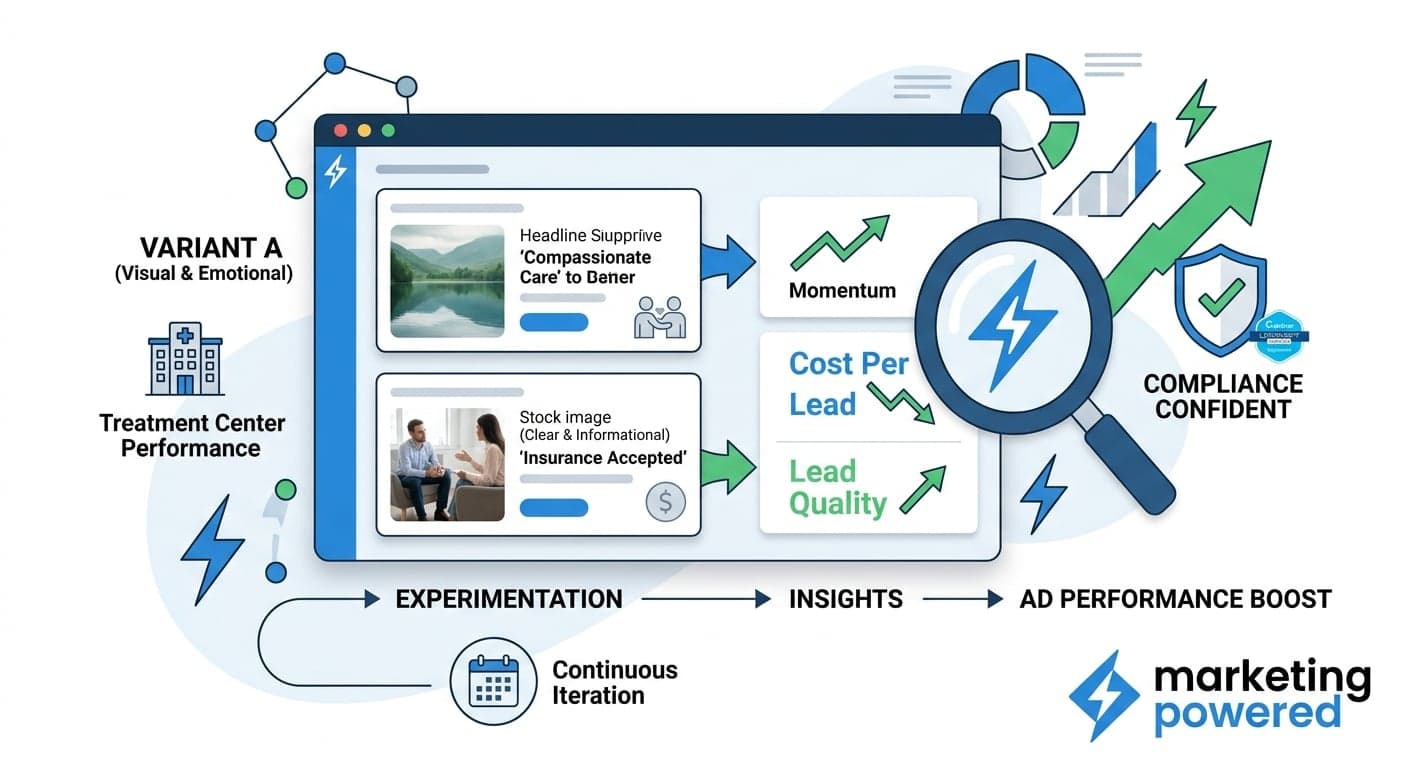
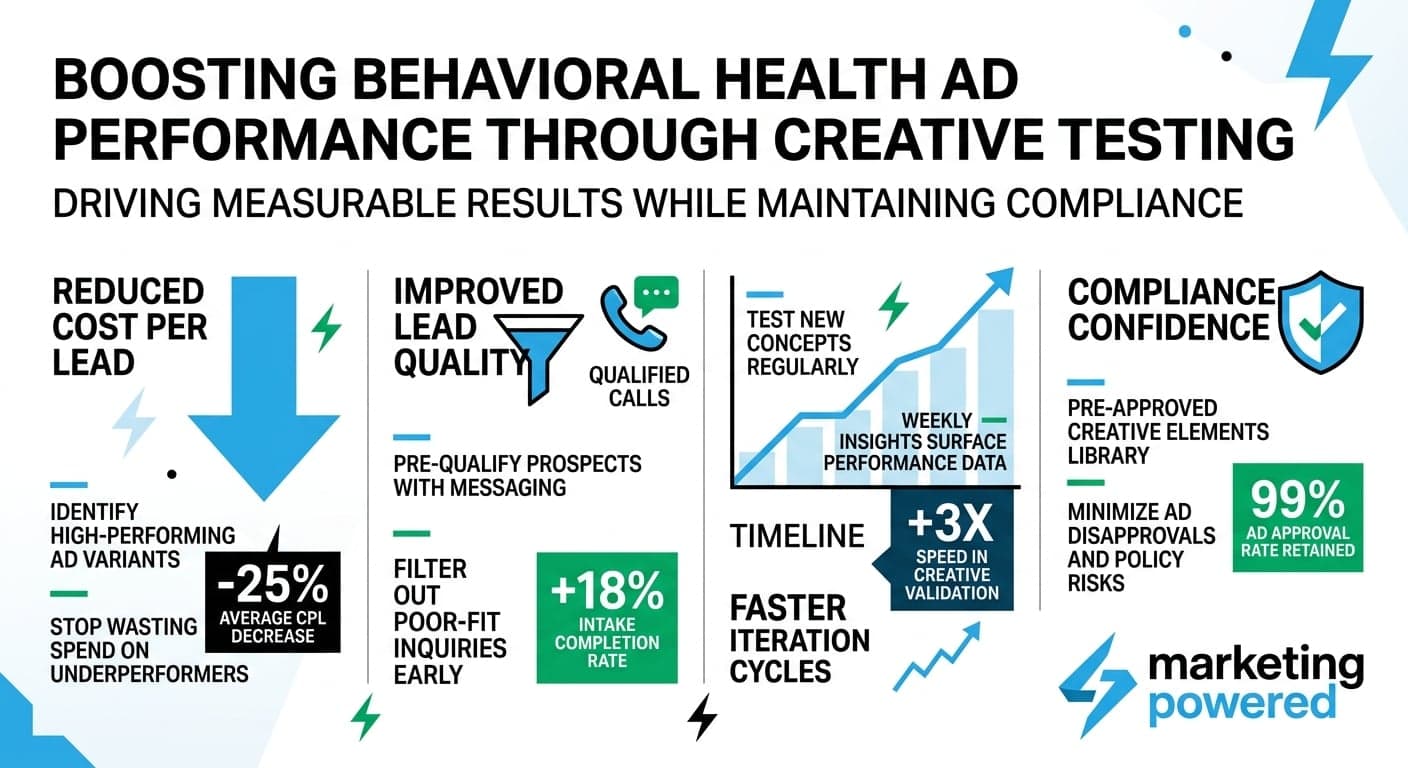
- Reduced cost per lead. When you identify high-performing creatives and allocate budget accordingly, you stop wasting spend on underperforming variants. Centers running systematic ad variant testing typically see cost per qualified call decrease as the testing program matures.
- Improved lead quality. Creative testing is not just about click volume. By testing messaging that pre-qualifies prospects through specific program mentions, insurance callouts, and geographic references, you filter out poor-fit inquiries before they reach your intake team.
- Faster iteration cycles. A structured creative experimentation framework gives your team a repeatable process for generating and validating new ad concepts. Instead of quarterly creative refreshes based on gut feeling, you run continuous experiments that surface insights weekly.
- Compliance confidence. Testing builds a library of pre-approved creative elements vetted against platform policies. When you know which approaches pass review consistently, you spend less time in ad disapproval cycles and more time driving admissions.
Creative Testing Strategies for Behavioral Health
Behavioral health advertising operates under constraints that general advertisers do not face. Your creative testing strategy must account for privacy and compliance requirements while still generating actionable insights.
A/B testing with compliance-safe variables. Start with elements that carry no compliance risk: background colors, font treatments, stock image selection, and headline structure. These tests establish baseline performance without triggering policy reviews. Once you understand which foundational elements perform best, layer in messaging tests with pre-approved copy variations.
Multivariate testing for landing page alignment. Your ad creative does not exist in isolation. Test creative variants against corresponding landing page variants to understand the full conversion path. A headline that wins on click-through rate may underperform on admission calls if the landing page does not continue the same message.
Platform-specific meta creative testing. Meta's Special Ad Categories remove most demographic and interest-based targeting for addiction treatment advertising. This makes creative testing your primary differentiation mechanism on Facebook and Instagram. Test video hooks, static versus carousel formats, and emotional versus informational framing to find what resonates without relying on prohibited targeting.
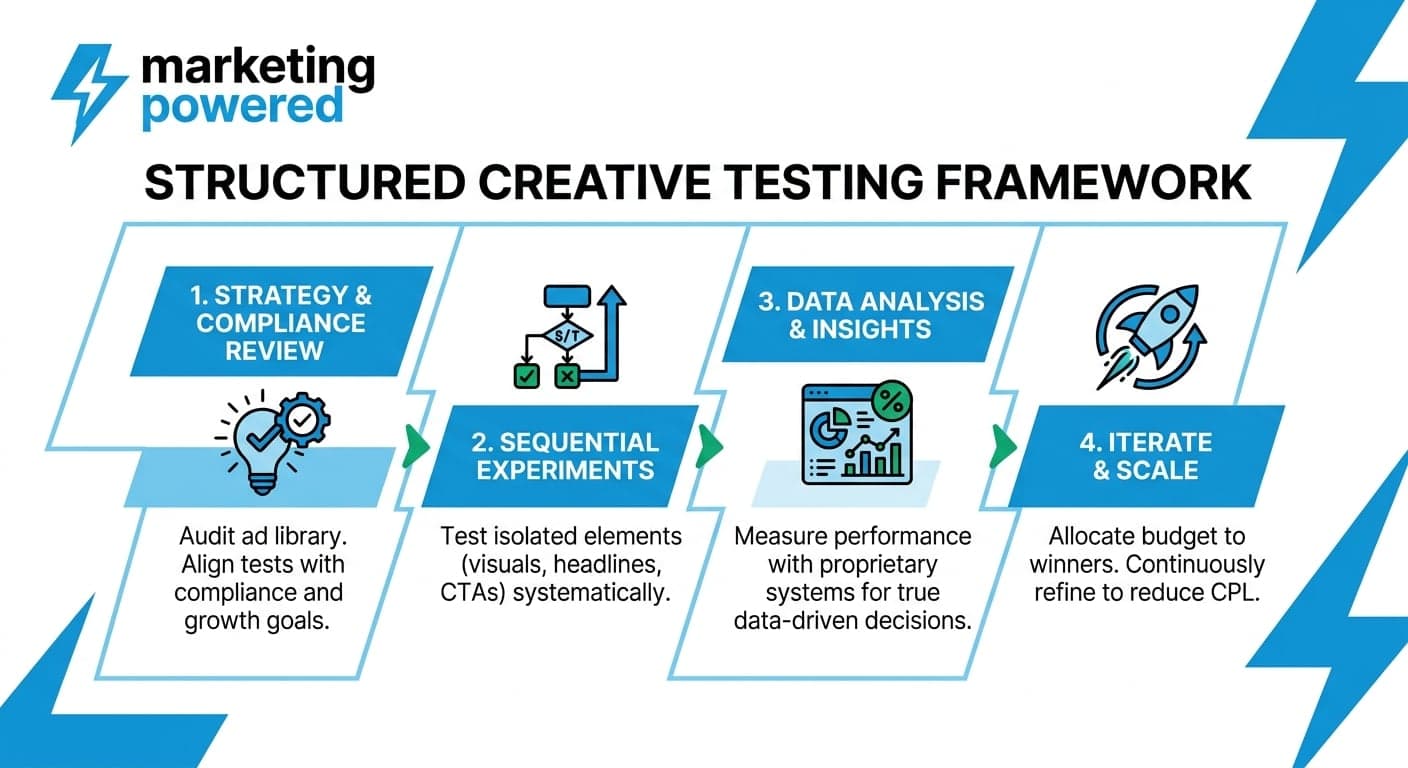
Sequential creative testing. Rather than testing everything at once, structure your experiments in phases. Phase one: visual direction. Phase two: headline approach. Phase three: call to action language. Phase four: offer framing. This sequential approach isolates variables and produces cleaner data than running dozens of variants simultaneously.
All testing must respect the no-retargeting restriction that applies to healthcare advertisers on Google. You cannot pixel visitors and serve them follow-up ads based on their site behavior. This constraint actually simplifies your testing framework by removing retargeting creative from scope entirely.
Free Audit
Want a straight read on where your budget is leaking?
How Marketing Powered Runs Creative Testing
Marketing Powered brings more than $50M in managed behavioral health and mental health ad spend to every creative testing engagement. We have seen what works across dozens of treatment centers, from single-location outpatient practices to multi-state residential networks.
Our AI-native infrastructure, built since 2022, accelerates the testing cycle. Proprietary systems analyze creative performance patterns across your campaigns and surface insights that would take a human analyst days to identify. This technology layer sits on top of deep behavioral health expertise, ensuring that AI-generated recommendations align with vertical-specific compliance requirements.
We operate with HIPAA-conscious practices throughout our stack and maintain awareness of LegitScript certification requirements for addiction treatment advertising. Your creative testing program will not generate policy violations or put your facility's advertising accounts at risk.
The engagement starts with a creative audit. We review your current ad library, analyze historical performance data, and identify the highest-impact testing opportunities. From there, we build a testing roadmap tailored to your programs, locations, and growth objectives.
Case Study: Multi-Location Growth
When a multi-location behavioral health organization engaged Marketing Powered, they operated three treatment locations with a marketing program that had reached a performance ceiling. Ad costs were rising, lead quality was inconsistent, and their internal team lacked the bandwidth to run systematic creative experiments.
We implemented a structured creative testing program alongside their existing campaigns, focusing on three areas: admission call messaging, insurance verification language, and geographic targeting copy for their specific service areas.
We ran rolling two-week tests with statistically significant sample sizes, measuring not just click-through rates but downstream metrics: call connection rate, intake completion rate, and ultimately admission rate. This discipline ensured we optimized for business outcomes, not vanity metrics.
Over the course of our engagement, Operator-side multi-market growth. The systematic approach to ad creative performance testing contributed to sustainable scaling. The testing program identified winning creative frameworks that could be adapted for new locations without starting from zero each time.
The compliance dimension remained central throughout. Every creative variant was reviewed against LegitScript requirements before entering the testing pool. This front-loaded review process meant zero ad disapprovals during the scaling period, a significant operational advantage when launching campaigns for new facilities on tight timelines.
Request a Creative Audit
See where your current ad creative is leaving performance on the table. Our audit reviews your existing campaigns, identifies high-impact testing opportunities, and delivers a roadmap for systematic optimization. No obligation, just clarity on what is possible.
Questions, answered.
Creative testing is the practice of experimenting with different ad elements, including visuals, headlines, body copy, and calls to action, to determine which combinations perform best with your target audience. Rather than guessing which creative approach will resonate, you run controlled experiments and let performance data guide your decisions. For behavioral health advertisers, this process must account for platform policy restrictions and compliance requirements that do not apply in other verticals.
Creative testing improves ad performance by systematically identifying which creative variants drive the strongest response from your audience. As you accumulate test data, you allocate budget toward proven performers and retire underperforming variants. Over time, this reduces cost per lead, improves lead quality by pre-qualifying prospects through messaging, and builds institutional knowledge about what works for your specific programs and markets.
Proven strategies include A/B testing with compliance-safe variables such as colors, images, and headline structure; multivariate testing that aligns ad creative with landing page variants; and sequential testing that isolates one variable at a time. For behavioral health specifically, AI-driven analysis tools can surface performance patterns across campaigns faster than manual review. The key is structuring tests with statistically significant sample sizes and measuring downstream metrics like admission rate, not just click-through rate.
Yes. Creative testing is especially valuable for social media platforms like Meta, where addiction treatment ads fall under Special Ad Categories with restricted targeting options. When you cannot rely on demographic or interest-based targeting, the creative itself becomes your primary differentiation mechanism. Meta creative testing focuses on video hooks, format selection, and emotional versus informational framing to find what resonates without relying on prohibited targeting approaches.
Ready to see what AI-native marketing can do for your treatment center?
Request a free audit of your paid media, landing pages, attribution, and compliance posture. You'll get a straight assessment of where the opportunities are.
or email us at info@marketingpowered.ai