Resources
In-Depth Marketing Research for Paid Media Strategies
Data-driven benchmarks and methodologies that separate high-performing behavioral health campaigns from wasted spend.
Why Paid Media Research Matters
Running paid media in behavioral health without current benchmark data is like navigating intake volume without tracking call sources. You might hit your numbers, but you have no idea which spend is working and which is burning budget. Marketing research grounds every dollar in context.
Treatment centers operating in this space face a unique challenge: Google Ads sensitive vertical restrictions, no behavioral health retargeting, and compliance frameworks that most agencies never learn to navigate. Without research that accounts for these constraints, you are comparing your performance to benchmarks that do not apply to your vertical.
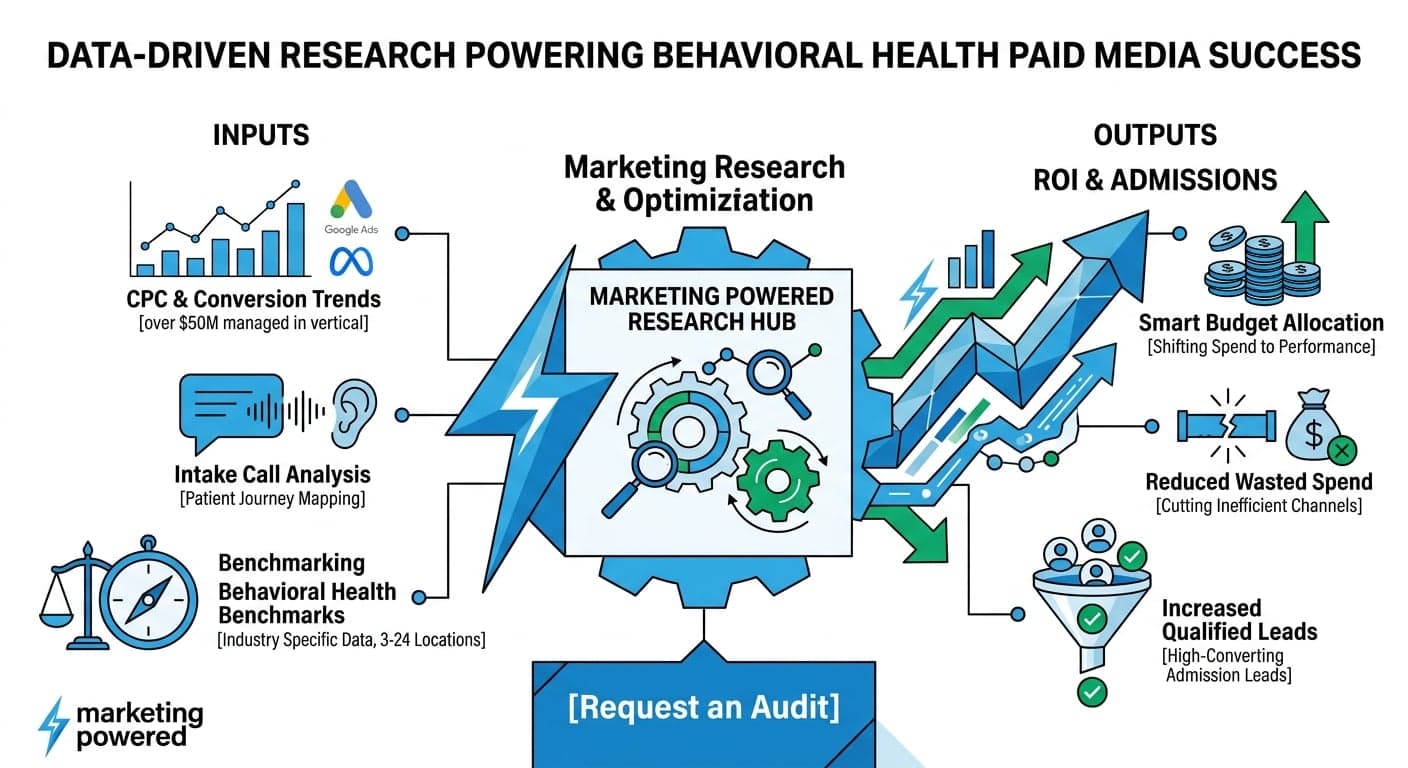
At Marketing Powered, we have managed over $50M in behavioral health and mental health media spend. That scale generates proprietary data that most agencies simply do not have access to. When we talk about paid media benchmarks, we are not pulling from generic SaaS reports. We are drawing from thousands of campaigns across admission-focused treatment centers, from 3-location startups to 24-location regional operators.
Key Benchmarks in Paid Media
Behavioral health paid media benchmarks differ significantly from standard healthcare or B2C verticals. The patient journey is longer, the decision-maker is often not the patient themselves, and the compliance environment restricts targeting options that other industries take for granted.
Based on campaigns managing $1.5M to $2M monthly in Google Ads across treatment center clients, we track benchmarks across several categories:
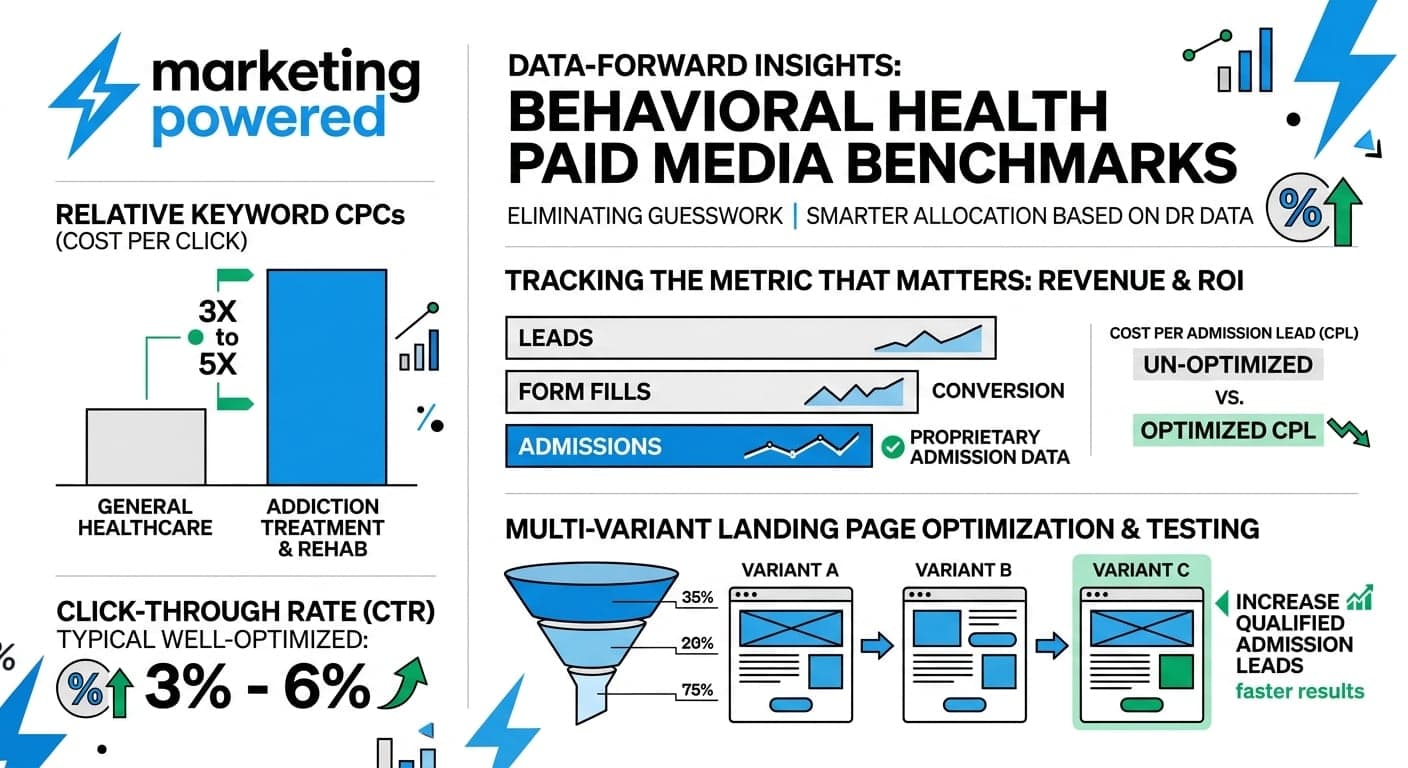
- Cost per click (CPC): Addiction treatment and rehab keywords consistently command premium CPCs, often 3x to 5x general healthcare terms. According to WordStream's industry benchmarks, legal and healthcare verticals see the highest CPCs, and behavioral health falls at the top of that range.
- Click-through rate (CTR): Treatment center campaigns typically see CTRs between 3% and 6% for well-optimized search campaigns. Lower CTRs often indicate ad copy compliance issues or poor keyword-to-landing-page alignment.
- Cost per admission lead: This is the metric that matters. We track attribution through to admission, not just form fills. A $200 lead that never converts to intake is worth less than a $400 lead that admits.
- Conversion rate by channel: Search consistently outperforms display in this vertical, partly due to retargeting restrictions. Performance Max campaigns require careful audience exclusions to avoid wasted impression share.
Behavioral Health Marketing Research Methodologies
Effective marketing research in behavioral health combines quantitative performance data with qualitative insights about patient acquisition dynamics. Neither approach alone gives you the full picture.
Free Audit
Want a straight read on where your budget is leaking?
Quantitative approaches
Quantitative research relies on measurable data points: CPC trends, conversion rates, channel attribution, and admission tracking. We pull this data from live campaigns and compare it against historical performance across similar facility types. According to SAMHSA's National Survey on Drug Use and Health, treatment admission patterns shift by region, substance type, and demographic. Paid media research must account for these variables.
Multi-variant optimization allows us to test landing page variations at scale, routing traffic to the highest-performing version for each visitor segment. This generates statistically significant data faster than traditional A/B testing.
Qualitative approaches
Qualitative research includes intake call analysis, patient journey mapping, and competitive positioning audits. Understanding why a lead converts (or does not) requires more than numbers. It requires listening to intake conversations, reviewing call recordings, and identifying friction points that data alone cannot surface.
Both methodologies feed into strategy formation. Quantitative data tells you what is happening; qualitative research explains why. Treatment centers that combine both approaches make better budget decisions and avoid the common trap of optimizing for vanity metrics.
How Research Links to ROI and Success
Marketing research directly impacts ROI by eliminating guesswork from budget allocation. When you know your cost per admission by channel, you can shift spend toward what works and cut what does not.
Consider a treatment center spending $150,000 monthly across Google Ads, Meta (within compliance limits), and programmatic display. Without research-driven attribution, they might allocate budget based on lead volume alone. With proper attribution tracked through to admission, they discover that 70% of actual admissions originate from search, even though display generates more form fills. That insight shifts $30,000 monthly from low-converting channels to high-converting ones.
We have seen this pattern repeatedly across the case studies in our portfolio. Operator-side multi-market growth using a research-driven media strategy. The difference was not more spending. It was a smarter allocation based on real admission data.
Strategy
Ready to map a growth plan built for your vertical?
Getting Started with Research-Driven Marketing Strategies
Implementing marketing research into your paid media strategy does not require a complete overhaul. Start with what you can measure today and build from there.
- Audit your current attribution: Can you trace a lead from an ad click to admission? If not, that is the first gap to close.
- Benchmark against vertical-specific data: Generic industry reports will mislead you. Seek benchmarks from operators who have actually run behavioral health campaigns at scale.
- Review compliance alignment: Are your campaigns structured for Google Ads healthcare vertical restrictions? LegitScript certification context matters here.
- Test and measure: Use multi-variant optimization to generate statistically valid insights faster. Small sample sizes lead to bad decisions.
- Connect research to action: Data without implementation is just reporting. Every insight should tie to a specific budget or creative decision.
Next Steps
If your current agency cannot show you cost per admission by channel, or if your benchmarks come from generic reports that ignore behavioral health compliance constraints, you are operating blind.
Marketing Powered brings AI-native infrastructure built specifically for healthcare marketing research, combined with the operational experience of managing eight-figure annual media budgets in this vertical. We track attribution through to admission and hold ourselves accountable to the metrics that actually matter to your census.
Request an audit to see how your current performance compares to behavioral health benchmarks, and where the gaps are costing you admissions.
See How Your Campaigns Compare
Request an audit to benchmark your current paid media performance against behavioral health industry standards. We will identify where the budget is being wasted and where opportunities exist to increase qualified admission leads.
Questions, answered.
Behavioral health paid media benchmarks include cost per click (typically 3x to 5x general healthcare), click-through rates between 3% and 6% for optimized search campaigns, and cost per admission lead rather than cost per form fill. These benchmarks vary by treatment type, geography, and facility size. Generic healthcare benchmarks do not account for sensitive vertical restrictions that limit targeting options in this space.
Marketing research identifies which channels, keywords, and creative approaches generate actual admissions rather than just leads. Without research grounded in behavioral health data, treatment centers often allocate budget based on vanity metrics like lead volume while missing the channels that drive census. Research also surfaces compliance gaps and competitive positioning opportunities that intuition alone cannot reveal.
Connect research insights directly to budget allocation decisions. If your data shows that search generates 70% of admissions but receives 50% of the budget, shift spend accordingly. Use attribution tracking that follows leads through to admission, not just form submission. Test landing page variations through multi-variant optimization to improve conversion rates with statistical confidence.
Effective marketing research combines quantitative and qualitative approaches. Quantitative methods include performance data analysis, attribution modeling, and multi-variant testing. Qualitative methods include intake call analysis, patient journey mapping, and competitive audits. Both are necessary: quantitative data shows what is happening, while qualitative research explains why.
Ready to see what AI-native marketing can do for your treatment center?
Request a free audit of your paid media, landing pages, attribution, and compliance posture. You'll get a straight assessment of where the opportunities are.
or email us at info@marketingpowered.ai