Resources
Your Complete 2026 Meta Ads Guide
Practical strategies for healthcare marketers running Facebook and Instagram campaigns under Special Ad Category restrictions.
Introduction to Meta Ads
This meta ads guide exists because healthcare marketers face a specific problem: Meta's Special Ad Categories restrict the targeting options that make Facebook and Instagram advertising effective for most industries. If you manage campaigns for treatment centers, mental health practices, or health-adjacent organizations, you already know the frustration of building audiences with one hand tied behind your back.
Meta's advertising ecosystem reaches over 3 billion monthly active users across Facebook and Instagram. For healthcare organizations, that reach matters less than the quality of attention you can capture within compliance boundaries. The platform's visual-first environment works well for awareness campaigns and community building, but conversion-focused campaigns require a sharper strategy.
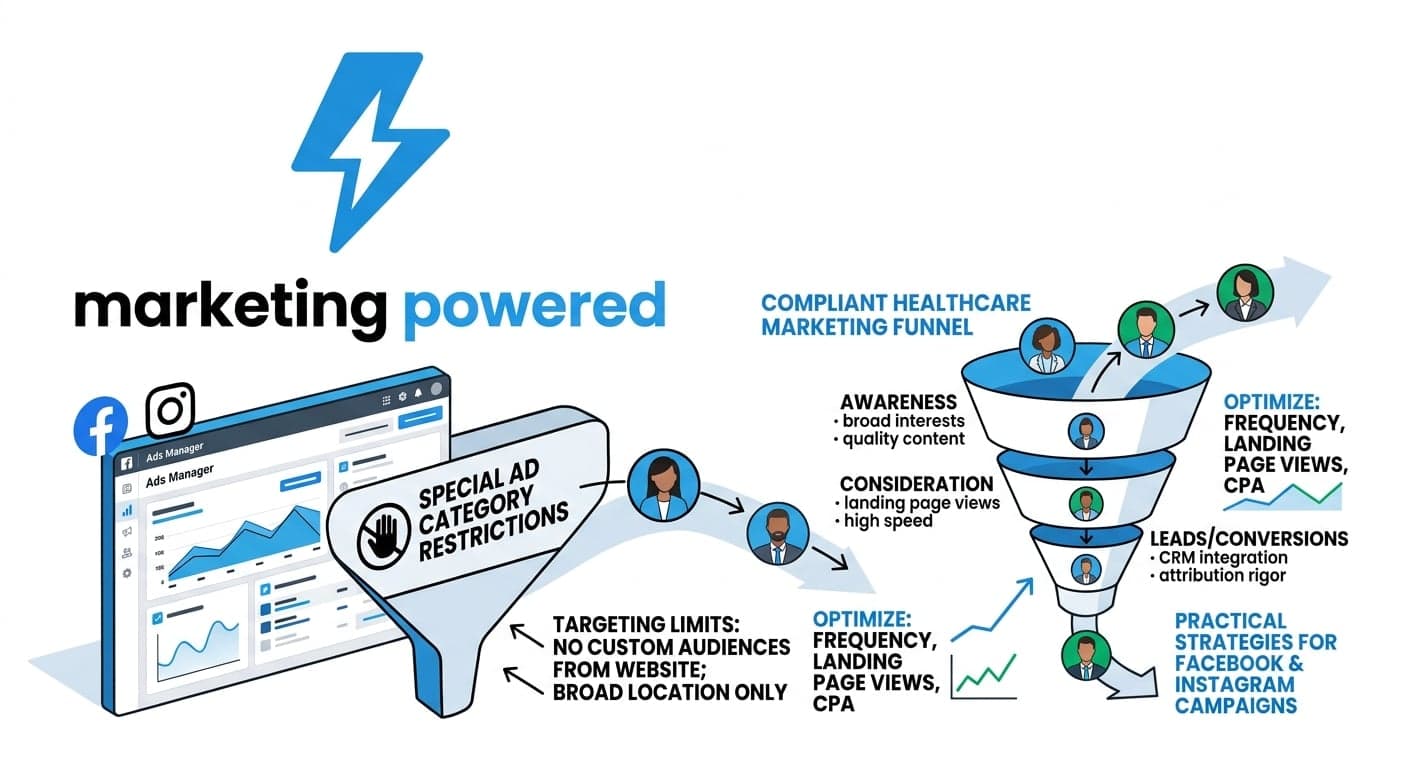
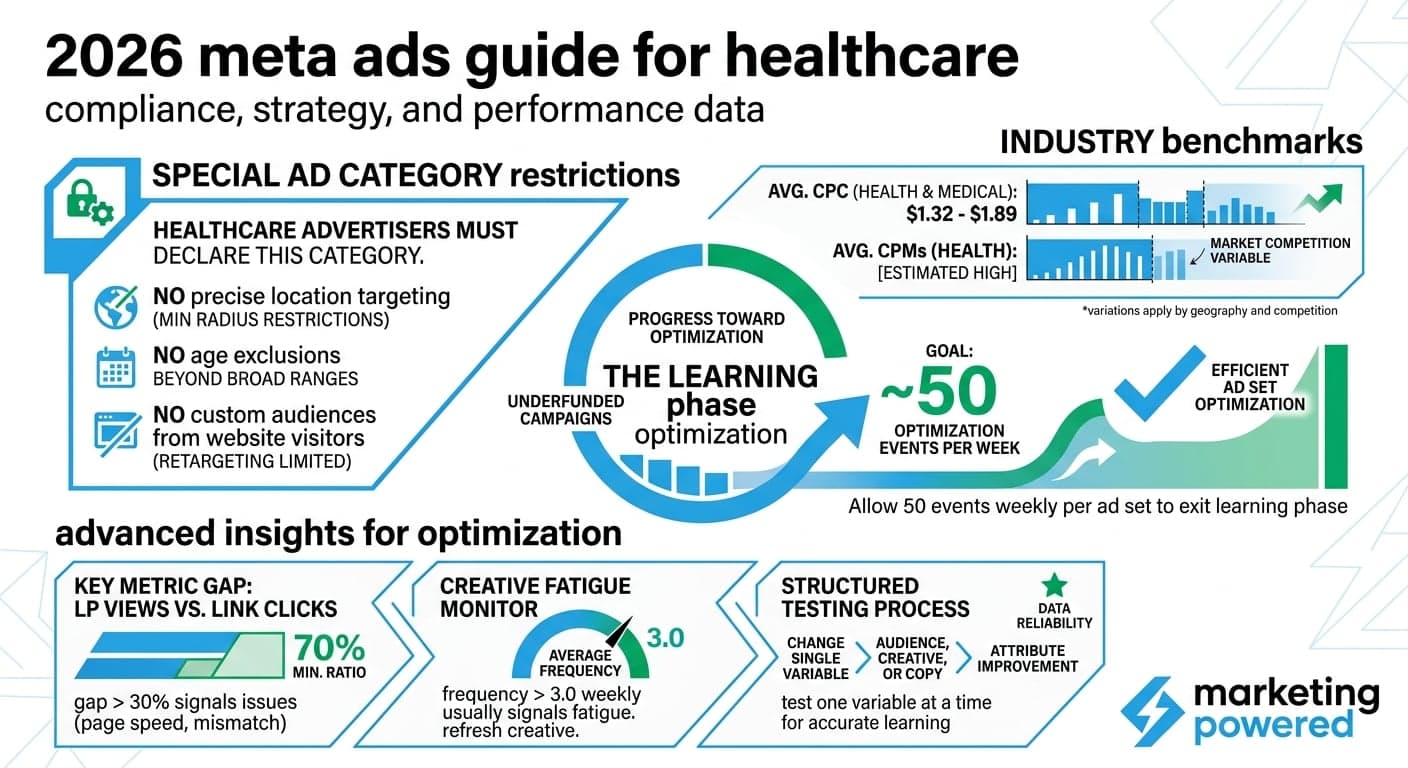
Healthcare advertisers operating under Special Ad Categories cannot use custom audiences built from website visitors, cannot exclude by age beyond broad ranges, and cannot target by zip code with precision. These restrictions exist because Meta classifies health-related advertising alongside housing and credit, categories where discriminatory targeting poses legal risk. Understanding these constraints before you build your first campaign saves budget and frustration.
Setting Up Your Meta Ads Campaign
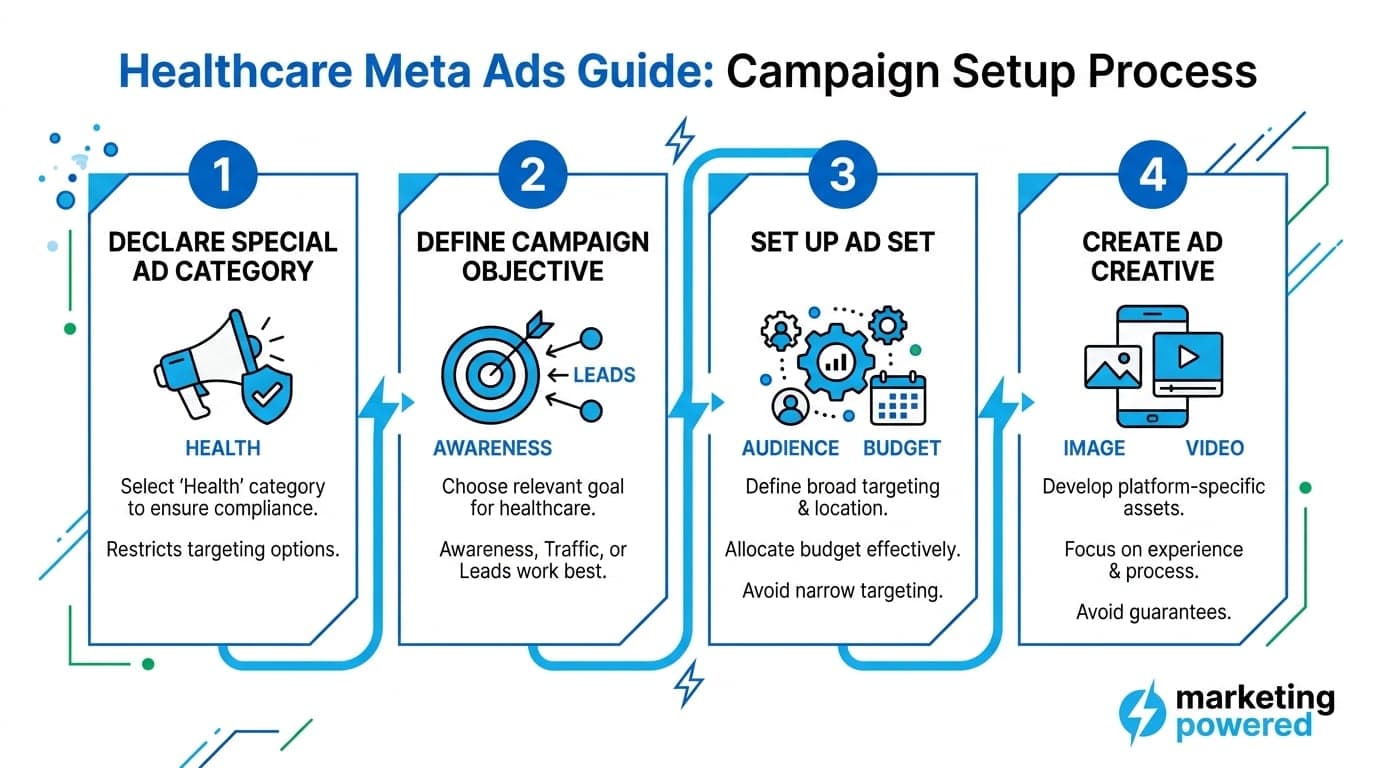
Campaign structure in Meta Ads Manager follows a three-tier hierarchy: campaign, ad set, and ad. Each level controls different variables, and getting the structure right from the start prevents budget waste and reporting confusion.
- Campaign level: Choose your objective. For healthcare organizations, Awareness, Traffic, and Leads objectives work within Special Ad Category restrictions. Conversion objectives can work, but require careful pixel configuration and understanding that attribution windows are compressed.
- Ad set level: Define your audience, placements, budget, and schedule. Under Special Ad Categories, you must declare the category during setup. This limits your targeting to broad interest categories and location targeting with minimum radius restrictions.
- Ad level: Build your creative. Upload images or video, write copy, select your call-to-action button, and set your destination URL. Each ad set can contain multiple ads for testing.
Budget and Bidding Considerations
Start with campaign budget optimization (CBO) unless you have a specific reason to control spend at the ad set level. CBO allows Meta's algorithm to allocate budget toward the best-performing ad sets automatically.
For healthcare campaigns, expect higher CPMs than general consumer advertising. Industry benchmark data shows health and medical advertisers see average CPCs between $1.32 and $1.89, with significant variation based on geography and competition. Treatment center advertising in competitive markets often exceeds these benchmarks.
Set daily budgets that allow each ad set to exit the learning phase, which requires approximately 50 optimization events per week. Underfunded campaigns never gather enough data to optimize effectively.
Free Audit
Want a straight read on where your budget is leaking?
Creative and Ad Format Best Practices
Meta offers multiple ad formats: single image, carousel, video, collection, and instant experience. For healthcare advertisers, single-image and video formats deliver the most consistent results within Special Ad Category constraints.
Facebook and Instagram have different optimal specifications. Facebook feed ads perform well at 1:1 or 4:5 aspect ratios. Instagram feed prefers 1:1, while Stories and Reels require 9:16 vertical video. Creating platform-specific creative rather than resizing a single asset improves performance.
Healthcare creatives must avoid before-and-after imagery, outcome promises, and any language that could be interpreted as a guarantee. Focus on the experience of working with your organization, your team's qualifications, and the process rather than results. This aligns with Meta's advertising policies for health-related content and protects your account from review flags.
Advanced Insights and Optimization
Meta Ads Manager provides performance data at campaign, ad set, and ad levels. The metrics that matter depend on your objective, but healthcare advertisers should focus on cost per result, frequency, and quality indicators like landing page views versus link clicks.
The gap between link clicks and landing page views reveals how many users abandon before your page loads. A ratio below 70% suggests page speed issues or audience mismatch. This metric matters more than raw click volume.
Frequency above 3.0 in a seven-day window often signals audience fatigue. Refresh creative or expand targeting before performance degrades. Creative fatigue happens faster in healthcare advertising because compliant messaging tends toward similarity.
Test one variable at a time. Changing audience, creative, and copy simultaneously makes it impossible to attribute improvement to any single factor. Structured testing requires patience but produces reliable learning.
Attribution in healthcare advertising requires connecting metadata to your CRM or intake system. Platform-reported conversions tell you what Meta thinks happened. Actual admissions or appointments tell you what your business experienced. The gap between these numbers reveals your true cost per acquisition.
Resources and Tools for Meta Ads
Meta Blueprint offers free certification courses covering platform fundamentals through advanced optimization. The certifications validate competency, but the real value is the structured curriculum.
Third-party tools like AdEspresso, Revealbot, and Madgicx provide automation and reporting features beyond native Ads Manager capabilities. Evaluate whether the efficiency gains justify the subscription cost for your campaign volume.
For additional digital marketing resources specific to healthcare verticals, explore our resource library. Organizations ready to discuss strategy, compliance, and channel mix can review our case studies or explore how AI-driven marketing solutions apply to Meta advertising optimization.
Strategy
Ready to map a growth plan built for your vertical?
Ready to Improve Your Meta Advertising Results?
Healthcare advertising on Meta requires compliance awareness, creative discipline, and attribution rigor that generic agencies overlook. If your current campaigns produce low-quality leads or compliance headaches, a focused conversation about strategy and channel mix can identify specific improvements.
Questions, answered.
A Meta ads campaign consists of three levels: campaign (objective and budget strategy), ad set (audience targeting, placements, and schedule), and ad (creative assets and copy). For healthcare advertisers, the Special Ad Category declaration at the campaign level determines available targeting options. Success requires alignment between your objective selection and the actions you can realistically track under compliance restrictions.
Monitor frequency, cost per result, and the ratio of landing page views to link clicks. When frequency exceeds 3.0 weekly, refresh the creative before fatigue sets in. Test single variables at a time to attribute improvements accurately. Connect metadata to your CRM to understand true cost per acquisition rather than platform-reported conversions alone.
Meta Ads Manager handles campaign creation and basic reporting. Meta Business Suite consolidates organic and paid management. Third-party tools like AdEspresso, Revealbot, and Madgicx add automation, bulk editing, and enhanced reporting. Meta Blueprint provides free training and certification for skill development.
Targeting determines whether your budget reaches people likely to convert. Under Special Ad Categories, healthcare advertisers face significant restrictions: no custom audiences from website visitors, limited demographic exclusions, and broad location targeting only. This makes creative quality and landing page relevance even more important for filtering qualified prospects.
Meta Blueprint offers free certification courses. The Meta Ads Help Center documents platform features and policy requirements. For healthcare-specific guidance, our resource library covers compliance considerations and vertical-specific strategies. Industry publications like Search Engine Journal and Social Media Examiner provide ongoing tactical updates.
Ready to see what AI-native marketing can do for your treatment center?
Request a free audit of your paid media, landing pages, attribution, and compliance posture. You'll get a straight assessment of where the opportunities are.
or email us at info@marketingpowered.ai