Resources
Effective Strategies for Mental Health Marketing
Industry-specific insights for practice growth, lead quality, and regulatory confidence
Understanding the Basics of Mental Health Marketing
Mental health marketing requires a fundamentally different approach than general healthcare advertising. The patients you serve are navigating sensitive decisions about their well-being, and every touchpoint must balance accessibility with discretion. Generic marketing playbooks fail here because they ignore the compliance landscape, the trust barriers unique to mental health, and the specific channels where your ideal patients actually search for help.
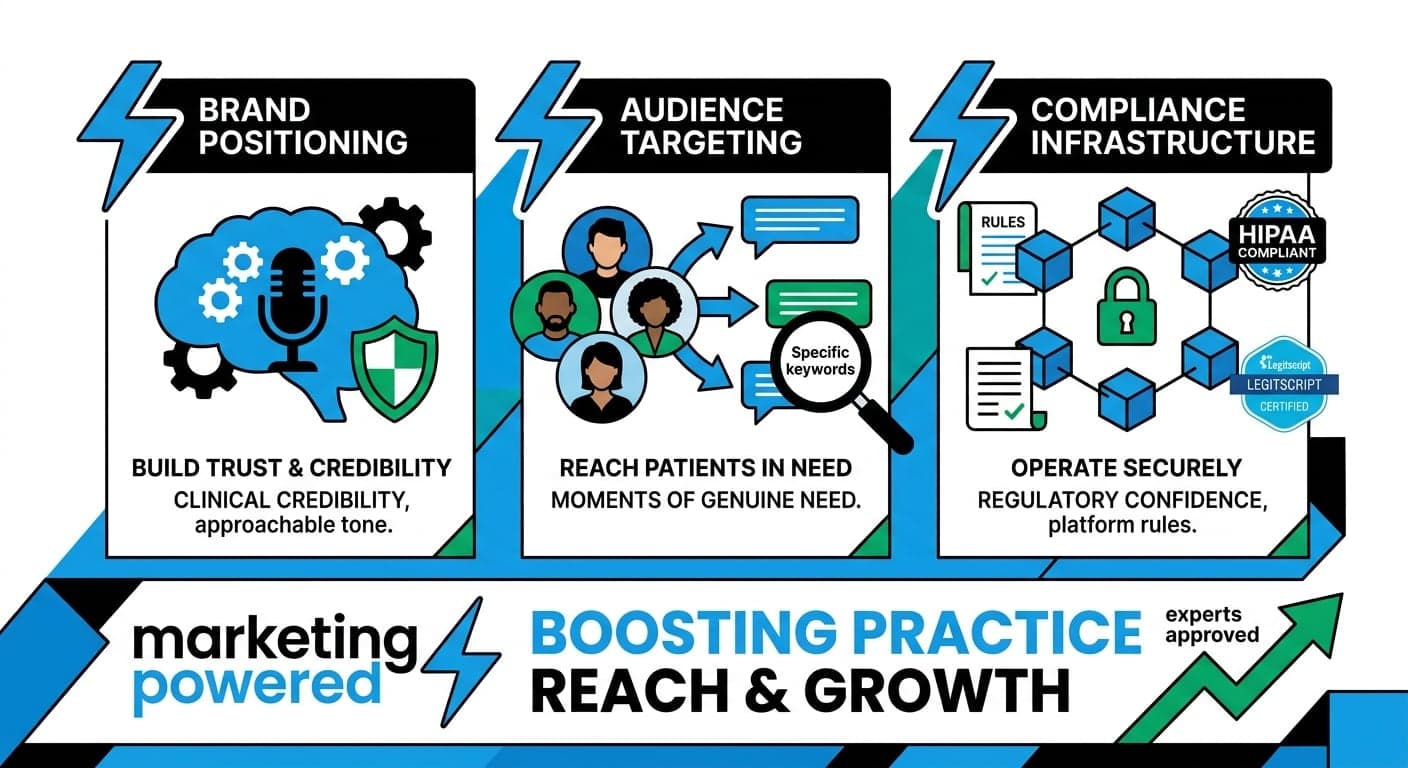
Effective mental health marketing starts with three pillars: brand positioning that communicates clinical credibility without clinical coldness, audience targeting that reaches people in moments of genuine need, and compliance infrastructure that keeps your practice protected. Each pillar demands specialized knowledge. A campaign that works for an orthopedic clinic will underperform or create liability when applied to a therapy practice or psychiatric group.
The stakes are higher than wasted ad spend. HIPAA regulations govern how you can communicate with prospects. Google Ads healthcare policies restrict retargeting and certain messaging tactics. LegitScript certification requirements apply to practices advertising addiction or mental health services. Without operator-level familiarity with these constraints, marketing partners create risk, not growth.
Crafting a Digital Strategy for Your Practice
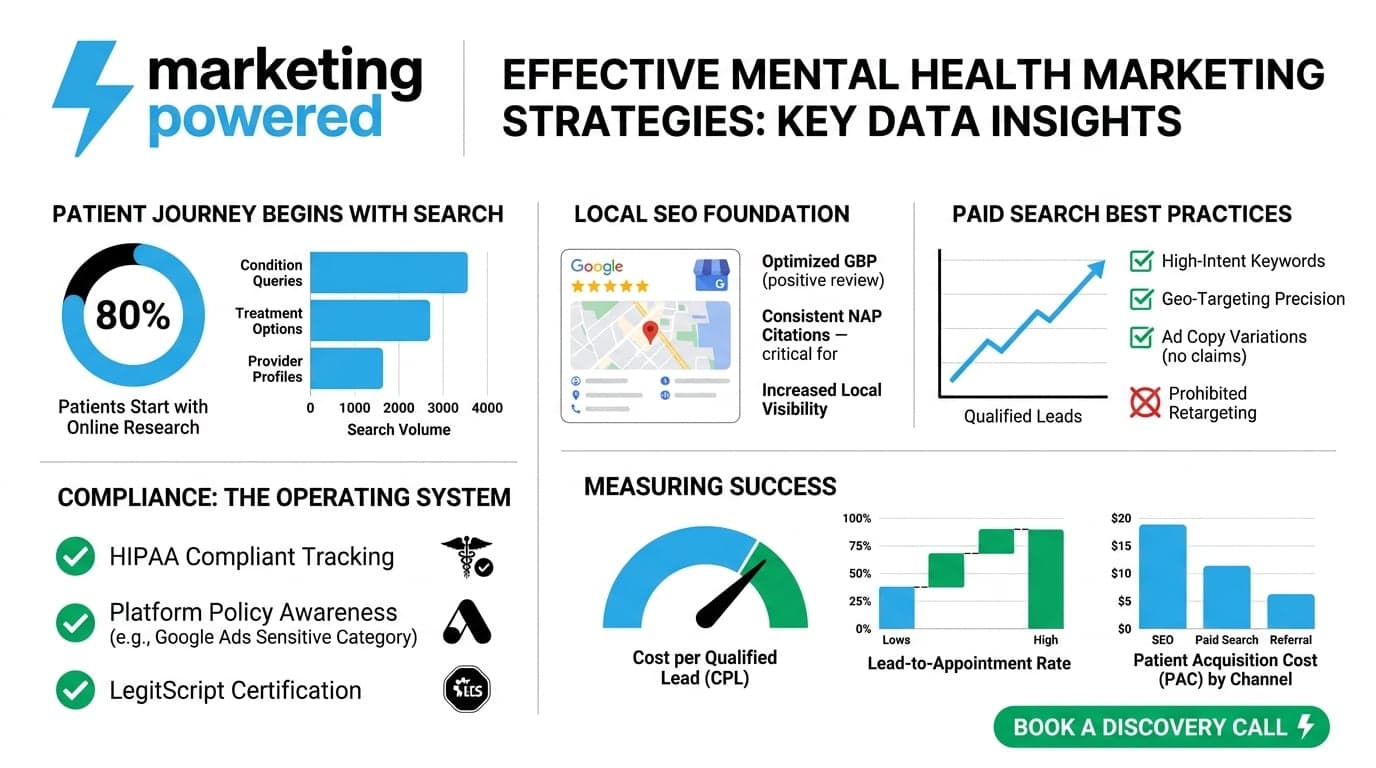
A digital strategy for mental health practices must account for how patients actually find care. Most begin with a search: symptoms, treatment options, therapists near them, or specific modalities like CBT or EMDR. Your visibility in those moments determines whether they find you or a competitor.
Mental health marketing SEO starts with content that answers the questions your ideal patients are asking. This means condition-specific pages, treatment modality explanations, and provider profiles that build trust before the first call. Technical SEO matters too: site speed, mobile responsiveness, and schema markup help search engines understand and surface your content. According to Google's search documentation, sites that load quickly and render well on mobile devices consistently outperform slower competitors in organic rankings.
Paid media adds precision. Google Ads allows you to appear for high-intent searches like 'psychiatrist accepting new patients' or 'anxiety therapist near me,' but the healthcare vertical designation restricts your targeting options. Retargeting is prohibited for mental health services under Google's healthcare and medicines policy. Effective campaigns work within these limits by focusing on search intent, geographic targeting, and ad copy that qualifies leads before the click.
- Build condition-specific landing pages that match search intent and pre-qualify visitors
- Prioritize local SEO with optimized Google Business Profile and consistent NAP citations
- Structure paid campaigns around high-intent keywords, not broad awareness terms
- Test ad copy variations that communicate specialization without making outcome claims
Marketing Mental Health Private Practices
Private practices face a distinct challenge: smaller budgets competing against larger group practices and hospital systems with significant marketing resources. The advantage is specialization. A solo practitioner or small group can position themselves around specific populations, modalities, or conditions that larger competitors serve less personally.
Mental health practice marketing works best when it emphasizes what makes your practice different. If you specialize in adolescent anxiety, your content, ads, and local presence should all reinforce that focus. Community engagement compounds this positioning: speaking at local schools, partnering with pediatricians, or contributing to community mental health events builds referral relationships that paid media cannot replicate.
Local SEO is the foundation for private practice visibility. A complete Google Business Profile with accurate hours, services, and photos is table stakes. Reviews matter: practices with consistent positive reviews rank higher in local pack results and convert at higher rates. Encourage satisfied patients to share their experience, but never incentivize reviews or request specific language, which violates both Google policy and FTC guidelines.
Patient testimonials on your website require careful handling. HIPAA does not prohibit testimonials, but it does govern how you obtain consent. Written authorization must specify how the testimonial will be used. Video testimonials require additional consideration for patient privacy. The safest approach: work with a marketing partner who understands these boundaries.
Free Audit
Want a straight read on where your budget is leaking?
Ensuring Compliance in Mental Health Advertising
Compliance is not a footnote in mental health marketing; it is the operating system. Practices that treat compliance as an afterthought face advertising account suspensions, regulatory scrutiny, and reputational damage that outlasts any campaign.
HIPAA governs patient data, but its implications for marketing are often misunderstood. Any tracking pixel, form submission, or analytics tool that captures protected health information must comply with Business Associate Agreement requirements. This affects how you implement Google Analytics, Meta Pixel, and CRM integrations. The HHS Office for Civil Rights has issued specific guidance on tracking technologies and HIPAA, clarifying that IP addresses combined with health-related browsing can constitute PHI.
Advertising platforms add another layer. Google Ads designates mental health services as a sensitive category, prohibiting personalized advertising and retargeting. Meta has similar restrictions. LegitScript certification is required for advertising addiction treatment on Google and recommended for mental health services. These requirements change; a compliant campaign in 2023 may violate 2025 policies.
Marketing Powered maintains active awareness of LegitScript requirements, platform policy updates, and HIPAA guidance specifically because we operate in behavioral health and mental health verticals. This is not general healthcare marketing adapted for your practice. It is mental health marketing built from operator experience with compliance frameworks that protect your license and your patients.
Measuring the Success of Your Marketing Efforts
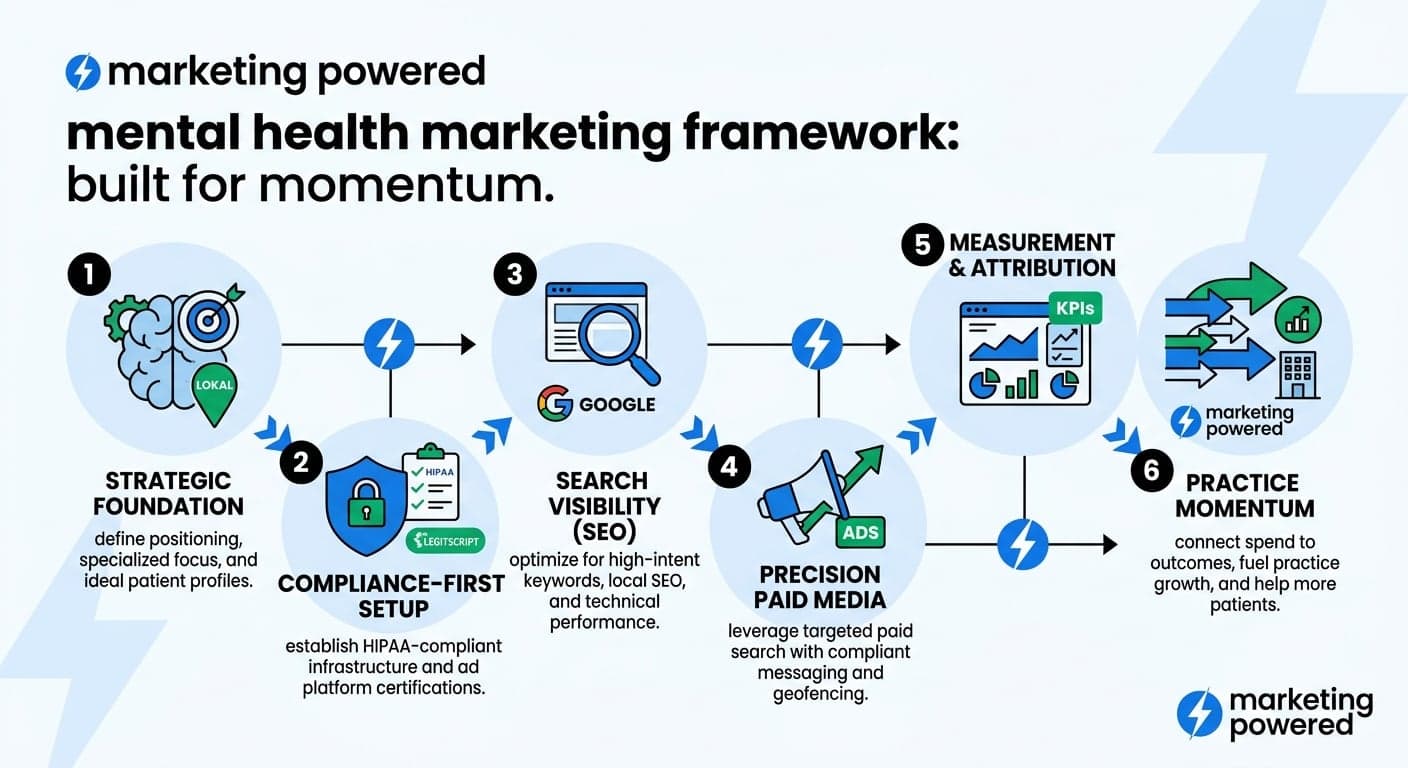
Marketing without measurement is guessing. In mental health, where patient acquisition costs vary widely, and lead quality determines intake efficiency, attribution discipline separates profitable practices from those bleeding budget.
The metrics that matter are not impressions or clicks. They are qualified leads, booked appointments, and patients who complete intake. Tracking these outcomes requires connecting your marketing data to your practice management system. Marketing Powered has tracked attribution through to admission across $50M+ in managed behavioral health and mental health spend, using infrastructure that respects HIPAA boundaries while delivering the visibility practice operators need.
Key performance indicators for mental health practice marketing include cost per qualified lead, lead-to-appointment rate, and patient acquisition cost by channel. Comparing these across SEO, paid search, and referral sources reveals where to invest and where to cut. Without this clarity, you are optimizing for vanity metrics while missing the numbers that affect your P&L.
Ready to Build a Marketing Strategy That Fits Your Practice?
Mental health marketing demands more than generic tactics. It requires compliance awareness, vertical expertise, and attribution discipline that connects spend to patient acquisition. Schedule a discovery call to discuss your practice's growth goals, current challenges, and the channel mix that makes sense for your market.
Questions, answered.
Effective mental health marketing SEO combines content optimization, technical performance, and local presence. Create condition-specific pages that answer the questions prospective patients search for. Ensure your site loads quickly on mobile devices and implements proper schema markup. Build your Google Business Profile with complete information and encourage authentic patient reviews. Keyword research should focus on terms with treatment intent, not just informational queries, to attract visitors ready to book.
Social media supports mental health practices primarily through brand awareness and reputation management rather than direct patient acquisition. Share educational content that demonstrates clinical expertise without making treatment claims. Respond to comments and messages professionally, but never discuss patient matters publicly. Platform policies restrict health-related targeting, so organic reach and community building matter more than paid social for most practices. Always review platform-specific healthcare advertising policies before running paid campaigns.
Mental health marketing operates under overlapping regulatory frameworks: HIPAA governs patient data, platform policies restrict targeting and messaging, and LegitScript certification is required for certain advertising. Non-compliance creates real consequences including advertising account suspension, regulatory penalties, and reputational harm. Practices need marketing partners with active awareness of these requirements, not agencies learning compliance at your expense.
A specialized agency brings vertical expertise that general marketing firms and in-house teams typically lack. This includes compliance knowledge, platform policy navigation, and attribution systems that track marketing spend through to patient acquisition. Marketing Powered has supported growth through multi-market growth at a multi-location behavioral health organization and manages $1.5M to $2M monthly in Google Ads across behavioral health and mental health accounts. The difference is operator-level experience, not just agency services.
Ready to see what AI-native marketing can do for your treatment center?
Request a free audit of your paid media, landing pages, attribution, and compliance posture. You'll get a straight assessment of where the opportunities are.
or email us at info@marketingpowered.ai