Resources
LegitScript Certification for Addiction Treatment Advertising
I'll verify the current Google and LegitScript requirements first, then rewrite the guide as a publishable page with those sources cited.Meta title: LegitScript Certification for Treatment Advertising
By Mike Hulick, Founder, Marketing Powered

What LegitScript certification decides
Treat legitscript certification as a readiness project with named owners, documented requirements, and a measurement plan. It is an eligibility step for certain addiction treatment advertising, not a decision that ads are approved and not a measure of admissions. This guide explains when it applies, who owns each step, what to budget, and how to judge the channel it unlocks.
Picture a Tuesday operations meeting. The compliance lead has the license file. The web lead has the program pages open, including every facility address and photo. The marketing lead has a Google Ads account that cannot serve recovery-related queries. The admissions lead has last month’s call log and a definition of a qualified call that marketing has not yet adopted. LegitScript certification is the third-party review that asks whether the organization behind those records meets published standards for legitimacy, licensing, disclosure, and public-facing practices. It is not the meeting that decides bids, landing pages, or intake.
LegitScript is a private certification and monitoring program. Its addiction treatment standards cover licensure and business registration, legal compliance, policies and procedures, facility location and disclosure, clinical staff qualifications, prior discipline and litigation history, insurance where the law requires it, website content, privacy, medication-assisted treatment practices, ownership ties to lead generators, advertising, incentives, affiliates and domains, and transparency. LegitScript Addiction Treatment Certification Certification is not a state license, and it is not a clinical quality credential you should describe to the public as one. Maintain the licenses and registrations required for your services and jurisdictions, and document any accreditation you claim. LegitScript Certification Standards
Three distinctions keep the project from drifting.
It addresses one eligibility requirement. It does not approve the ads. People searching for legitscript Google Ads are usually asking whether the seal is enough to turn spend on. It is not. In the United States, an advertiser that wants to promote recovery-oriented drug and alcohol addiction services must be certified as an addiction services provider by the LegitScript Certification program and must also be certified with Google. Services that are not eligible for that certification are not allowed to advertise those services on Google. LegitScript charges a fee for processing and monitoring applicants, and fee waivers may be available in some circumstances. Healthcare and medicines LegitScript certification addresses one eligibility requirement. Google makes its own certification and advertising decisions.
It is not a performance lever. Certification does not set your bids, write your ads, staff your phones, or complete verification of benefits. Admissions after a channel opens depend on those later steps. Crediting the certification decision with admissions confuses permission with execution.
It is not a one-time purchase. The program includes ongoing monitoring. The annual certification fee is due only after approval and is what finalizes certification. LegitScript Addiction Treatment Certification After approval, LegitScript asks certified organizations to report significant changes within 30 days, including changes in business operations, licensure and accreditation, treatment providers, and legal or regulatory matters. Adding a location does not require a new application, but it does require notice and the applicable fee. Addiction Treatment Certification FAQs A new landing page, a renamed program, or a new domain can create a later problem. Name an owner for that work before you submit.
This guide is a planning framework, not legal advice. Platform rules and vendor requirements change. Re-read the current policy text before you submit, before you apply to Google, and before you launch.
When the requirement applies
Google’s addiction-services policy concerns recovery-oriented drug and alcohol addiction services, not every mental-health service. Promotion of services unrelated to drug and alcohol addiction, such as services for impulse control disorders, behavioral addiction, or nicotine addiction, is outside that policy. Addiction services That limit is about the service being promoted. It is not an organization-wide exemption for every behavioral health advertiser, and it does not remove other healthcare advertising rules.
Google’s examples of recovery-oriented drug and alcohol addiction services include clinical addiction treatment providers, recovery support such as sober living environments and mutual help organizations, lead generators or referral agencies, and crisis hotlines. Approved advertisers may promote these services in Australia, Canada, France, Ireland, New Zealand, and the United States. The location rules are not the same in each country. Addiction services
What Google requires by location
Read the location row for every country you intend to target. The current healthcare and medicines policy draws these lines for addiction services:
- United States. You must be certified as an addiction services provider by LegitScript, and you must also be certified with Google. Services not eligible for LegitScript certification are not allowed to advertise recovery-oriented drug and alcohol addiction services on Google.
- Canada. You must be certified by LegitScript’s Addiction Treatment Certification program, and you must also be certified with Google.
- Australia, France, Ireland, and New Zealand. Google allows these ads by government entities only, and those advertisers must also be certified with Google.
Healthcare and medicines A private treatment provider in a government-only location should not assume the US route applies. A US provider should not assume certification in one country covers campaigns aimed at another. If you want to advertise in more than one location, Google’s addiction-services guidance says to submit a separate application for each location or group of locations. Addiction services
Display and Video 360 users must comply with the same healthcare and medicines policy. Healthcare and medicines Treat that as a media-plan question, not a footnote, if a hospital or multi-location group buys through a programmatic desk.
Who LegitScript describes as eligible
Google’s restriction and LegitScript’s eligibility list are not the same set of businesses. LegitScript describes eligible applicants as organizations offering licensed addiction treatment services in the United States or Canada, in person or remotely. The clinical services it names include detox, residential or outpatient treatment, outpatient counseling, and medication-assisted treatment. Addiction treatment provided as part of a co-occurring treatment program qualifies. Telehealth substance use treatment is eligible if the other standards are met, and a traditional building is not required. Professionally licensed clinical care in a patient’s home, such as concierge detox, is described as in scope. Non-clinical operations run from a private residence are not. LegitScript Addiction Treatment Certification Addiction Treatment Certification FAQs
LegitScript also describes two narrower categories: mutual support groups that facilitate peer interaction and do not use that path for sober living environments, and crisis hotlines that offer addiction-related assistance without promoting or directing people to specific treatment providers. It states that lead generators, call centers, and marketers who refer people to other providers for compensation are not eligible, and that sober living or recovery residences without licensed clinical services do not meet the requirements. LegitScript Addiction Treatment Certification
The practical reading for a US advertiser is uncomfortable and precise. A business can sit inside Google’s restricted category and still be unable to advertise, because it is not eligible for the certification Google requires. Do not plan a Google launch for a referral desk or an unlicensed residence on the hope that a related clinical affiliate’s seal will cover it. Confirm the applicant, the services, and the domains before anyone builds campaigns.
Mental health, co-occurring care, and website content
A practice that treats depression, anxiety, or trauma and does not offer or advertise substance use treatment may sit outside the addiction-services certification rule. Do not stop the analysis at the campaign you hope to run. LegitScript’s getting-started guidance says that if a website includes information about substance use disorder treatment, advertising platforms may classify the business under addiction treatment policies even when the advertiser does not intend to advertise those services directly. In those cases, LegitScript generally recommends Addiction Treatment Certification rather than its separate healthcare certification. Certification FAQs
Assess the organization’s services, website content, and proposed campaigns together. Substance-use-treatment content on the website may affect platform classification even when a campaign promotes another service. A dual-diagnosis page, an alumni story about substance use, or a menu item for detox can matter even if the ad group is labeled mental health. Confirm scope for the entity and the site, not once in a brand deck and never again.
Health content can still face targeting limits when it is outside the addiction-services certification rule. Google treats health as a sensitive interest category. Its examples include counseling for mental health issues such as depression, anxiety, and addiction, including alcohol addiction. Health in personalized advertising Certification status does not remove that category.
Hospitals, health systems, and several locations
For a hospital service line, document the provider entity, treatment locations, website domains, and services before determining the application scope. Do not assume hospital affiliation creates an exemption. A health system can have an inpatient withdrawal unit, a substance use program, or a co-occurring service inside an organization that also runs unrelated service lines. The useful questions are which legal entity would be the applicant, which locations provide the in-scope service, which domains describe that service, and which campaigns would point there. Retrieved platform pages do not establish a universal hospital-specific entity rule, so do not invent one in the project plan.
Facilities under common ownership may be included in one application. Certification fees apply per eligible facility. LegitScript defines a unique facility as a distinct location that provides addiction treatment services, even under the same corporate registration. Most organizations can apply with multiple locations. Organizations with 10 or more facilities likely qualify for an enterprise program with an alternative pricing model. Addiction Treatment Certification FAQs LegitScript Addiction Treatment Certification
That facility count is an executive scoping decision. The founder of Marketing Powered ran marketing for a treatment network that grew from 3 to 24 locations. At that kind of footprint, “one brand website” and “one applicant” are not the same fact. List every location, every domain, and every legal name before anyone requests a quote.
Other channels
LegitScript states that its addiction treatment certification is a certification and monitoring solution recognized by Google, Meta, Microsoft, and Nextdoor. LegitScript Addiction Treatment Certification That statement is not a map of another platform’s current rules. If you plan to use another advertising channel, assess its requirements separately rather than transferring Google’s rules. LegitScript’s advertising standard also says applicants seen advertising on Google, Bing, or Facebook without certification, or in apparent violation of a platform’s terms, may be treated as trying to circumvent the program, and that this may be grounds for denial. LegitScript Addiction Treatment Certification Put a hold on in-scope paid campaigns until the eligibility path is clear. Do not “test a few ads” on the assumption that a later application will ignore them.
For how paid and other channels fit together once eligibility is settled, see the rehab advertising guide. State advertising and licensing rules sit beside platform rules. Have counsel review the states where you operate and the states where ads would run. This page does not substitute for that review.
Six gates and named owners
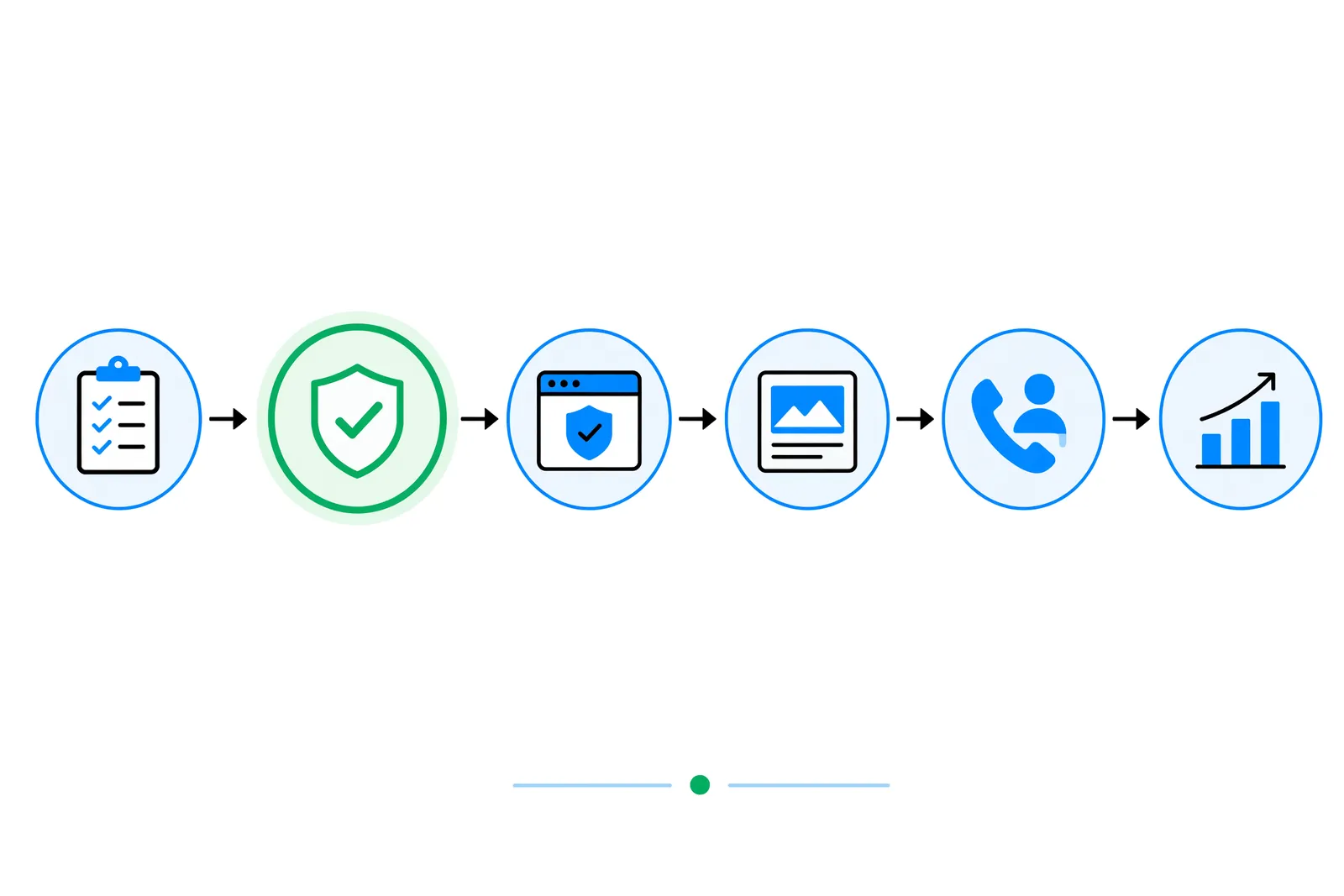
Treat the path from “we will advertise” to “first qualified call” as six gates. Certification is gate 3. Executives who track only that gate get surprised by the work before it and the work after it.
Gate 1: Scope and decision. List each legal entity, location, service line, domain, and channel. Mark what you believe is in scope and which source you used. Record who may approve a public claim. Output: a one-page scope statement with a retrieval date for every policy point.
Gate 2: Records and website readiness. Gather licenses, registrations, ownership documents, and the public sites and phone numbers tied to each facility. Read the site against those records. Output: an evidence packet and a change list.
Gate 3: Certification review. Submit in the vendor portal, answer questions, complete any remediation the reviewer requires, and record the decision and any conditions. Output: a decision file, not a verbal update.
Gate 4: Google certification and account setup. After the LegitScript decision, complete Google’s own healthcare certification for the locations you intend to target. Confirm the account you will use, billing, and the settings that must be in place before spend. Output: a Google certification status that matches the business model, plus a configured account. “Certified by LegitScript” and “certified with Google” are different statuses. Healthcare and medicines
Gate 5: Launch readiness. Test call tracking, forms, consent language, intake logging, and the verification-of-benefits handoff before the first media dollar. Output: a tested path from click to a person who can help the caller.
Gate 6: First qualified call. Define “qualified” in writing before launch. Confirm admissions can record it. Output: a baseline you can defend, not a victory slide.
Potential blockers differ by gate. Gate 1 stalls when service lines are lumped together. Gate 2 stalls on a missing license, a domain nobody inventoried, or a photo that does not show the applicant’s facility. Gate 3 stalls when the site and the entity records disagree, or when answers arrive late. Gate 4 stalls when the Google application is filed for the wrong category, the wrong location, or the wrong account. Gate 5 stalls on the handoff between marketing and admissions. Gate 6 stalls when two teams use two definitions of the same call.
Name one accountable owner for the whole timeline, usually a COO or marketing lead, and one accountable owner for each gate. The matrix below is a starting template. Adapt the titles. R means the person does the work. A means one accountable owner. C means consulted. I means informed.
- Scope statement and channel plan. CEO or COO: A. Compliance or legal: C. Clinical or operations: C. Marketing lead: R. Web: I. Admissions: C. Outside firm: C.
- License and entity packet. CEO or COO: I. Compliance or legal: A. Clinical or operations: R. Marketing lead: I. Web: I. Admissions: I. Outside firm: I.
- Website claims review. CEO or COO: I. Compliance or legal: A. Clinical or operations: C. Marketing lead: R. Web: I. Admissions: I. Outside firm: C.
- Website changes. CEO or COO: I. Compliance or legal: C. Clinical or operations: C. Marketing lead: A. Web: R. Admissions: I. Outside firm: C.
- Certification submission and replies. CEO or COO: I. Compliance or legal: A. Clinical or operations: C. Marketing lead: R. Web: I. Admissions: I. Outside firm: C.
- Google certification and account setup. CEO or COO: I. Compliance or legal: C. Clinical or operations: I. Marketing lead: A. Web: I. Admissions: I. Outside firm: R.
- Tracking and call handling. CEO or COO: I. Compliance or legal: C. Clinical or operations: I. Marketing lead: A. Web: R. Admissions: C. Outside firm: R.
- Qualified-call definition. CEO or COO: C. Compliance or legal: I. Clinical or operations: C. Marketing lead: C. Web: I. Admissions: A. Outside firm: C.
- Change control after launch. CEO or COO: I. Compliance or legal: A. Clinical or operations: I. Marketing lead: R. Web: R. Admissions: I. Outside firm: C.
- Readiness cost and payback report. CEO or COO: A. Compliance or legal: I. Clinical or operations: I. Marketing lead: R. Web: I. Admissions: C. Outside firm: C.
Two rows deserve a name before the kickoff. The website review needs a compliance owner, because the person who can read the license should decide what the site may say. Change control after launch is a standing job. A new page, a new facility name, or a new phone number can reopen a discrepancy that the original review already closed.
Free Audit
Want a straight read on where your budget is leaking?
How to prepare and submit
The work looks like a records review, not a media launch. Put the evidence on one table: current licenses, entity and ownership documents, a list of every domain and phone number, and printed copies of the pages a reviewer will see. One person owns the packet. One person owns correspondence. Everyone else supplies documents by a date on the dashboard.
Write the scope before you collect paper
For each entity, location, service, and channel, write whether you believe it is in scope and which policy or standard you relied on. Assign every uncertain item to a person who will open the current page and record the date. This is the document that stops a group from discovering, halfway through, that five facilities were planned as one launch and need separate Google applications, or that a shared brand site describes a service the applicant does not provide.
Check for differences between legal names and brand names, and between the address on the license and the address on the site. Organizations that have grown by acquisition often carry more than one name. Resolve the difference or document it before submission. Do not assume a reviewer will treat a brand name and a legal name as the same facility.
Build the packet against the standards
Use LegitScript’s published standards as the checklist, not a generic compliance binder. The items that most often touch a marketing project are specific.
The applicant must be registered as a legal entity where services are offered and adequately licensed for those services in those jurisdictions. Prescribing and dispensing must meet the licensing and registration rules that apply, including controlled-substance authorizations where they are required. The applicant must be able to document ownership or a lease for locations where services are offered, and must disclose physical properties and corporate entities under its control. Clinical staff who provide substance use treatment need documented expertise and any license the jurisdiction requires. Prior criminal, regulatory, or civil violations related to the business, facilities, or key staff must be disclosed, along with litigation commenced, resolved, or otherwise addressed over the past 10 years. Insurance must be documented where the law requires it. LegitScript Addiction Treatment Certification
The website standard is a marketing standard. The site must conspicuously show the physical address where services are rendered and the specific services provided. Photographs must truthfully depict the applicant’s own facilities. Content must not misrepresent the scope or location of services. When privacy law requires a policy, it must be posted. US applicants who collect, store, or transmit protected health information must comply with applicable HIPAA requirements. That is a vendor standard for the applicant. It is not a statement that any marketing workflow is certified. LegitScript Addiction Treatment Certification
Read incentives with the same care as licenses. The applicant must disclose incentives offered to patients or clients. In general, applicants that offer to pay for travel will not be eligible. Paying a patient’s rent or health insurance premiums during treatment is also listed among problematic incentives. Co-ownership of a lead generator, or a formal or informal affiliation such as sponsoring or answering a lead generator’s hotline, is prohibited and may be grounds for denial. Affiliates and partners must meet program standards, and the applicant must provide every domain it controls. LegitScript Addiction Treatment Certification
Keep public language accurate and non-stigmatizing. Write about people seeking treatment. Remove outcome promises and success claims you cannot document. Do not copy another provider’s pages. A reviewer can compare what the site says with what the license allows.
Submit, then separate the Google step
Make the website changes you already know about before you submit. Applicants may take reasonable remedial action during the review without penalty. Failure to provide full and accurate information can result in denial. LegitScript Addiction Treatment Certification Designate one person to handle portal messages. Log each request and determine whether it concerns missing information, clarification, or remediation. Answer the request and fix the underlying record so the same issue does not return in a different form.
LegitScript does not publish a general estimated certification timeline. It says every application is different. Review times vary with application complexity, applicant responsiveness, and overall application volume. Submitting complete information and responding promptly can help avoid unnecessary delays. Queue position is not visible in the client portal. Certification FAQs Do not put a borrowed duration on an executive calendar. Put the actual start date on your own dashboard and update it when the status changes.
Expedited processing is an optional add-on, not a shorter review. For an additional $2,500 per application, LegitScript says review will begin within two business days after screening is successfully completed. The add-on prioritizes the start. It does not shorten the compliance review itself. Certification FAQs LegitScript Addiction Treatment Certification
After the LegitScript decision, apply for Google certification in the addiction-services category. Do not apply under a different healthcare category because that form is familiar. If more than one location is in the media plan, submit a separate Google application for each location or group of locations. Addiction services Account standing, billing, and advertiser verification are readiness checks. They are not, on the policy pages retrieved for this guide, a separate addiction-only obligation list. Complete them anyway. An approved category in an account that cannot bill does not produce a qualified call.
For most healthcare policies, Google says that if a campaign targets allowed locations and the domain is properly certified, the ad can be labeled Eligible (limited) and can run in allowed locations. Healthcare and medicines Read that label as a location limit, not as a clean bill of health for every asset. Violations of the addiction-services policy do not lead to immediate account suspension without warning. Google says it will issue a warning at least 7 days before suspending an account for that policy. Addiction services A warning is a deadline for the owner of change control. It is not a cushion for launching unclear claims.
Test the path, then fix the measurement rules
Place test calls and test forms. Confirm that the number on the page is the number that rings, that the form reaches the inbox or CRM admissions actually uses, and that staff can log source and qualification status. Agree on the qualified-call definition before the first report. A useful definition names who the caller is seeking care for, whether the level of care is one you provide, whether benefits or self-pay status can be discussed, and which calls do not count, such as job seekers, vendors, and current patients calling about a schedule change.
Review what, if anything, you send to ad platforms. Google’s customer data policies say conversions related to sensitive categories cannot be used for measurement in enhanced conversions or store-sales uploads. Health or medical information, including purchases of medical services, is listed among those categories. Customer data policies Advertisers promoting sensitive interest categories, including health, cannot use advertiser-curated audiences. That restriction covers Customer Match, your data segments, audience expansion, and lookalike segments. Predefined Google audiences are treated differently because Google configures them without sensitive user signals. Restricted targeting in personalized advertising Marketing Powered is built for Google’s sensitive healthcare vertical, where retargeting is not permitted. Plan measurement around calls, forms, and authorized admission records, not around a remarketing pool of people who visited a treatment page.
Have counsel review the data flow. A sentence in a project plan that says a workflow has been “checked” is not a privacy review.
A suggested readiness dashboard
Use a readiness dashboard to record owners, dates, status, and blockers. The framework below is a planning template, not a client result. Copy it into a sheet your executive sponsor can see weekly. Leave the cells blank until your team fills them. One blocker per gate, in plain language, is more useful than a status of “in progress.”
- 1. Scope and decision.
- 2. Records and website readiness.
- 3. Certification review.
- 4. Google certification and account setup.
- 5. Launch readiness.
- 6. First qualified call.
For each row above, record: Accountable owner, start, target date, actual date, status, current blocker.
Record actual dates, not only targets. After one project, your own elapsed time is a better planning input than a duration a vendor does not publish. The person who owns the whole timeline reports blockers to the executive sponsor. Gate owners report their own rows. That split is what keeps certification from becoming a marketing task that marketing cannot finish.

LegitScript certification cost
Searches for LegitScript certification cost usually expect one number. The vendor fee is a real number, and it is not the project budget. Budget separately for vendor fees, remediation, professional review, and internal staff time.
As checked against LegitScript’s addiction treatment certification page, pricing is in US dollars and applies to the United States and Canada. Fees are per unique facility. The application fee is nonrefundable regardless of outcome. The annual certification fee is due only if the application is approved. Annual fees are nonrefundable, are not pro-rated if you cancel, and cancellation ends certification immediately. LegitScript Addiction Treatment Certification
Published standard tiers on that page:
- 1 to 9. Application fee per facility: $1,595. Annual certification fee per facility: $3,095.
- 10 to 24. Application fee per facility: $1,495. Annual certification fee per facility: $2,775.
- 25 or more. Application fee per facility: $1,395. Annual certification fee per facility: $2,550.
For the standard 1 to 9 facility tier, that is a $1,595 application fee and a $3,095 annual certification fee per facility. The annual fee is due after approval. Other tiers differ. A single facility’s published vendor fees in the first year are $4,690 if approved, before expedited processing or any readiness work. Three facilities at that same tier are $4,785 in application fees and $9,285 in annual fees if all are approved, or $14,070 in vendor fees. Those figures are arithmetic on the published schedule. They are not a quote for your organization, and they exclude legal review, website work, tracking, and staff time.
An individual practitioner tier is separate. It is designed for a small practice with one to three addiction treatment providers, a single location, one website, and no affiliation with a larger addiction treatment organization. The published fees are a $535 nonrefundable application fee and a $1,070 annual certification fee, due only after approval. Hardship waivers may be available for qualifying nonprofits. LegitScript determines eligibility from its hardship form. LegitScript Addiction Treatment Certification
Optional expedited processing is $2,500 per application on both the standard and individual practitioner schedules. It starts the review window. It does not replace the annual fee. Organizations with 10 or more facilities should ask whether the enterprise program’s pricing applies before they multiply the published tier by location count. Recheck the certification page before you budget. Fees change, and a downloaded screenshot is not a current invoice.
If you add a location after certification, LegitScript says you do not file a new application. Added locations share the existing renewal date. If an added location is approved within six months of renewal, its initial annual certification fee is reduced by 50 percent. Addiction Treatment Certification FAQs
Use the worksheet for total readiness. Enter amounts from the current vendor page and from your own quotes. Leave a cell blank until you have a source and a date.
- Application fee. What to include: Nonrefundable fee for each facility in the chosen tier. Owner: Compliance. One-time or recurring: One-time.
- Annual certification fee. What to include: Fee due after approval, per facility. Owner: Compliance. One-time or recurring: Recurring.
- Expedited processing. What to include: Optional $2,500 per application, if you choose it. Owner: Executive sponsor. One-time or recurring: One-time.
- Legal review. What to include: Policy reading, claims review, state advertising questions. Owner: Legal.
- Records preparation. What to include: Licenses, entity documents, insurance, litigation history. Owner: Operations.
- Website remediation. What to include: Addresses, services, photos, disclosures, page removals. Owner: Web.
- Content revision. What to include: Program pages and landing pages written to match licensed services. Owner: Marketing.
- Google certification setup. What to include: Applications by location or location group, account checks. Owner: Marketing.
- Tracking and call handling. What to include: Numbers, forms, routing, intake logging. Owner: Marketing and web.
- Internal staff time. What to include: Hours by role, using loaded hourly cost. Owner: Each owner.
- Contingency. What to include: Rework after reviewer questions. Owner: Executive sponsor.
For each row above, record: Amount, one-time or recurring, source and date.
Total readiness cost is the sum of the amount column. Do not label that sum as the certification fee.
Add one line that is an estimate, not a cost: delay. If finance expects a channel to contribute a stated margin per month once it is live, each month before launch defers that contribution. Write the assumptions next to the figure. Do not present it as a measured loss. It is a way to decide whether extra legal hours or a faster website queue is worth buying. It is not evidence that certification itself creates revenue.
How to measure calls and admissions
Leaders ask whether certification increased admissions. The question is reasonable, and a before-and-after comparison cannot answer it cleanly.
If the platform would not run the ads before certification, there is no “before” on that platform. You are comparing a channel that was closed with a channel that is open. Anything that follows also depends on bidding, ads, landing pages, call handling, verification of benefits, intake capacity, seasonality, competitor activity, and the account’s early learning period. Certification permits those factors to operate. It is not one of them.
Measure the certification project as an eligibility milestone. Measure the channel as a performance system. Put both on the same report and do not add them together.
Milestone measures.
- Days in each gate, using actual dates
- Reviewer requests, tagged as missing information, clarification, or remediation
- Total readiness cost from the worksheet
- Time from the LegitScript decision to the first ad Google allows to serve
- Time from that first eligible ad to the first call that meets the written definition
Performance measures, after launch.
- Qualified calls, using the definition admissions and marketing signed before launch
- Qualified-call rate per click and per answered call
- Verification of benefits completed
- Admissions by source, matched only with data your organization is authorized to use
- Cost per qualified call and cost per admission for the channel
- Contribution per admission, supplied by finance
Marketing Powered tracks attribution to admission, not just the lead, because a form fill is not an admission. The founder previously managed $1.5 to $2M per month in Google Ads across 11+ behavioral and mental health accounts. At that spend level, a platform-reported conversion is a starting point for a conversation with admissions, not a number you take to a board as census.
A payback frame can still be honest. Ask whether the channel the eligibility work unlocked repays the total readiness cost. Take the contribution from admissions matched to that channel over a period finance chooses. Subtract media spend, outside fees, tracking cost, and the incremental intake labor the channel required. Compare the remainder with the readiness-cost total. Write down who defines “matched,” how long the window is, and how contribution is calculated before the first report arrives. This is a project payback test. It is not a claim that certification caused the admissions.
What the data cannot prove should be on the same page as the numbers.
- Certification does not cause admissions. It permits a channel. Execution after that permission is a different system.
- A platform-reported conversion is not an admission. The call can be a wrong number, a job seeker, or a current patient.
- A short window misleads. Admissions often lag the first call, and early delivery in a new account is not a steady state.
- Matching a person to a source is incomplete. People use more than one path, and privacy limits constrain what can be sent back to an ad platform. State the matching method and the gaps.
- Search interest in a certification query is not demand for your program. Do not treat a keyword market as a conversion rate.
For the paid media work that starts after an organization is eligible, see rehab PPC. Eligibility is the door. The service question is whether the path from click to admission is measurable.

Email Us
Prefer to send the context directly?
Mistakes and a readiness checklist
Put two reports side by side before the first budget review. The left report has one number, admissions, and a caption that certification produced the change. The right report has two blocks: gate dates and readiness cost on one side, qualified calls and admissions by source on the other, with a line that says the channel is what is being judged. The right report is the one a CFO can use. The left report creates a budget argument nobody can settle.
The mistakes that produce the left report are operational.
Assigning the project only to marketing. Marketing cannot cure a license gap, a litigation disclosure, or an entity-name mismatch. Compliance and operations own those gates.
Submitting while known site problems are still live. Addresses, photos, service claims, and incentive language are part of the published standards. Clean the pages you already know are wrong, then submit.
Using one scope decision for every service line. A mental health page, a detox page, and a hospital service line can fall in different places. Document each one.
Launching without a shared definition of qualified. If admissions and marketing count different calls, the first monthly report starts a dispute.
Letting pages change without an owner. New locations, new domains, and rewritten program names belong on the change-control row.
Reading certification as a performance result. A rise in admissions does not prove the project “worked” as a marketing tactic. A flat month does not prove the certification “failed.” Both readings skip the channel.
Relying on an old policy PDF. Retrieve the current Google location row and the current fee table. Record the date. Recheck before the Google application and again before launch.
Assuming an outside firm can hold the certification. The standards apply to the organization that provides the services. An outside firm can help assemble records, revise pages, keep the dashboard, and prepare platform applications. The applicant remains responsible for the accuracy of what is submitted. Do not describe the seal as something an agency owns.
If a review does not proceed, start with the same questions as the records gate. Do the licenses, the entity documents, and the public site describe the same services, locations, and organization? Log the stated reason. Separate missing information from a practice the standards do not allow, such as an undisclosed incentive or a lead-generator affiliation. Denial patterns and remediation are a separate topic. Do not turn the first response into a race to resubmit the same packet.
Use the checklist below to organize readiness work. It is a planning aid. It is not legal advice, and it is not a promise of any certification or advertising decision.
Scope and ownership.
- [ ] Every entity, location, service line, domain, and channel is listed
- [ ] Each item has an in-scope note and the policy source used
- [ ] Uncertain points have an owner and a retrieval date
- [ ] One person owns the full timeline
- [ ] One person owns each gate
- [ ] One person owns change control after launch
Records.
- [ ] Current licenses are attached for each in-scope location
- [ ] Entity, ownership, and lease or ownership proof are complete
- [ ] Prescribing and controlled-substance authorizations are included where they apply
- [ ] Insurance required by law is documented
- [ ] Ten years of litigation and any disciplinary history are disclosed
- [ ] Legal names, brand names, and addresses match, or differences are documented
- [ ] Every domain and phone number tied to each facility is listed
Website and advertising.
- [ ] Physical addresses and specific services are conspicuous
- [ ] Photos show the applicant’s own facilities
- [ ] Service descriptions match licensed services and real locations
- [ ] Outcome claims you cannot document are removed
- [ ] Incentives are disclosed, and travel, rent, or premium offers are reviewed against the standard
- [ ] Lead-generator ownership and hotline affiliations are reviewed
- [ ] Accreditations you claim can be documented
- [ ] Language is accurate and focused on people seeking care
- [ ] In-scope ads are not running on platforms where uncertified advertising can affect the application
Review and Google.
- [ ] One person manages certification correspondence
- [ ] Each request is logged as missing information, clarification, or remediation
- [ ] Google applications are planned by location or location group
- [ ] The Google category matches addiction services, not a neighboring healthcare category
- [ ] Account standing, billing, and verification are checked before launch
Launch and reporting.
- [ ] Test calls and test forms are complete
- [ ] Call tracking, routing, and intake logging work end to end
- [ ] Counsel has reviewed any data shared with ad platforms
- [ ] Advertiser-curated audiences and sensitive-category conversion uploads are not in the plan
- [ ] Qualified call has a written definition
- [ ] Matching method and its gaps are written down
- [ ] Readiness cost and actual gate dates are in the worksheet
- [ ] Milestone measures and performance measures are reported separately
- [ ] Estimates are labeled as estimates
Questions, Answered.
No. In the United States, recovery-oriented drug and alcohol addiction services require certification as an addiction services provider by LegitScript and separate certification with Google. Services that are not eligible for LegitScript certification are not allowed to advertise those services on Google. Canada also requires LegitScript’s Addiction Treatment Certification and Google certification. Australia, France, Ireland, and New Zealand currently limit these ads to government entities, which must still be certified with Google. Content, location, and measurement rules still apply after both certifications are in place. Healthcare and medicines Plan certification as one gate in a sequence.
On the published 1 to 9 facility schedule, the application fee is $1,595 per facility and the annual certification fee is $3,095 per facility, due after approval. The 10 to 24 tier is $1,495 and $2,775. The 25 or more tier is $1,395 and $2,550. An individual practitioner tier is $535 to apply and $1,070 annually. Expedited processing is an additional $2,500 per application. Application fees are nonrefundable. LegitScript Addiction Treatment Certification Total readiness cost also includes legal review, records work, website changes, tracking, and staff time. Use the worksheet and recheck the vendor page before you budget.
LegitScript does not publish a general estimated timeline. It says review time varies with application complexity, applicant responsiveness, and application volume, and that complete submissions and prompt replies help avoid unnecessary delays. Expedited processing starts the review within two business days after screening. It does not shorten the review. Certification FAQs Your gate dashboard will show how long your own packet took. That is the planning number to keep.
Not for every mental health service. Google’s addiction-services policy does not cover services unrelated to drug and alcohol addiction, including impulse control disorders, behavioral addiction, and nicotine addiction. Addiction services If the website includes substance use treatment information, platforms may still classify the business under addiction policies even when a campaign promotes another service. Certification FAQs Assess the site and the campaigns together. Health ads can also face sensitive-category targeting limits without falling under the addiction certification rule.
It depends on the advertised service, the locations, the domains, and the legal entity that would apply. Document those facts before you set a launch date. Do not assume hospital affiliation creates an exemption. A substance use or detox service line inside a broader system can still fall under the addiction-services rules that apply to the country you want to target.
Measure certification as an eligibility milestone with its own dates and costs. Measure the channel it unlocks by qualified calls, verification of benefits, admissions matched through authorized data, and cost per admission. Then test whether that channel repays total readiness cost. Do not credit certification with admissions lift. The data cannot isolate that effect from bidding, creative, landing pages, call handling, and intake.
An outside firm can help prepare the packet, revise the site, manage the timeline, and set up the ad account. The certification standards apply to the provider organization. The provider remains accountable for its licenses, claims, and disclosures. LegitScript states that certification may be required for some advertising programs, and that platform approval remains a separate decision. Addiction Treatment Certification FAQs
Read the stated reason against the records and the website. Determine whether the gap is missing information, a clarification, or a practice the standards restrict. Fix the record before you resubmit. Do not treat a denial as a media problem. If the next decision is whether this channel can repay the readiness work, an acquisition audit is the useful review. It looks at scope, tracking, call handling, the qualified-call definition, and the path from click to admission, and it names the constraint and the owner. It does not promise a result. Request an acquisition audit
Ready to see where your marketing can improve?
Request a free audit of your paid media, landing pages, attribution, and measurement setup. You'll get a straight assessment of where the opportunities are.
or email us at info@marketingpowered.ai