Guide
A Complete Guide to Meta Ads for Treatment Centers
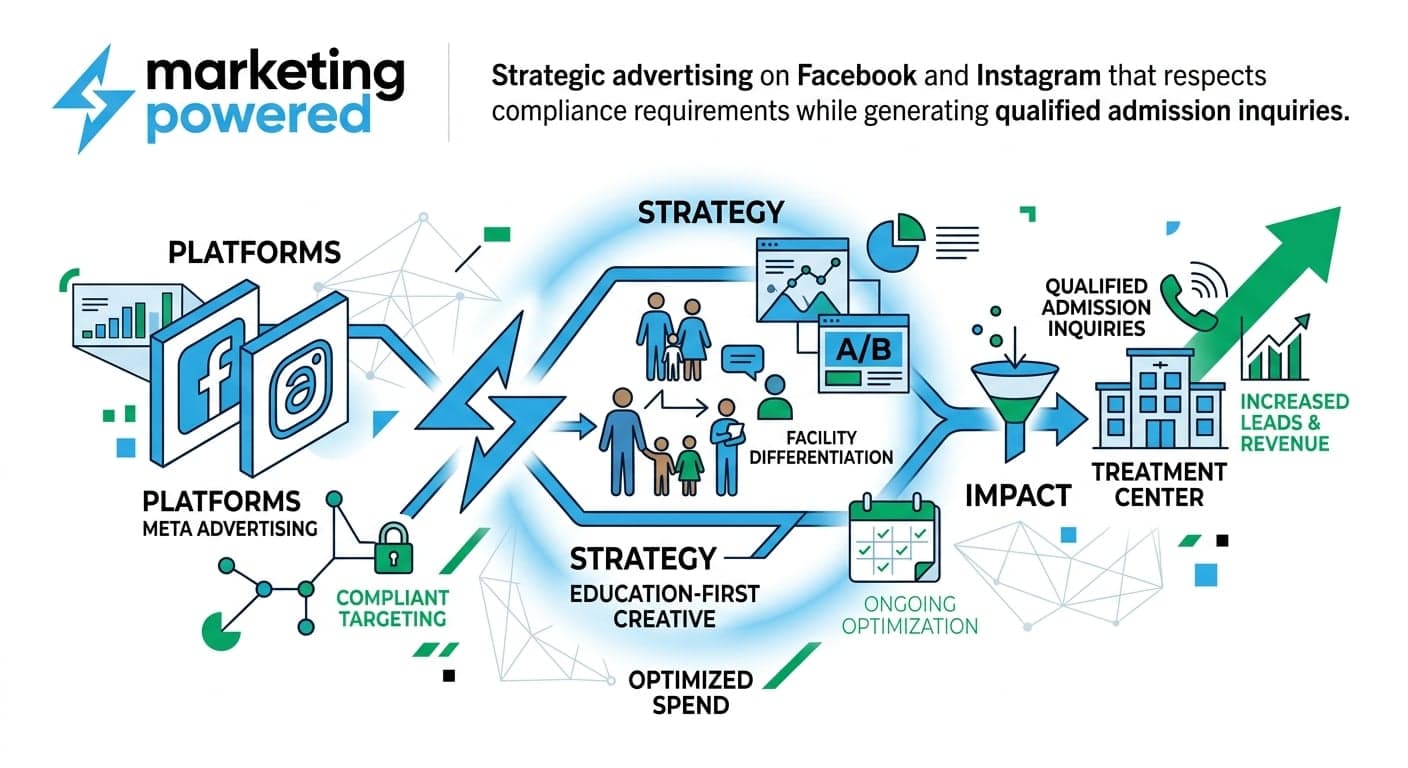
Strategic advertising on Facebook and Instagram that respects compliance requirements while generating qualified admission inquiries.
Understanding Meta Platforms for Treatment Centers
Why Facebook and Instagram matter for behavioral health marketing
Meta ads for treatment centers represent one of the most effective channels for reaching individuals and families actively seeking help for substance use disorders and mental health conditions. Unlike traditional advertising channels, Meta's platforms (Facebook and Instagram) offer granular audience targeting, real-time performance data, and the ability to tell your facility's story through multiple creative formats. For treatment centers operating in a competitive admission environment, these capabilities translate directly into qualified leads.
The behavioral health advertising space on Meta is different from general healthcare marketing. According to Meta's advertising policies, treatment centers must navigate specific restrictions around targeting, messaging, and landing page requirements. Understanding these constraints before launching campaigns prevents wasted spend and account-level policy violations that can sideline your entire advertising program.
Facebook remains the primary platform for treatment center advertising due to its demographic reach. Adults aged 35-65, often the decision-makers when a family member needs treatment, spend significant time on Facebook. Instagram skews younger and works well for adolescent treatment programs, young adult facilities, and brand awareness campaigns that support your broader marketing mix. Both platforms share the same advertising infrastructure through Meta Ads Manager, allowing coordinated campaigns across properties.
The core advantage of Meta advertising for behavioral health marketing comes down to intent signals and audience building. While you cannot retarget website visitors in this vertical (Meta prohibits behavioral health retargeting under its Special Ad Categories policy), you can build lookalike audiences from your existing patient intake data, target by geography and demographics, and use interest-based targeting to reach people researching treatment options.
Treatment centers that succeed with Meta ads treat the platform as a mid-funnel awareness and consideration tool rather than a direct-response machine. The path from ad impression to admission typically includes multiple touchpoints: a Meta ad drives awareness, your website provides information, and your intake team closes the admission. Attribution matters here. Without tracking the full journey, you will misallocate budget and misunderstand which campaigns actually produce admissions.
Key Strategies for Meta Advertising Success
Free Audit
Want a straight read on where your budget is leaking?
Targeting, creative, and campaign structure for behavioral health
Effective Facebook ads for rehabs require a fundamentally different approach than consumer advertising. You are reaching people in crisis or their concerned family members. The creative and targeting strategy must respect that context while still communicating your facility's value proposition clearly.
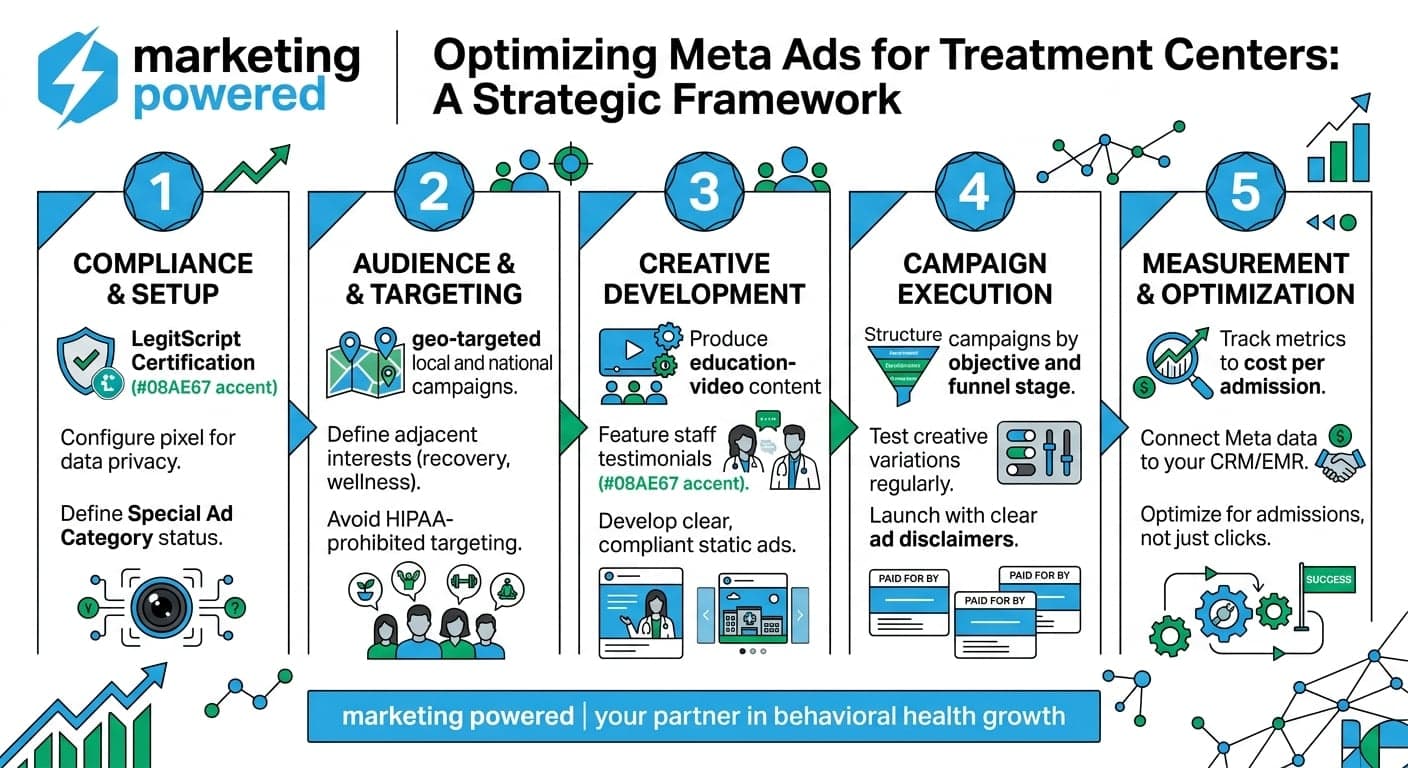
Start with audience definition. Meta's Special Ad Categories restrictions limit targeting options for treatment centers, but you retain access to geographic targeting, age, gender, and broad interest categories. Layer these strategically:
Geographic targeting should focus on your actual admission radius. For most residential treatment centers, this means a combination of local targeting (for PHP/IOP referrals and family members who want proximity) and national targeting (for destination facilities or specialized programs). Run separate campaigns for each geography to control budget allocation and measure performance independently.
Interest-based targeting in the behavioral health space requires careful construction. You cannot target 'addiction' or 'substance abuse' directly. Instead, build audiences around adjacent interests: recovery communities, wellness content, family support resources, and mental health awareness. These audiences are broader but compliant, and they contain a meaningful percentage of people researching treatment options.
Creative strategy for treatment center Meta ads follows a specific hierarchy that we have refined across $50M+ in managed behavioral health media spend:
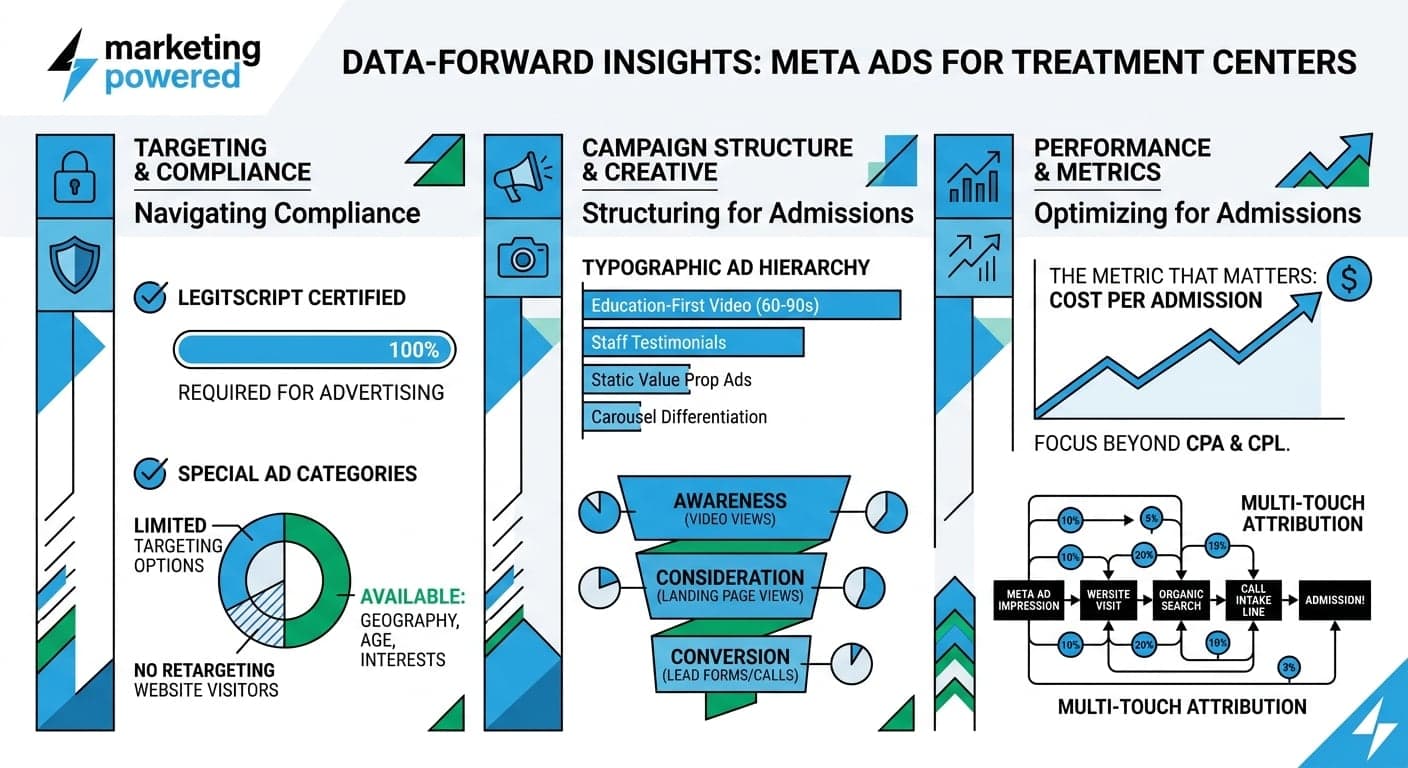
- Education-first video content (60-90 seconds) explaining treatment levels of care, what to expect, or how to help a loved one. These ads build trust and generate engaged audiences for retargeting exclusion workarounds.
- Testimonial-style content featuring staff members (not patients) discussing the facility's approach, clinical philosophy, or admissions process. This humanizes your facility without violating HIPAA or platform policies.
- Static image ads with clear value propositions for high-intent placements. These work well in remarketing-adjacent strategies using engagement-based custom audiences.
- Carousel ads showcasing facility amenities, program components, or the admission journey. Effective for differentiation when competing facilities run similar messaging.
Campaign structure for treatment centers
Your Meta account structure should separate campaigns by objective, geography, and funnel stage. A typical structure includes a top-of-funnel awareness campaign optimized for video views or engagement, a mid-funnel consideration campaign optimized for landing page views, and a conversion campaign optimized for lead form submissions or admission inquiry calls.
Budget allocation across these campaigns depends on your facility's current admission pipeline. Facilities with strong organic traffic and referral networks can allocate spend toward conversion campaigns. Facilities building awareness in new markets need heavier investment in top-of-funnel content that establishes credibility before asking for the admission inquiry.
The digital strategist managing your Meta campaigns should test creative variations continuously. Meta's algorithm rewards fresh content with better delivery and lower costs. Plan for 3-5 new creative concepts per month, with multiple variations of each concept for testing hooks, visuals, and calls to action.
Compliance Considerations for Meta Ads
Strategy
Ready to map a growth plan built for your vertical?
LegitScript certification, HIPAA, and platform policy requirements
Compliance in treatment center advertising is not optional, and the consequences of violations extend beyond disapproved ads. LegitScript certification is required for advertising addiction treatment services on Meta. Without certification, your ads will be disapproved, and your account may face permanent restrictions. The certification process involves facility verification, policy review, and ongoing monitoring. Plan for 4-8 weeks for initial certification.
Meta's Special Ad Categories policy classifies treatment center advertising under the 'Social Issues, Elections, or Politics' umbrella in some cases, and under health-related restrictions in others. The practical impact: limited targeting options, no retargeting of website visitors, and additional creative review before ads go live. Every ad must include the 'Paid for by' disclaimer required for Special Ad Category campaigns.
HIPAA compliance intersects with Meta advertising in several ways. Your pixel implementation must not transmit protected health information (PHI) to Meta's servers. This means excluding the Meta pixel from pages that contain patient information, using server-side conversion tracking with PHI stripped, or implementing consent management platforms that allow patients to opt out of tracking entirely.
The recent wave of healthcare pixel lawsuits has made HIPAA-conscious advertising infrastructure a business requirement, not just a best practice.
According to the HHS Office for Civil Rights, covered entities must evaluate their use of tracking technologies and ensure PHI is not improperly disclosed to third parties like Meta.
Platform policy violations accumulate. A single disapproved ad may seem minor, but repeated violations trigger account-level reviews that can shut down your entire advertising program. Build a compliance review process into your creative workflow:
- Review all ad copy against Meta's prohibited content list before submission.
- Ensure landing pages meet LegitScript's requirements for treatment advertising.
- Audit pixel implementation quarterly to verify no PHI transmission.
- Document your compliance process for LegitScript's ongoing monitoring requirements.
- Train anyone with ad account access on healthcare advertising restrictions.
Optimizing Ad Performance for Treatment Centers
Metrics, attribution, and budget allocation that drive admissions
Metrics and analytics for treatment center Meta ads require a different framework than standard e-commerce or lead generation campaigns. The metric that matters is cost per admission, not cost per click or cost per lead. Everything upstream of an admission is a proxy metric that may or may not correlate with actual business outcomes.
Build your measurement framework from the admission backward. Track admissions in your CRM or EMR system, then connect those admissions to the marketing touchpoints that preceded them. This requires either manual attribution (asking patients how they heard about you and recording it consistently) or technical attribution using call tracking, form tracking, and CRM integration.
The attribution challenge in behavioral health is significant. A patient may see a Meta ad, visit your website, leave, return via organic search, call your intake line, and admit three days later. Without multi-touch attribution, that admission looks like an organic conversion. Your Meta campaigns appear underperforming, and you cut the budget from a channel that actually influenced the admission.
We have tracked attribution through to admission across $1.5M to $2M in monthly managed media spend. The patterns are consistent: Meta ads typically appear early in the attribution path, influencing awareness and consideration, while Google Ads and organic search capture intent closer to the admission decision. Cutting the Meta budget based on last-click attribution misses this contribution.
Proxy metrics to monitor while building toward admission-based measurement:
- Cost per lead (form submission or phone call): Target varies by geography and treatment type, but $150-$400 per lead is typical for residential treatment.
- Lead-to-admission rate: Track what percentage of Meta-sourced leads convert to admissions. Below 5% suggests lead quality issues; a score above 15% suggests your intake process is strong.
- Cost per landing page view: Indicates creative and targeting efficiency before the conversion event.
- Video view completion rate: For awareness campaigns, 25%+ completion on 60-second videos indicates engaged audiences.
- Frequency: Monitor how often the same users see your ads. Above 4-5 frequency in a 7-day window suggests audience exhaustion.
Email Us
Prefer to talk it through over email?
Budget optimization for treatment centers
Budget allocation across Meta campaigns should follow performance data, not assumptions. Start with a testing budget (typically 20-30% of total Meta spend) allocated to new creative concepts, audience tests, and campaign structure experiments. Reserve the remaining budget for proven performers.
Dayparting can improve efficiency for treatment centers. Admission inquiries often spike during evening hours and weekends when family members have time to research options. Adjust ad scheduling to weight delivery toward high-conversion windows, but avoid excluding daytime hours entirely as awareness exposure during work hours still contributes to later conversions.
If you want to optimize your Meta ad spend effectively, review performance weekly and make incremental adjustments rather than dramatic budget shifts. Meta's algorithm needs time to optimize delivery; constant changes reset the learning phase and waste budget on re-optimization.
Case Studies: Meta Ad Success Stories
Data-driven results from treatment center campaigns
Successful meta ads for behavioral health campaigns share common characteristics: compliant creative, strategic audience building, and measurement infrastructure that connects ad spend to admissions. The following examples illustrate these principles in practice.
A multi-location residential treatment network (scaled through multi-market growth over several years) used Meta ads as the primary awareness channel while Google Ads captured high-intent search traffic. The Meta strategy focused on video content featuring clinical staff explaining treatment approaches, facility tours, and family education content. These videos built engaged custom audiences that were then targeted with conversion-focused campaigns. The result: Meta contributed 18% of total admissions at a cost per admission 23% lower than the Google Ads channel, despite Meta's upper-funnel positioning.
An adolescent mental health treatment center used Instagram-heavy creative to reach parents of teenagers struggling with mental health challenges. The campaign avoided direct 'your teen needs treatment' messaging (which performs poorly and risks policy violations) in favor of educational content about recognizing warning signs and understanding treatment options. Landing pages offered downloadable guides in exchange for contact information, feeding the intake team a consistent flow of early-stage leads. Over 14 months, the Meta program generated 340+ qualified inquiries with a 12% conversion to admission.
A PHP/IOP program in a competitive metro market used geographic targeting combined with interest-based audiences to reach working adults seeking outpatient treatment. The creative emphasized flexibility, insurance acceptance, and clinical outcomes (framed as program completion rates, not patient recovery claims). Weekly budget optimization based on day-of-week performance data improved cost per lead by 31% over six months.
These campaigns succeeded because they respected the compliance environment, invested in measurement infrastructure, and optimized toward admission outcomes rather than vanity metrics. The tactical details matter, but the strategic foundation determines whether Meta advertising produces admissions or just ad spend.
Free Audit
Want a straight read on where your budget is leaking?
Overcoming Common Challenges in Meta Advertising
Practical solutions for treatment center marketing teams
Treatment centers face specific challenges with Meta advertising that general marketing guidance does not address. Understanding these obstacles and their solutions prevents wasted budget and account-level problems.
Challenge: Ad disapprovals and account restrictions: Meta's automated review system flags treatment-related content aggressively. Even compliant ads may be disapproved initially. Solution: Build a disapproval response process. Appeal promptly with clear documentation of LegitScript certification and policy compliance. Maintain relationships with Meta support (available to advertisers at certain spend thresholds) for escalation. Keep backup ad accounts in good standing to maintain continuity if primary accounts face review.
Challenge: Limited targeting options under Special Ad Categories: The targeting restrictions that apply to treatment advertising eliminate many of the precise audience tools available in other verticals. Solution: Compensate with creative quality and first-party data. Build engagement-based custom audiences from video viewers, page engagers, and website visitors (for non-retargeting campaign objectives). Use these audiences for lookalike modeling to find new prospects with similar characteristics.
Challenge: Attribution complexity: The multi-touch, multi-day path from Meta ad impression to treatment admission makes ROI measurement difficult. Solution: Implement call tracking on all phone numbers displayed to Meta traffic. Use hidden form fields to capture UTM parameters and pass them to your CRM. Build weekly reporting that shows Meta's contribution to the full admission funnel, not just last-click conversions. Consider working with an attribution platform that handles cross-channel, multi-touch modeling.
Challenge: Creative fatigue: Meta's algorithm penalizes stale creatives with higher costs and reduced delivery. Treatment centers often struggle to produce fresh content at the pace the platform rewards. Solution: Build a creative production calendar that delivers 3-5 new concepts monthly. Repurpose existing content (facility photos, staff interviews, educational materials) into ad formats. Test variations of proven concepts rather than starting from scratch each month.
Challenge: Lead quality issues: Meta's broad reach can generate high volumes of unqualified leads that burden intake teams without producing admissions. Solution: Tighten audience targeting even within Special Ad Categories constraints. Add qualifying questions to lead forms (insurance type, treatment timeline, geographic flexibility). Score leads before passing to intake and prioritize high-probability contacts. Review lead-to-admission rates weekly and adjust targeting when quality drops.
Challenge: Scaling beyond initial success: Campaigns that perform well at $5,000/month may break down at $25,000/month as audience saturation increases. Solution: Expand geographic targeting incrementally. Build parallel campaign structures for different treatment programs or facility locations. Increase creative variation to prevent frequency-driven fatigue. Monitor cost per admission (not just cost per lead) as scale increases to catch efficiency declines early.
These challenges are manageable with the right infrastructure and expertise. The treatment centers that succeed with Meta advertising invest in compliance, measurement, and creative production as ongoing operational requirements, not one-time setup tasks.
Moving forward with Meta advertising
Meta ads for treatment centers work when they are built on compliant infrastructure, strategic audience development, and measurement systems that connect ad spend to admissions. The platform's restrictions in the behavioral health vertical are real constraints, but they do not prevent effective advertising. They require a more sophisticated approach than the standard playbooks written for unrestricted verticals.
The treatment centers generating consistent admission volume from Meta have three things in common: LegitScript certification and ongoing compliance monitoring, creative strategies that educate rather than pressure, and attribution infrastructure that tracks the full path from impression to admission. Without these foundations, Meta advertising becomes expensive brand awareness at best and a compliance liability at worst.
If your current Meta campaigns are not producing qualified admission inquiries at an acceptable cost, the problem is usually structural. Targeting, creative, measurement, or compliance infrastructure needs attention. An external review often identifies issues that internal teams miss after months of incremental optimization.
Request a personalized audit to evaluate your current Meta advertising performance, identify compliance gaps, and build a strategy that connects ad spend to actual admissions. The conversation covers your current performance data, competitive positioning, and the specific challenges facing your facility's marketing program.
Strategy
Ready to map a growth plan built for your vertical?
Ready to improve your Meta advertising performance?
Request an audit to evaluate your current Meta campaigns, identify compliance gaps, and build a strategy that connects ad spend to qualified admissions. The conversation covers your performance data, competitive positioning, and the specific challenges facing your facility's marketing program.
Questions, answered.
Meta Ads are paid advertising placements across Facebook, Instagram, Messenger, and the Meta Audience Network, managed through a unified platform called Meta Ads Manager. For treatment centers, these ads provide access to demographic and interest-based targeting that reaches individuals researching treatment options and their family members. The primary benefits include geographic precision (targeting your actual admission radius), creative flexibility (video, image, carousel, and lead form formats), and the ability to build custom audiences from engaged users for ongoing campaigns.
Compliance requires LegitScript certification before running any addiction treatment advertising on Meta. Beyond certification, compliant advertising involves implementing HIPAA-conscious pixel configurations that do not transmit protected health information, following Meta's Special Ad Categories requirements, including limited targeting and required disclaimers, and building internal review processes that catch policy violations before ads go live. Ongoing compliance monitoring is required as both LegitScript and Meta update their policies regularly.
Effective strategies focus on education-first creative that builds trust rather than pressure-based messaging that triggers policy reviews. Video content featuring staff members, facility tours, and treatment education performs well. Audience strategy should layer geographic targeting with broad interest categories related to recovery, wellness, and family support. Campaign structure should separate awareness, consideration, and conversion objectives with appropriate budget allocation to each stage.
The primary metric is cost per admission, which requires attribution infrastructure connecting ad exposure to intake outcomes. Proxy metrics include cost per lead (typically $150-$400 for residential treatment), lead-to-admission conversion rate (target 8-15%), cost per landing page view, video completion rates for awareness campaigns, and ad frequency to monitor audience saturation. Weekly reporting should show Meta's contribution across the full admission funnel, not just last-click conversions.
Successful campaigns share common elements: compliant creative, strategic audience building, and admission-focused measurement. One multi-location network generated 18% of total admissions from Meta at 23% lower cost per admission than paid search by using staff video content and engagement-based audience building. An adolescent program generated 340+ qualified inquiries with 12% admission conversion using educational content on Instagram. Results depend on compliance infrastructure, creative production capacity, and attribution systems that measure actual outcomes.
Ready to see what AI-native marketing can do for your treatment center?
Request a free audit of your paid media, landing pages, attribution, and compliance posture. You'll get a straight assessment of where the opportunities are.
or email us at info@marketingpowered.ai