Guide
How to Master Meta Ads for Your Mental Health Practice
A compliance-first framework for running profitable Facebook and Instagram campaigns in a regulated healthcare vertical.
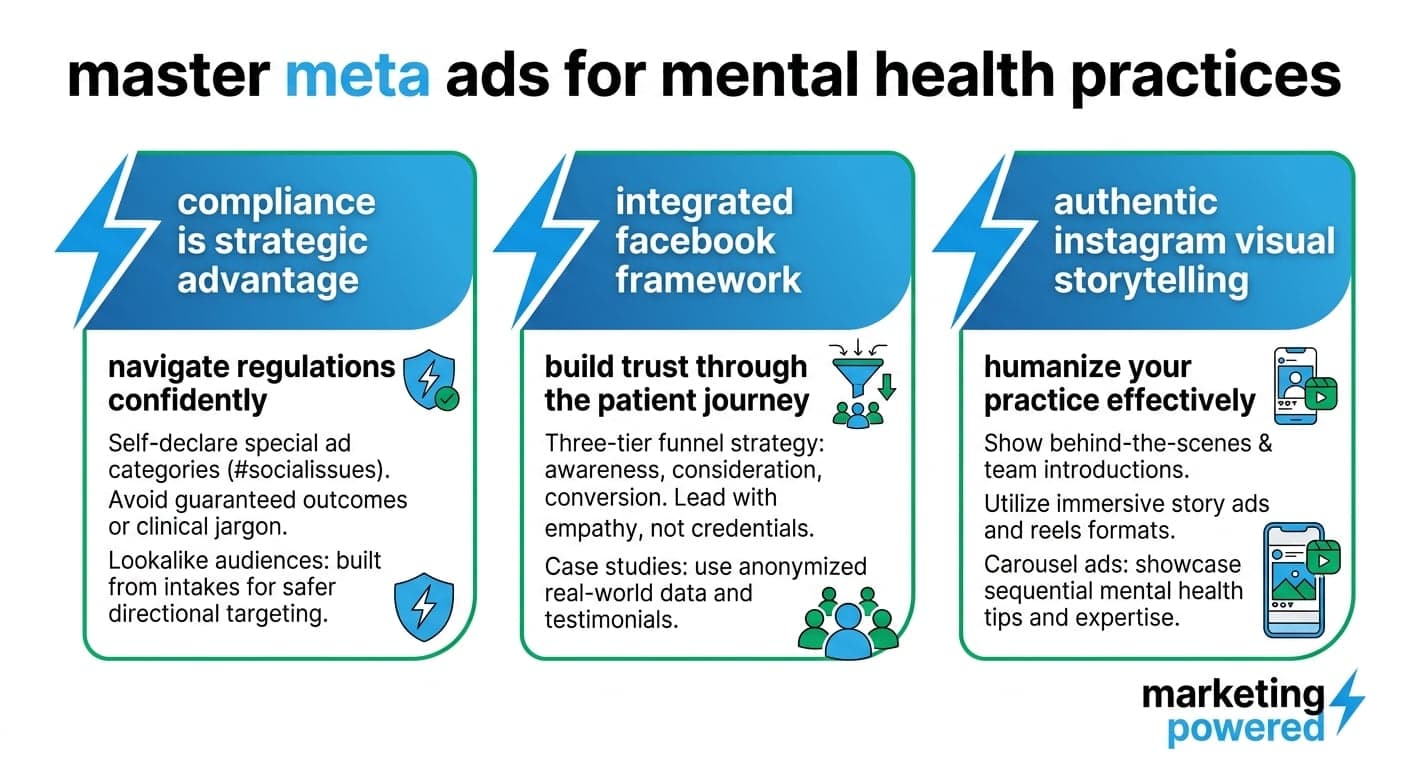
Understanding Meta Ads for Mental Health Practices
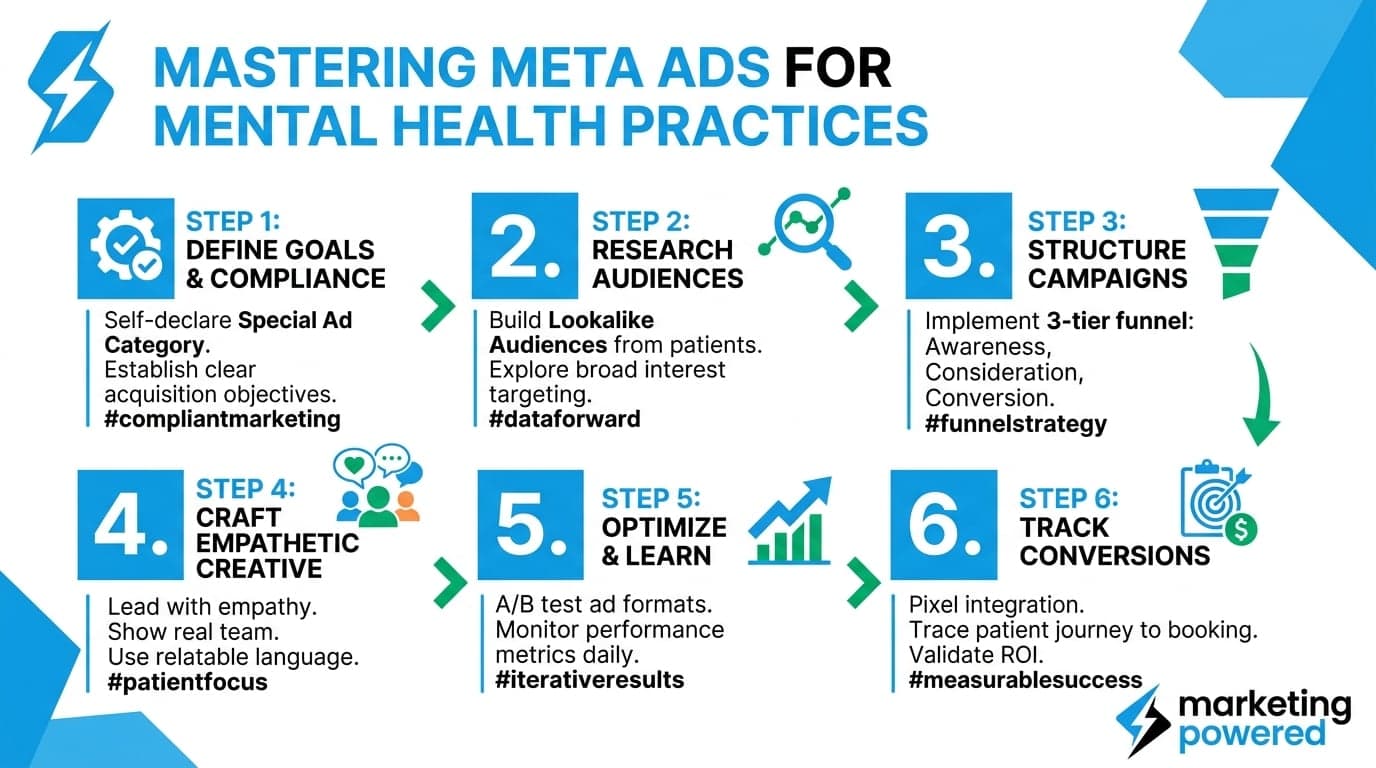
Why Meta's ecosystem offers unique advantages for patient acquisition
Mental health practices face a distinct challenge when advertising online. The audience is often in a vulnerable state, searching for help during difficult moments. Meta's ecosystem, which includes both Facebook and Instagram, provides access to over 3 billion monthly active users, making it one of the largest patient acquisition channels available to mental health providers.
Meta ads for mental health practices work differently from standard healthcare advertising. The platform's interest-based and behavioral targeting allows practices to reach users who have demonstrated engagement with mental health content, wellness topics, and related communities. This creates opportunities to connect with potential patients before they begin an active search on Google.
The visual nature of Meta's platforms also supports the kind of authentic, approachable messaging that resonates with mental health audiences. Short-form video, carousel ads showcasing different service offerings, and story placements can communicate empathy and expertise in ways that text-heavy search ads cannot.
However, this opportunity comes with significant regulatory complexity. Mental health advertising falls under Meta's Special Ad Categories, which restrict certain targeting options and require specific compliance measures. Practices that ignore these requirements risk disapproval, account restrictions, and wasted spend.
The practices that succeed on Meta share a common trait: they treat compliance as a strategic advantage rather than a limitation. By understanding the rules and building campaigns within them, they create sustainable acquisition channels that competitors struggle to replicate.
Compliance with Meta's Special Ad Categories
Free Audit
Want a straight read on where your budget is leaking?
What the regulations require and how to build campaigns within them
Meta's Special Ad Categories policy applies to ads related to credit, employment, housing, social issues, elections, or politics. Mental health services often fall under the social issues category, and certain therapeutic services may trigger additional restrictions depending on the claims made in ad copy.
When your ads are classified under Special Ad Categories, Meta removes access to detailed targeting options, including age, gender, ZIP code precision, and many interest-based audiences. The platform does this to prevent discrimination, but it creates real challenges for practices trying to reach specific demographics or geographic service areas.
Non-compliance carries serious consequences. Ads that violate Special Ad Categories requirements face immediate rejection. Repeated violations can result in ad account restrictions, business manager penalties, or permanent bans. For practices that depend on Meta for patient acquisition, an account shutdown can mean weeks or months of lost revenue while appeals are processed.
The path forward requires building compliant campaigns from the ground up. Start by self-declaring your ads under the appropriate Special Ad Category during campaign creation. This may feel counterintuitive since it limits your targeting options, but it protects your account and ensures your ads actually run.
Within Special Ad Categories, focus on broader geographic targeting at a minimum 15-mile radius and use Lookalike Audiences built from your existing patient base or website visitors. These audiences are automatically adjusted by Meta to comply with restrictions while still providing directional targeting.
Creative compliance matters equally. Avoid language that implies diagnosis, guaranteed outcomes, or specific treatment efficacy. The FTC's Health Products Compliance Guidance provides a useful framework: if you cannot substantiate a claim with reliable scientific evidence, do not make it in your ads.
Practices that work with agencies experienced in mental health marketing gain an advantage here. The compliance knowledge becomes institutional rather than learned through expensive trial and error.
Best Practices for Facebook Ads in Mental Health
Targeting, creative, and campaign structure for therapists and practices
Facebook ads for therapists require a different playbook than standard direct-response advertising. The goal is not immediate conversion but building enough trust and familiarity that a potential patient feels comfortable taking the next step.
Start with campaign structure. For most mental health practices, a three-tier funnel works well: awareness campaigns using video content, consideration campaigns with educational carousel ads or blog content promotion, and conversion campaigns targeting users who have already engaged with your practice. This structure respects the patient journey while maximizing the value of your spend.
Targeting within Special Ad Categories constraints requires creativity. Build Lookalike Audiences from your highest-value patients, which are those who completed intake, not just those who clicked. Use broad interest targeting around wellness, self-improvement, and personal development rather than clinical terms that may trigger additional restrictions.
Creative that converts shares common elements across successful campaigns. Lead with empathy, not credentials. Show real team members rather than stock photos. Use first-person language that acknowledges the difficulty of seeking help. Avoid clinical jargon that creates distance between your practice and potential patients.
Ad copy should address the patient's current state, not just the solution you provide. Phrases like 'Feeling overwhelmed?' or 'Struggling to manage daily stress?' create recognition. Follow with a clear value proposition: what type of care you provide, who you serve, and what taking the next step looks like.
Landing page alignment determines whether your Facebook ads investment pays off. Every ad should link to a dedicated landing page that matches the ad's message, not your homepage. Include a clear call to action above the fold, social proof from patient reviews anonymized appropriately, and a simple form or scheduling widget.
The practices that see the strongest results from paid media campaigns treat Facebook as part of an integrated strategy, not an isolated channel. Attribution across touchpoints matters; patients often see a Facebook ad, search your practice name on Google, and then book through your website. Without proper tracking, Facebook gets zero credit for the conversion.
- Awareness tier: Use 15 to 60-second videos introducing your practice philosophy, team members, or approach to common conditions. Optimize for ThruPlay (15-second views) rather than impressions.
- Consideration tier: Promote educational content that addresses common patient concerns. Carousel ads linking to blog posts about anxiety management, depression symptoms, or therapy expectations perform well.
- Conversion tier: Retarget website visitors and video viewers with direct appointment booking ads. Keep creative fully compliant with Special Ad Categories at every stage.
Strategy
Ready to map a growth plan built for your vertical?
Leveraging Instagram for Mental Health Advertising
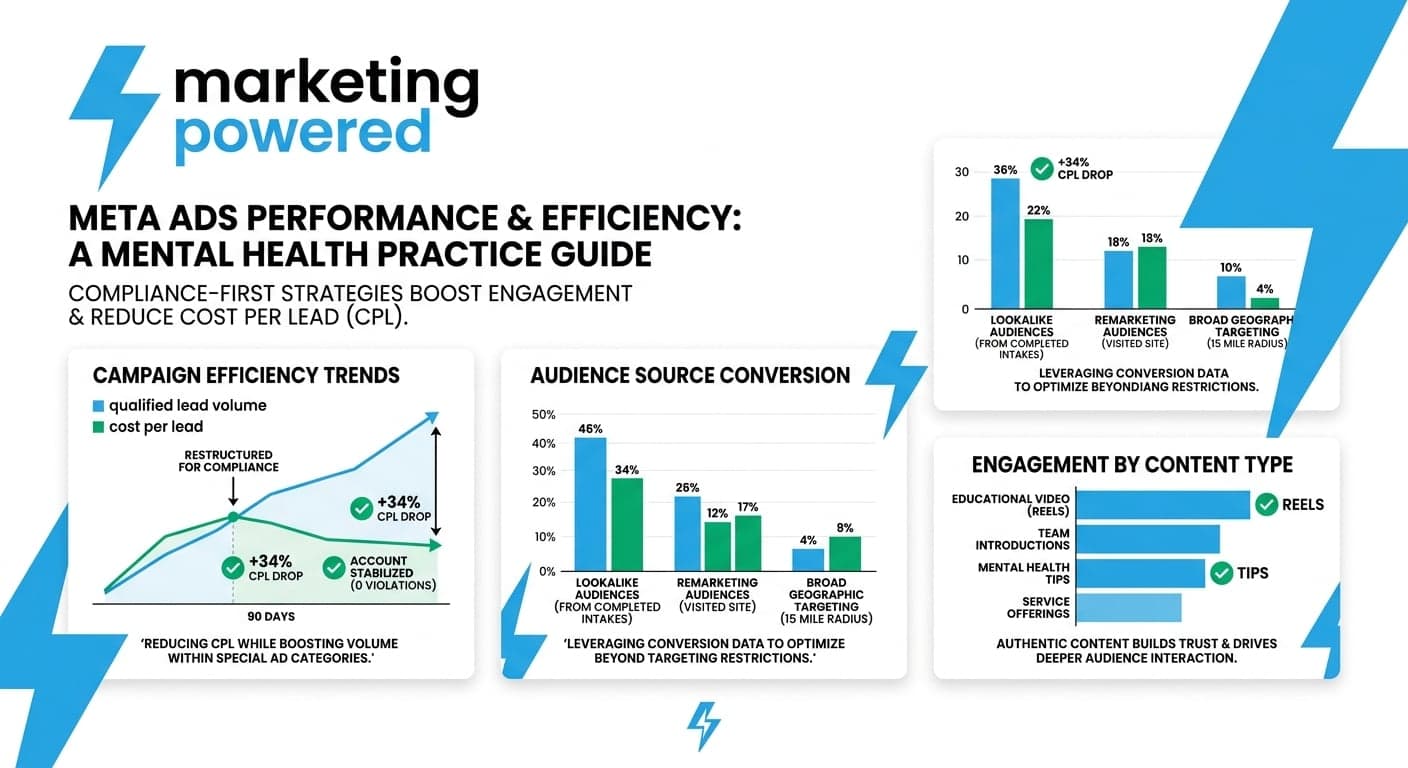
Visual storytelling that builds trust and drives engagement
Instagram ads for mental health require a visual-first approach that differs from Facebook's more text-tolerant environment. The platform's audience skews younger and expects content that feels native to their feed, not obviously promotional.
The most effective Instagram strategies for mental health practices center on authenticity. Behind-the-scenes content showing your office environment, team introductions, and day-in-the-life posts humanize your practice. This content works organically and can be amplified through paid promotion to reach users outside your existing following.
Story ads and Reels placements offer the highest engagement rates for mental health content. These full-screen, immersive formats capture attention in ways that feed ads cannot. Short educational videos under 30 seconds explaining common mental health concepts, coping techniques, or what to expect from therapy perform particularly well.
Carousel ads on Instagram allow practices to tell a sequential story. Use them to walk potential patients through your intake process, introduce multiple therapists, or present a series of mental health tips that establish expertise. Each card should be visually cohesive while offering standalone value.
Audience interaction separates successful Instagram accounts from those that struggle. Respond to comments on your ads within hours, not days. Use story polls and questions to gather insights about what content your audience wants. This engagement signals to the algorithm that your content is valuable, improving organic reach alongside your paid efforts.
The integration between Instagram and your broader paid media strategy should be intentional. Use Instagram for top-of-funnel awareness and community building, then retarget engaged users with conversion-focused Facebook ads. The platforms share an ad manager and pixel infrastructure, making cross-platform campaigns straightforward to execute.
Case Studies and Success Stories
Email Us
Prefer to talk it through over email?
Real results from mental health practices using Meta ads effectively
The difference between theory and practice shows up in results. Mental health practices that implement compliant, strategically structured Meta campaigns see measurable improvements in patient acquisition cost and volume.
One multi-location therapy practice came to us, spending $8,000 monthly on Meta ads with inconsistent results. Ad accounts had been flagged multiple times for policy violations, and the team was manually managing campaigns without clear attribution. Within 90 days of restructuring their campaigns around Special Ad Categories compliance, implementing proper conversion tracking, and building Lookalike Audiences from completed intakes, their cost per qualified lead dropped 34%. More importantly, their ad accounts stabilized with zero policy violations.
A solo practitioner launching a new telehealth practice faced the cold-start problem: no existing patient base to build Lookalike Audiences from and a limited budget for broad awareness campaigns. The solution was a content-first approach using Instagram Reels. Educational content about managing work anxiety generated organic engagement, which was then amplified with modest paid spend. Within six months, the practice had built an email list of 2,400 subscribers and achieved a waitlist for new patient appointments.
Scale creates different challenges. A regional mental health provider operating across 12 locations needed to maintain brand consistency while allowing location-specific targeting. The campaign structure used shared creative assets with location-specific landing pages and call tracking. Attribution tracking through to completed intake appointments revealed that Meta was driving 23% of new patient volume — a contribution that had been invisible under their previous tracking setup.
These outcomes reflect patterns we have seen across $50M+ in managed ad spend. The practices that succeed share common traits: they prioritize compliance, they track attribution through to actual patient acquisition rather than just form fills, and they treat Meta as one component of an integrated marketing strategy.
How Marketing Powered Can Elevate Your Meta Ads Strategy
Operator experience and AI-native infrastructure for compliant, measurable growth
Marketing Powered brings a different perspective to mental health advertising. Our team has operated in regulated healthcare verticals since our founding, managing campaigns for practices ranging from solo therapists to multi-state behavioral health systems for multi-location behavioral health organizations.
This operator experience translates to practical advantages. We understand compliance requirements not as abstract policies but as operational constraints we navigate daily. Our campaigns are built for LegitScript certification standards and HIPAA-aware practices from the start, not retrofitted after problems arise.
Our AI-native approach adds capabilities that traditional agencies cannot match. We use proprietary AI systems running on controlled infrastructure to analyze campaign performance, generate creative variations, and identify optimization opportunities at a pace manual processes cannot sustain. This is purpose-built technology developed since 2022 for healthcare marketing applications.
Attribution discipline separates our work from standard agency deliverables. We track Meta campaigns through to actual patient acquisition, not just clicks or form fills. This requires integration with your intake systems and CRM, which is work that most agencies avoid because it is technically complex and exposes their actual performance. We pursue it because it is the only way to understand true return on ad spend.
The combination of compliance expertise, operator experience, and AI-native technology creates a foundation for sustainable patient acquisition. We have managed $1.5M to $2M monthly in paid media across our client base, with court-certified expert witness credentials in advertising strategy backing our recommendations.
If your practice is running Meta ads without clear attribution, struggling with compliance issues, or simply not seeing the patient volume you expect from your spend, a strategic audit can identify the gaps. We will review your current campaign structure, compliance posture, tracking setup, and creative approach, then provide specific recommendations you can implement whether you work with us or not.
Find Out What Your Meta Ads Should Actually Deliver
A strategic audit reveals the gaps between your current Meta performance and what compliant, properly attributed campaigns can achieve. We will review your campaign structure, compliance posture, tracking setup, and creative approach, then provide specific recommendations you can implement immediately.
Questions, answered.
Meta's Special Ad Categories are policy classifications that restrict targeting options for ads related to credit, employment, housing, and social issues. Mental health services often fall under the social issues category, which limits demographic targeting, requires minimum geographic radius settings of 15 miles, and removes access to many interest-based audiences. Practices must self-declare their ads under the appropriate category during campaign creation to maintain compliance and avoid account penalties.
Facebook ads allow mental health practices to reach potential patients through interest-based targeting before they begin active search queries. The platform supports multiple ad formats, including video, carousel, and lead generation ads that can communicate empathy and expertise. With over 3 billion monthly active users on Meta platforms, Facebook provides scale that most other channels cannot match, and the visual formats allow practices to build trust through authentic content showing real team members and office environments.
Successful Instagram strategies for mental health prioritize authenticity and native-feeling content. Short-form educational videos in Reels format perform particularly well, as do Story ads and carousel posts that tell a sequential story. Consistent engagement with comments and story interactions signals quality to the algorithm. The most effective approaches use Instagram for top-of-funnel awareness and community building, then retarget engaged users with conversion-focused ads.
Marketing Powered builds compliance into campaign architecture from the start rather than retrofitting after problems occur. Our team has operated in regulated healthcare verticals since our founding, with campaigns structured for LegitScript certification standards and HIPAA-aware practices. We self-declare Special Ad Categories appropriately, avoid prohibited claims in ad copy, and maintain creative guidelines that align with FTC Health Products Compliance Guidance. This compliance-first approach has allowed us to manage $50M+ in ad spend without the account shutdowns that plague less experienced advertisers.
Marketing Powered combines operator experience in regulated healthcare verticals with AI-native technology built specifically for healthcare marketing. Our track record includes operator-side multi-market growth and managing $1.5M to $2M monthly in paid media across client accounts. We track attribution through to actual patient acquisition rather than just form fills, and our founder holds court-certified expert witness credentials in advertising strategy. This depth of experience means fewer compliance mistakes, faster optimization cycles, and measurable patient acquisition outcomes.
Ready to see what AI-native marketing can do for your treatment center?
Request a free audit of your paid media, landing pages, attribution, and compliance posture. You'll get a straight assessment of where the opportunities are.
or email us at info@marketingpowered.ai