Guide
Mental Health Paid Media: A Complete Guide for CMOs and Marketing Directors
A field-tested playbook for marketing leaders navigating paid advertising in the mental health space, built on more than $50M in managed behavioral and mental health media spend.
Why Mental Health Paid Media Requires Its Own Playbook
Standard PPC advice fails in sensitive healthcare verticals
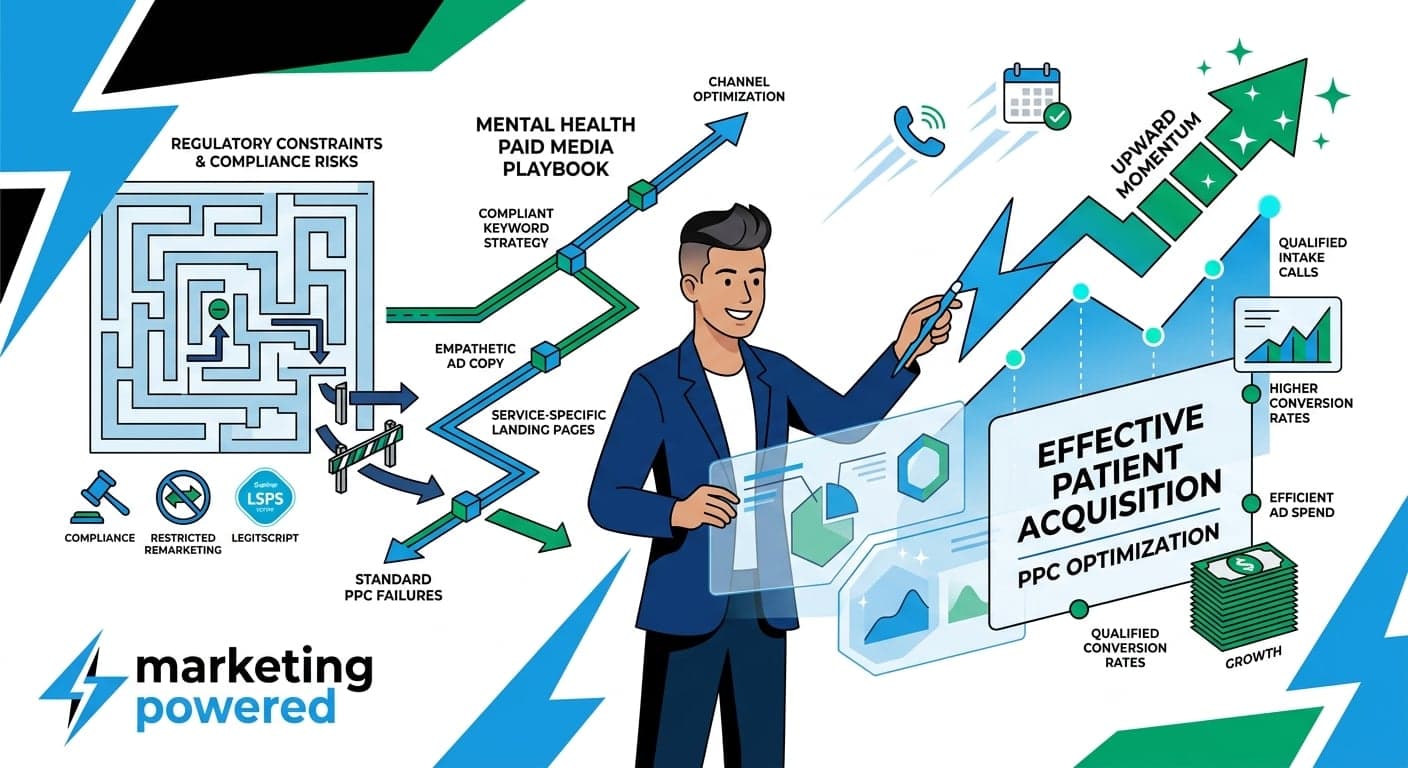
Mental health paid media operates under constraints that most marketing guides never address. Google classifies mental health services as a sensitive healthcare vertical, which means standard remarketing tactics are prohibited outright. Meta imposes similar restrictions. If you have managed campaigns in other industries, the rules here will feel foreign, and the penalties for non-compliance can result in ad disapprovals, suspended accounts, or permanent platform bans.
The regulatory environment shapes every decision. Google Ads requires LegitScript certification for addiction treatment advertising, and while general mental health services face fewer certification barriers than substance abuse treatment, the platform still scrutinizes ad copy, landing page content, and targeting approaches. According to Google's healthcare and medicines policy, advertisers cannot make guarantees about treatment outcomes or use language that could be interpreted as providing medical advice.
Your target audience adds another layer of complexity. People searching for mental health services are often in vulnerable states. They may be searching on behalf of a family member. They may be in crisis. Copy that converts effectively in SaaS or e-commerce will read as tone-deaf or exploitative in this context. Messaging must be empathetic, clear, and free of pressure tactics.
Competition has intensified significantly. According to SAMHSA's 2023 National Survey on Drug Use and Health, over 57 million adults in the United States experienced mental illness in 2022. That demand has drawn telehealth platforms, private equity-backed practice groups, and national networks into the same auctions where independent and regional practices compete. CPCs for high-intent keywords like 'psychiatrist near me' or 'anxiety treatment' have climbed accordingly.
Understanding these constraints is the foundation. Every tactic in this guide was built specifically for mental health paid advertising, not adapted from general PPC advice. Each recommendation accounts for compliance requirements, audience sensitivity, and the competitive dynamics that define this vertical.
Paid Media Channels That Work for Mental Health
Free Audit
Want a straight read on where your budget is leaking?
Matching channels to patient acquisition goals
Not every paid media channel performs equally in mental health. Some channels are restricted entirely. Others work well for awareness but struggle to generate qualified intake calls. The right mix depends on your service type, geography, payer mix, and intake capacity.
Google Ads: Search and Display
Google Search remains the highest-intent channel for mental health patient acquisition. When someone searches 'therapist accepting new patients' or 'child psychiatrist near me,' they are actively seeking care. Conversion rates for these searches typically outperform other paid channels by a significant margin.
Search campaigns require careful keyword architecture. Broad match keywords in mental health attract irrelevant traffic quickly. Someone searching for "mental health awareness month' is not looking for treatment. Build tight ad groups around service-specific keywords: anxiety treatment, depression therapy, ADHD evaluation, couples counseling. Use exact match and phrase match to control where your spending goes.
Display campaigns serve a different purpose. Since remarketing is prohibited in sensitive healthcare verticals per Google's personalized advertising policies, display in mental health functions primarily serves as awareness and brand reinforcement. Contextual targeting on mental health content sites can work, but expect lower conversion rates than search.
Performance Max campaigns have become more common, but proceed carefully. The algorithm's reduced transparency makes it difficult to control where ads appear, and sensitive healthcare verticals require more control, not less. Monitor placement reports and exclude irrelevant content categories proactively.
Meta (Facebook and Instagram)
Meta platforms offer a broad reach but face significant targeting restrictions for health-related advertisers. According to Meta's advertising standards, ads cannot target users based on perceived health conditions. You cannot build audiences of people who engage with depression support content and then serve them treatment ads.
What does work: geographic targeting combined with interest-based audiences around adjacent topics. A therapy practice might target adults within 25 miles who show interest in self-improvement, mindfulness, or wellness content. The targeting is less precise than you may be used to, but the creative flexibility of Meta's formats compensates.
Video performs particularly well for mental health on Meta. Short content from clinicians explaining the intake process or what to expect in a first session can reduce the anxiety that prevents people from reaching out. Carousel ads work for practices with multiple service lines or several locations.
Strategy
Ready to map a growth plan built for your vertical?
Microsoft Advertising
Bing captures a smaller share of search volume but often at lower CPCs than Google. The audience skews slightly older, which aligns well with certain mental health services and can yield stronger cost efficiency for the right practice. If you are running Google Search profitably, Microsoft Advertising is usually worth testing as a secondary channel.
Microsoft's healthcare policies largely mirror Google's restrictions, so the compliance framework you build for Google translates directly.
LinkedIn Ads
LinkedIn rarely makes sense for direct patient acquisition. The platform excels at B2B targeting, which limits its utility for most mental health practices. One clear exception: outreach to HR directors and benefits managers at organizations seeking mental health benefits for employees. If your practice offers corporate wellness or Employee Assistance Program (EAP) services, LinkedIn belongs in your channel mix.
Programmatic and Connected TV
For larger mental health organizations with brand-building budgets, programmatic display and connected TV (CTV) can build awareness at scale. These channels are upper-funnel and require meaningful investment before producing measurable patient acquisition results. Most practices with fewer than 10 locations should prioritize search and social before exploring programmatic.
When you do move into programmatic, work with a partner that understands healthcare advertising restrictions and can apply appropriate audience exclusions and content targeting guardrails.
Email Us
Prefer to talk it through over email?
Mental Health PPC Best Practices
Operational discipline that separates profitable campaigns from wasted spend
Managing mental health PPC requires more than setting up campaigns and monitoring cost per click. The compliance overlay, sensitive audience, and competitive pressure demand operational rigor at every level. The practices below come from managing $1.5M to $2M monthly in Google Ads across behavioral and mental health accounts.
Keyword Strategy
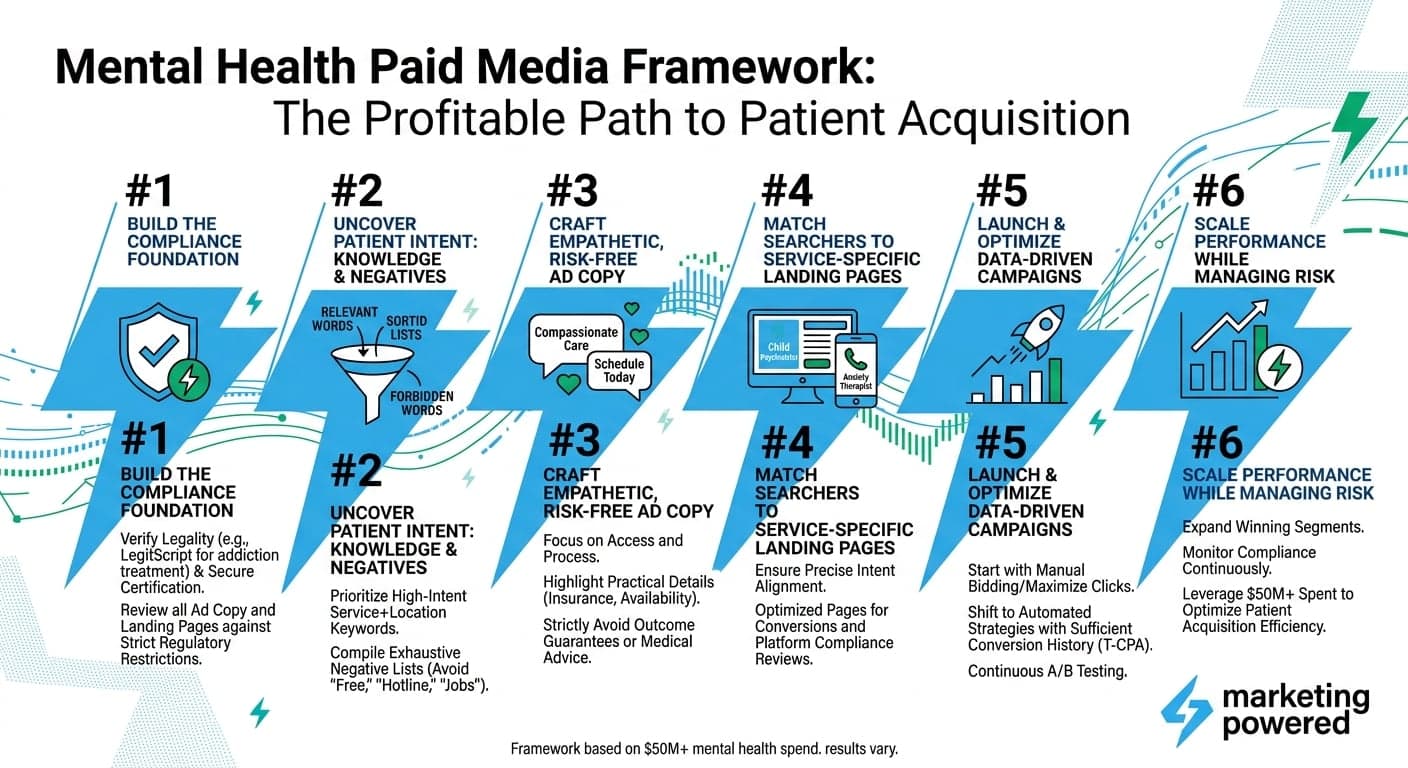
Start with service-specific, location-modified keywords. 'Anxiety therapist Austin' converts better than 'anxiety help' because the searcher has signaled both intent and geography. Build your campaign structure around these high-intent combinations and expand outward only after establishing performance baselines.
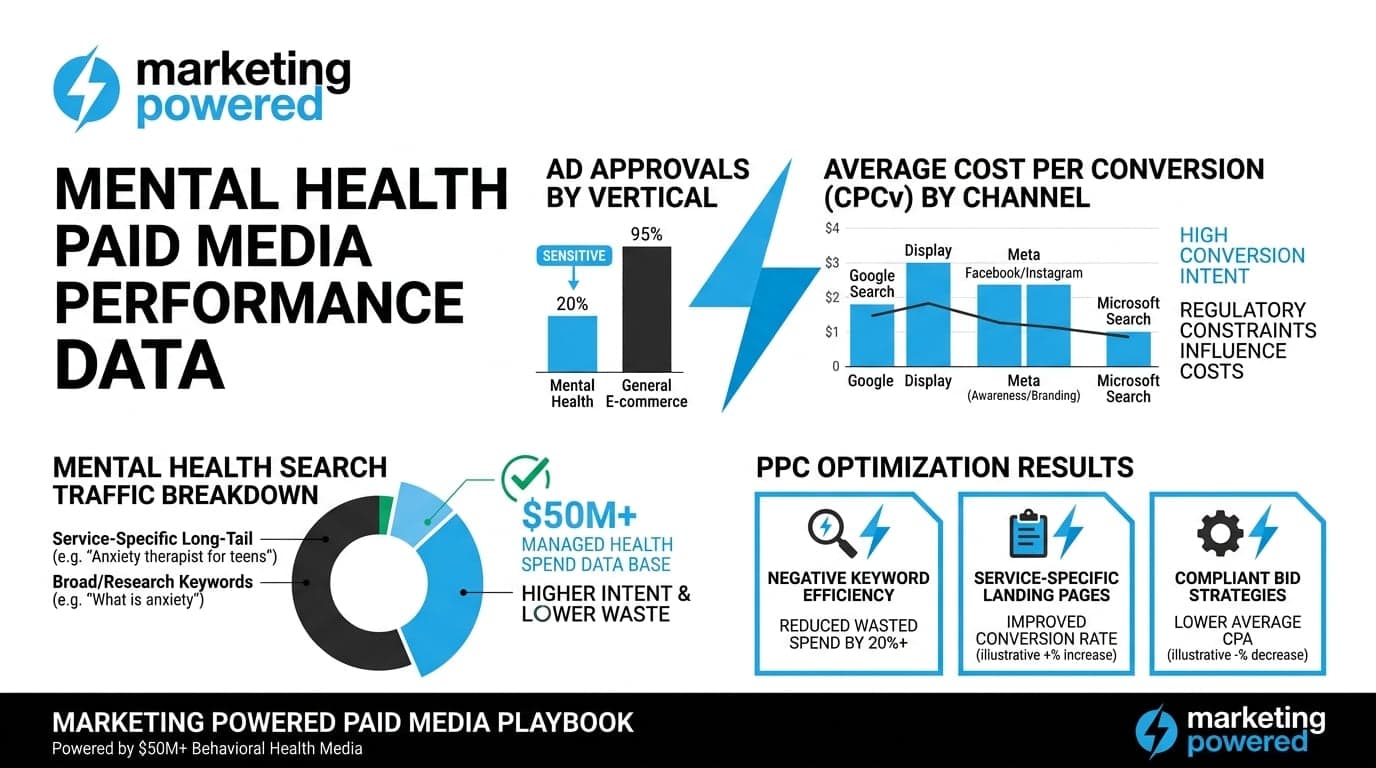
Negative keyword lists are non-negotiable in mental health. Add terms like 'free,' 'hotline,' 'crisis line,' 'degree,' 'certification,' 'salary,' and 'jobs' before your campaigns go live. Someone searching 'mental health counselor jobs' is looking for employment, not treatment. Without aggressive negative keyword management, 20% or more of your budget can go to clicks that will never convert.
Long-tail keywords often outperform head terms in efficiency. 'Therapist for teenage anxiety near me' signals higher intent than 'therapy.' Volume is lower, but conversion rates and lead quality are typically stronger. Build a tiered keyword architecture that captures both high-volume head terms and specific long-tail variations.
Free Audit
Want a straight read on where your budget is leaking?
Ad Copy That Converts Without Compliance Risk
Mental health ad copy walks a fine line. You need to communicate that your practice can help without making outcome claims. Avoid phrases like 'overcome your depression' or 'cure your anxiety.' Focus on the process and the access: 'Connect with a licensed therapist,' 'Schedule your first appointment today,' 'Compassionate care for anxiety and depression.'
Include practical information that reduces friction. Mention if you accept insurance, offer evening or weekend appointments, or have availability this week. These details differentiate your ad and address the questions prospective patients need answered before they call.
Test emotional versus practical framing. Some audiences respond to empathetic messaging ('You do not have to face this alone'). Others prefer direct, clinical language ('Board-certified psychiatrists accepting new patients'). Run controlled creative tests and let data guide your direction rather than assumptions.
Landing Page Alignment
Every ad group should point to a landing page that matches the search intent precisely. Someone clicking an ad for 'child psychiatrist' should not land on a general homepage. Build service-specific landing pages with clear calls to action: phone number, online scheduling link, or intake form.
Landing pages in mental health must also pass platform compliance review. Google evaluates landing pages as part of ad approval. Ensure your pages avoid outcome guarantees, do not display misleading testimonials, and do not use fear-based language designed to pressure vulnerable visitors into contacting you.
Page speed affects conversion rates more than most practices realize. In mental health, where prospective patients may be ambivalent about reaching out, a slow-loading page gives them time to abandon the decision. Prioritize Core Web Vitals performance on your paid landing pages.
Bidding Strategy
For mental health PPC campaigns with limited conversion history, start with manual CPC or maximize clicks with a bid cap while you gather data. Automated bidding strategies like target CPA or maximize conversions require sufficient conversion volume to optimize effectively, typically 30 or more conversions per month per campaign.
Once you have conversion data, test target CPA bidding. Set your target based on what you can afford to pay per qualified lead, accounting for your intake-to-patient conversion rate. If 40% of your leads convert to patients and your acceptable cost per new patient is $500, your target CPA for leads should be approximately $200.
Avoid target ROAS bidding unless you have true closed-loop revenue tracking connected to your advertising platform. Most mental health practices cannot pass accurate revenue data back to Google in a compliant way, making ROAS optimization unreliable.
Strategy
Ready to map a growth plan built for your vertical?
Budget Allocation and Pacing
Allocate budget based on your intake capacity, not your growth ambitions. If your intake team can handle 50 new inquiries per week, do not spend to generate 100. Poor response times are the fastest way to destroy the value of the leads your paid media generates.
Evaluate dayparting. Mental health searches often spike during evening hours and weekends when people have time to research. If your intake team only covers business hours, you may be generating calls that go to voicemail and never convert. Either extend intake coverage or apply bid adjustments to concentrate spend during responsive hours.
Review search impression share weekly. If you are losing share to budget constraints, you have room to scale. If you are losing share to lower ad rank, improve your quality score before increasing spend.
Measuring Success in Mental Health Paid Media
Attribution and analytics built for patient acquisition
Measuring mental health paid media accurately requires tracking that extends beyond the click. The metrics that matter are not impressions or even raw lead counts. They are qualified intake calls and, ultimately, patients who begin treatment. We have tracked attribution through to admission across more than $50M in behavioral and mental health media spend. The measurement approach below reflects what actually moves the needle.
Email Us
Prefer to talk it through over email?
Defining the Right KPIs
Start with business outcomes and work backward. For most mental health practices, the primary KPI is cost per new patient. Secondary KPIs include cost per qualified lead, lead-to-patient conversion rate, and intake response time. Align your reporting structure around these metrics from the beginning.
Vanity metrics like impressions, reach, and click-through rate have their place in optimization but should not drive strategic decisions. A campaign with a 5% CTR generating unqualified leads is worse than a campaign with a 2% CTR that fills your schedule with the patients your practice serves best.
Call Tracking and Form Attribution
Phone calls drive the majority of conversions for mental health services. Implement dynamic number insertion to track which campaigns, ad groups, and keywords generate calls. Platforms like CallRail or CallTrackingMetrics attribute calls to specific ad interactions and allow you to listen to recordings for lead quality assessment.
Form submissions require proper conversion tracking in Google Ads and Meta. Use thank-you page tracking or event-based tracking through Google Tag Manager. Ensure your CRM captures the source and medium of each lead so you can trace campaign performance through to patient acquisition.
For practices using an EHR with intake tracking, integrate your advertising data with patient records in a HIPAA-compliant manner to calculate true cost per new patient. This closed-loop attribution separates practices that optimize on real outcomes from those optimizing on proxy metrics that may not correlate with business results.
Reporting Cadence
Weekly reporting should cover spend, leads, cost per lead, and any notable performance changes. Monthly reporting should include cost per new patient, lead quality assessment from intake team feedback, and channel-level performance comparison.
Quarterly reviews should assess whether your paid media strategy remains aligned with business goals. Are you generating the right types of patients for your service mix? Is your intake team keeping pace with volume? Are certain services over- or under-represented in your incoming patient mix?
Build a feedback loop between your intake team and your media team or agency. If lead quality drops, intake staff will notice before it surfaces in aggregate reporting. Regular communication prevents extended periods of wasted spend on poor-quality traffic.
Free Audit
Want a straight read on where your budget is leaking?
Analytics Tools for Mental Health Paid Media
Google Analytics 4 provides baseline website and conversion tracking. Configure it to track key events: form submissions, phone number clicks, appointment scheduling interactions, and time on key service pages.
Google Looker Studio allows you to build dashboards combining advertising data with website analytics. A well-structured dashboard shows spend, leads, and cost per lead by channel and campaign in a single view, reducing the reporting time your team spends pulling data from multiple platforms.
CRM integration is where sophisticated practices separate from the rest. Whether you use Salesforce Health Cloud, HubSpot, or a mental health-specific EHR, connecting advertising data to patient outcomes enables true ROI calculation and more precise budget allocation decisions.
Mental Health Paid Media in Practice: What Success Looks Like
Results from applying this framework in real campaigns
The principles in this guide translate to measurable outcomes when applied consistently. The following examples illustrate what that looks like across different types of mental health organizations.
Strategy
Ready to map a growth plan built for your vertical?
Multi-Location Practice Group
A regional mental health practice operating across multiple states needed to increase patient volume while maintaining lead quality. Their previous agency had generated high raw volume but poor qualification rates, with intake staff spending significant time on calls that never converted to appointments.
We restructured their Google Ads account around service-specific campaigns with precise geographic targeting. Each major service line received dedicated campaigns with tailored ad copy and purpose-built landing pages. Negative keyword buildout eliminated waste from job seekers, students researching mental health careers, and crisis-related searches, better served by community resources.
Call tracking with recording allowed weekly lead quality audits and targeting adjustments based on actual intake conversations rather than click data alone. Within six months, the cost per qualified lead decreased by 34% while the total qualified volume increased by 28%. Intake staff reported measurable improvement in call quality, with fewer mismatched inquiries and more patients ready to schedule on first contact.
Telehealth Mental Health Platform
A telehealth-focused mental health platform sought to expand beyond its initial market while competing against well-funded national brands. Their challenge was entering new geographies without losing the unit economics that made their model work.
The strategy focused on geographic expansion through hyperlocal campaigns. Rather than competing head-to-head nationally from the start, we identified underserved markets where CPC competition was lower, and demand remained strong. State-specific landing pages addressed licensing and insurance acceptance for each geography, improving quality score and conversion rate simultaneously.
Meta video campaigns featuring their clinicians explaining what a first telehealth session looks like reduced the friction that prevents prospective patients from committing to online therapy. The platform expanded from three states to twelve within 18 months while maintaining cost per new patient within target ranges throughout the growth period.
Common Factors in Successful Mental Health PPC
Both examples share common success factors: tight alignment between ad targeting and landing page content, aggressive negative keyword management, closed-loop tracking connected to patient outcomes, and ongoing optimization informed by intake team feedback on lead quality.
Neither case relied on tactics that violate platform policies. No prohibited remarketing. No outcome guarantees in ad copy. No targeting approaches that exploit vulnerable audiences. Sustainable growth in mental health paid advertising requires building within platform rules rather than working around them.
If your current campaigns are not delivering qualified patients at an acceptable cost, a structured audit typically reveals where the gaps are within the first review.
Email Us
Prefer to talk it through over email?
Applying This Guide to Your Organization
The strategies in this mental health advertising guide apply across practice sizes and service types. What varies is the implementation complexity and the resources required to execute well.
For practices spending under $10,000 per month on paid media, concentrate on Google Search with tight geographic and service-specific targeting. Get call tracking in place before launch. Build a negative keyword list before your first campaign goes live. Review search term reports weekly to identify and exclude irrelevant queries.
For practices spending $10,000 to $50,000 monthly, add Meta campaigns for awareness and consideration, test Microsoft Advertising as a secondary search channel, and invest in landing page optimization. Implement CRM integration for closed-loop attribution. Assess regularly whether your intake capacity matches the lead volume you are generating.
For organizations spending over $50,000 monthly, the operational complexity benefits from dedicated expertise. Multi-location campaign management, cross-channel attribution modeling, creative testing at scale, and compliance monitoring across platforms become challenges that require specialized resources.
Whether you manage campaigns in-house or work with a specialist, the fundamentals remain consistent: target high-intent searches, write compliant copy that resonates with a sensitive audience, align landing pages precisely to search intent, and measure what actually matters to your business.
Ready to Improve Your Mental Health Paid Media Performance?
This playbook provides the framework. Execution requires compliance awareness, operational discipline, and ongoing optimization informed by real patient acquisition data. If you want a team with $50M+ in behavioral and mental health media spend behind them, let's talk about your specific situation and what better performance could look like.
Questions, answered.
The primary challenges include strict platform advertising policies that prohibit standard remarketing tactics, the need to write ad copy that resonates with sensitive audiences without making outcome claims, intense competition from well-funded national platforms and private equity-backed groups, and the requirement to maintain compliance with healthcare advertising regulations. Google classifies mental health as a sensitive healthcare vertical, which limits targeting options and requires more careful ad copy and landing page compliance than most industries.
Move beyond click and impression metrics to track cost per qualified lead and cost per new patient. Implement call tracking with dynamic number insertion to attribute phone inquiries to specific campaigns, ad groups, and keywords. Integrate your advertising data with your CRM or EHR to calculate true patient acquisition costs. Review lead quality with your intake team weekly and adjust campaigns based on which keywords and ads generate patients who actually begin treatment, not just form fills or calls.
Google Search ads targeting high-intent, service-specific keywords consistently deliver the strongest conversion rates for patient acquisition. Meta video ads featuring clinicians explaining the intake process or what to expect in a first session work well for awareness and consideration. The best-performing ads across channels focus on practical information like insurance acceptance, appointment availability, and the intake process rather than emotional pressure or outcome promises.
Non-compliance can result in ad disapprovals, account suspensions, or permanent bans from advertising platforms. Google closely monitors mental health ads for policy violations and evaluates landing pages as part of the ad approval process. Practices must avoid outcome guarantees, cure language, and targeting approaches based on perceived health conditions. Building campaigns within platform policies protects long-term advertising access and avoids the significant disruption that account suspensions create for patient acquisition pipelines.
The budget should align with your intake capacity. Generating more leads than your team can respond to quickly wastes spend and damages conversion rates through poor response times. CPCs for mental health keywords vary significantly by geography and service type, ranging from roughly $5 to over $50 for competitive terms. A starting budget of $3,000 to $5,000 monthly allows sufficient data collection for meaningful optimization. Scale budget as you validate ROI and confirm that your intake team can handle increased inquiry volume without quality degradation.
Ready to see what AI-native marketing can do for your treatment center?
Request a free audit of your paid media, landing pages, attribution, and compliance posture. You'll get a straight assessment of where the opportunities are.
or email us at info@marketingpowered.ai