Guide
Master Google Ads Compliance for Mental and Behavioral Health
A practitioner's guide to LegitScript certification, HIPAA-conscious advertising, and sensitive vertical policy navigation for treatment centers and mental health practices.
Understanding Google Ads Compliance Requirements
Why Google holds healthcare advertisers to a higher standard
Running Google Ads for a mental or behavioral health organization is not the same as advertising consumer products or professional services. Google classifies addiction treatment, mental health services, and related healthcare offerings as sensitive verticals. This classification triggers a distinct set of advertising requirements that go beyond the standard Google Ads policies every advertiser must follow.
Google ads compliance in the healthcare space exists for specific reasons. The platform has seen bad actors exploit vulnerable populations seeking treatment for substance use disorders and mental health conditions. Predatory lead generators, patient brokering operations, and facilities with questionable clinical practices created an environment where Google had to intervene. The result is a compliance framework that legitimate treatment providers must navigate carefully.
For treatment center operators and mental health practice owners, understanding these requirements is not optional. Non-compliance leads to ad disapprovals, account suspensions, and in some cases, permanent bans from the platform. The financial impact extends beyond lost advertising spend. When your ads stop running, your admissions pipeline stops filling.
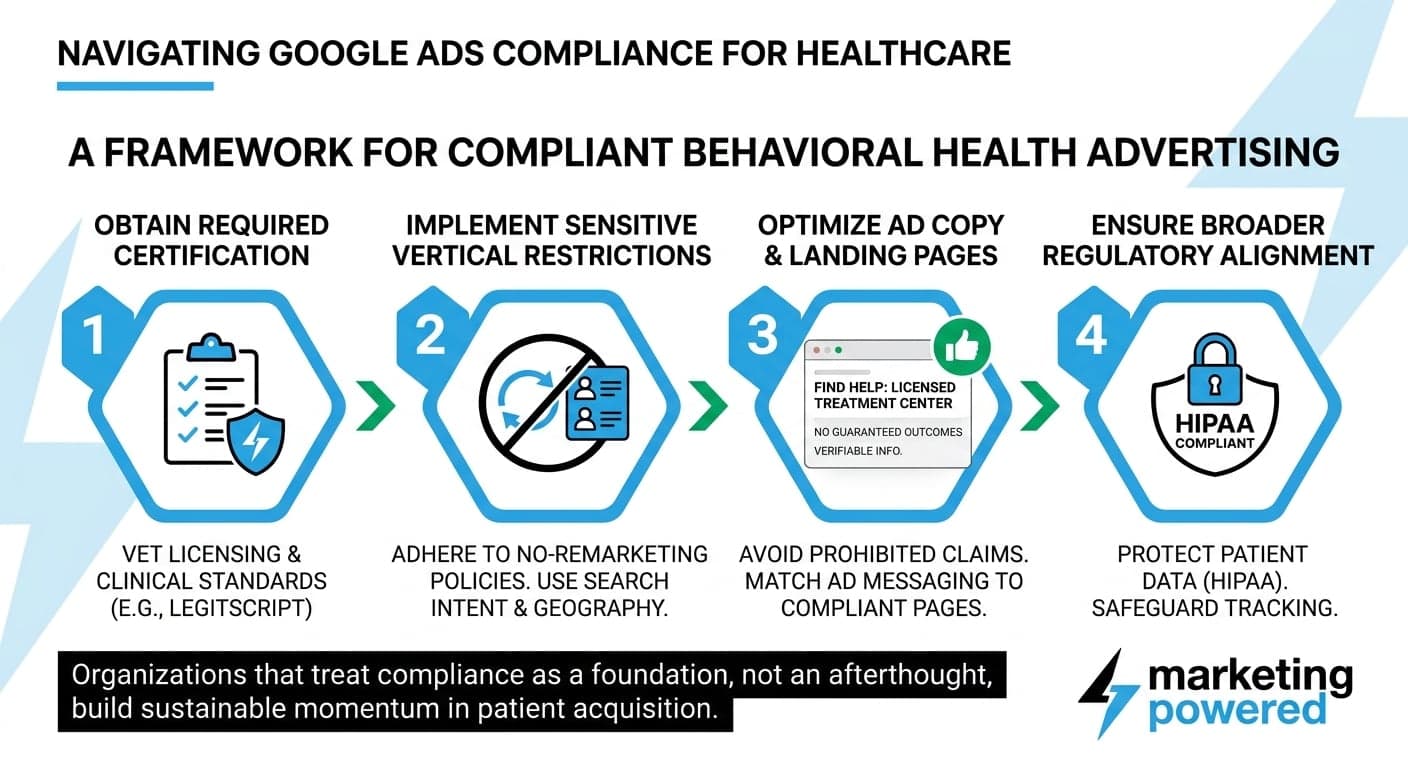
- Certification requirements: Most addiction treatment advertisers must hold LegitScript certification before Google will approve their ads. Mental health services face related but distinct verification requirements.
- Content restrictions: Ad copy cannot make claims about treatment outcomes, cure rates, or comparative effectiveness. Google's automated systems and human reviewers actively scan for policy violations.
- Targeting limitations: Healthcare advertisers cannot use remarketing or similar audience targeting for addiction treatment or mental health services. This restriction fundamentally changes campaign architecture.
- Landing page standards: The destination pages for healthcare ads must meet specific content and transparency requirements, including clear disclosure of services, credentials, and contact information.
LegitScript Certification and Its Importance
Free Audit
Want a straight read on where your budget is leaking?
The gateway to advertising addiction treatment on Google
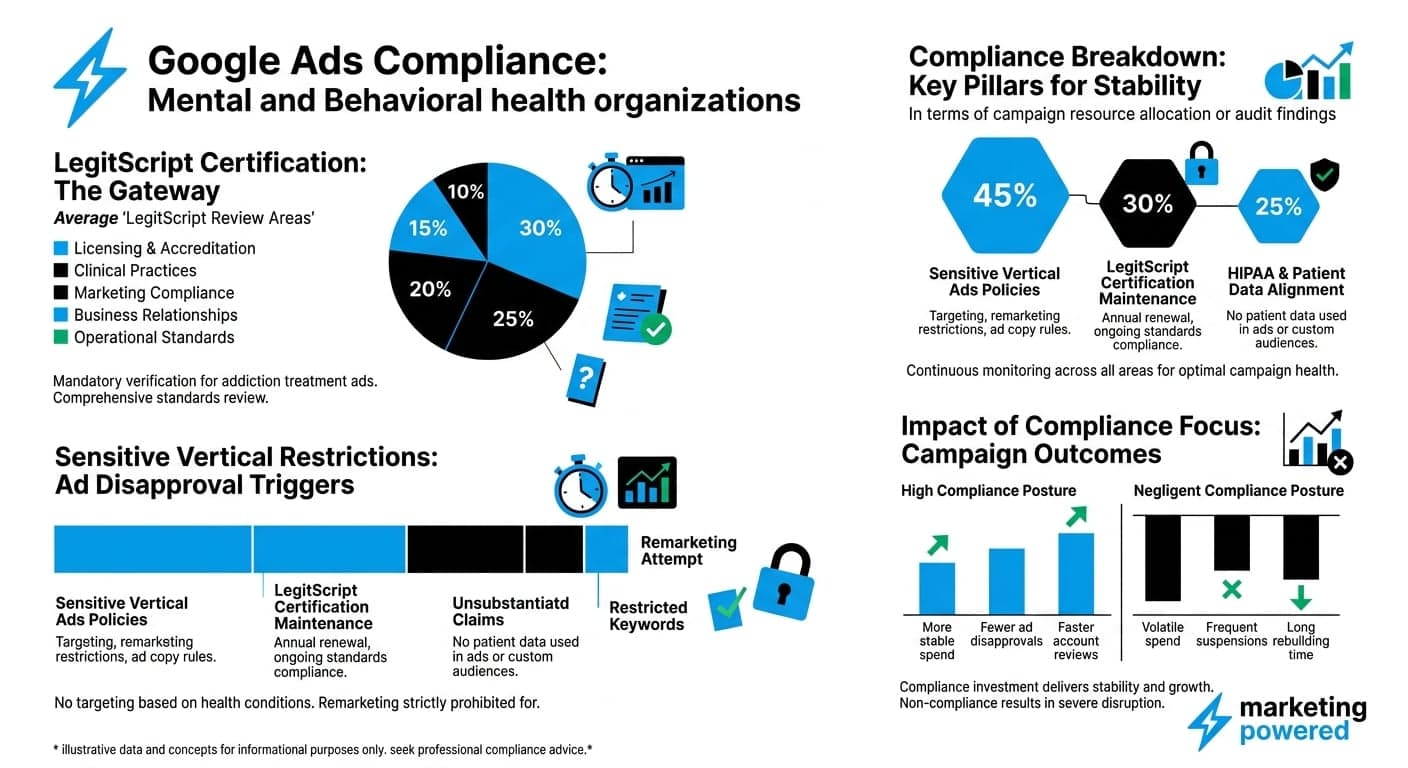
LegitScript certification is the mandatory first step for any organization advertising addiction treatment services on Google. Since 2017, Google has required this third-party verification for advertisers in the addiction treatment space operating in the United States and other countries. Without certification, your ads will not run. The requirement applies regardless of your facility's size, accreditation status, or clinical reputation.
LegitScript operates as an independent certification body that verifies healthcare advertisers meet specific standards for legitimacy, transparency, and ethical business practices. According to LegitScript's certification standards, the organization evaluates applicants across multiple criteria including licensing, clinical practices, marketing conduct, and patient care policies. The certification process is rigorous by design. It filters out operators who cannot demonstrate compliant practices.
The certification process
Obtaining LegitScript certification requires preparation, documentation, and patience. The process typically takes 4 to 8 weeks from application submission to approval, though timelines vary based on application completeness and any required remediation.
The application requires submission of licensing documentation, ownership information, clinical protocols, and marketing materials for review. LegitScript evaluates whether your organization's practices align with applicable laws, regulations, and industry standards. Facilities must demonstrate appropriate state licensing, legitimate clinical operations, and marketing practices that do not mislead potential patients or their families.
Common reasons for application delays or denials include incomplete documentation, marketing materials that make prohibited claims, ownership structures that lack transparency, and clinical practices that do not meet recognized standards. Organizations that have previously engaged in patient brokering or lead selling arrangements face additional scrutiny.
The annual certification fee varies based on organization size and complexity, typically ranging from several hundred to several thousand dollars. This cost is a minor investment compared to the advertising spend it enables and the reputational protection it provides.
Benefits beyond Google Ads access
LegitScript certification delivers value beyond simply enabling your Google Ads campaigns. The certification functions as a trust signal to referral sources, families researching treatment options, and other stakeholders evaluating your organization's legitimacy.
Treatment centers that maintain LegitScript certification demonstrate a commitment to operating within established guidelines. This differentiation matters in a market where families and referral sources have become increasingly aware of problematic operators. The certification badge communicates that an independent third party has verified your organization's practices.
From a competitive positioning standpoint, certification creates a barrier to entry that filters out operators unwilling or unable to meet compliance standards. Organizations like Marketing Powered, having managed $50M+ in behavioral health and mental health advertising spend, consistently see that certified facilities compete more effectively for high-intent search traffic because uncertified competitors simply cannot access the auction.
Maintaining certification requires annual renewal and ongoing compliance with LegitScript standards. Certified organizations are subject to monitoring and must report material changes to their operations, ownership, or practices. Certification can be revoked if an organization's practices drift out of compliance.
Strategy
Ready to map a growth plan built for your vertical?
Case context: What certification enables
Consider the operational reality of running a treatment center without the ability to advertise on Google. Organic search takes months or years to build. Referral relationships require sustained effort and may not scale with census needs. Direct mail and traditional advertising lack the intent signals that make paid search effective for treatment services.
Organizations that achieve and maintain LegitScript certification gain access to the highest-intent advertising channel available for treatment services. Families actively searching for help represent a fundamentally different prospect than those reached through interruptive advertising. The certification requirement, while creating compliance overhead, also creates competitive advantage for organizations willing to meet the standard.
Our experience scaling facilities through multi-market growth at a multi-location behavioral health organization demonstrated that Google Ads, operated compliantly with proper LegitScript certification, can serve as the primary growth engine for treatment center expansion. The compliance infrastructure is not a constraint on growth. It is the foundation that makes sustainable growth possible.
Navigating Google's Sensitive Vertical Ad Policies
Specific restrictions that shape campaign architecture
Google's sensitive vertical policies for healthcare advertising extend beyond certification requirements. These policies govern what you can say in ad copy, which audiences you can target, and how your landing pages must function. Understanding these restrictions is essential for building campaigns that remain active and effective.
The Google Ads Healthcare and medicines policy establishes the framework for advertising healthcare services. Within this framework, addiction treatment and mental health services face additional restrictions due to their classification as sensitive topics. These policies reflect Google's assessment that advertising in these categories carries elevated risk for user harm.
Email Us
Prefer to talk it through over email?
Targeting restrictions and the no-retargeting reality
The most significant operational constraint in Google Ads sensitive verticals is the prohibition on remarketing and similar audience targeting for addiction treatment and mental health advertising. This restriction eliminates tactics that work effectively in other industries.
Standard e-commerce and lead generation campaigns often rely heavily on retargeting users who visited the website but did not convert. In treatment center marketing, this approach is prohibited. You cannot build remarketing audiences from website visitors, create similar audiences based on converter profiles, or use customer match targeting to reach users across Google properties.
This restriction fundamentally changes campaign architecture. Every conversion must happen within a single session or through a user returning via a new search. There is no remarketing funnel to capture users who need more time to make a decision. Campaign strategy must account for this reality by maximizing the effectiveness of initial touchpoints.
The policy rationale centers on user privacy and the sensitive nature of treatment-seeking behavior. Google's position is that users researching addiction treatment or mental health services should not be followed around the web with related advertising. Regardless of the reasoning, the policy is non-negotiable for advertisers in this space.
Ad copy restrictions
Healthcare advertising on Google faces content restrictions that limit what claims you can make in ad copy. These restrictions apply to headlines, descriptions, and extensions.
Prohibited content includes claims about treatment outcomes or success rates, comparative claims about your services versus competitors, language that could be construed as guaranteeing results, and content that references specific controlled substances in promotional contexts. The automated review systems and human reviewers at Google actively scan for policy violations.
- Outcome claims: Statements like 'achieve lasting recovery' or '90% success rate' will trigger disapprovals. Focus ad copy on services offered, credentials held, and contact mechanisms rather than treatment outcomes.
- Urgency and pressure: Excessive urgency tactics or language designed to pressure immediate action can result in policy violations. Treatment marketing should inform rather than manipulate.
- Sensitive content: References to specific substances, detailed descriptions of addiction symptoms, or content that could be triggering to users in vulnerable states may face restrictions.
- Transparency requirements: Ads must clearly identify the advertiser and the nature of services offered. Misleading or vague descriptions that obscure the commercial nature of the offering will not be approved.
Landing page requirements
Google evaluates landing pages as part of the ad review process. Pages that do not meet healthcare advertising standards can result in ad disapprovals even when the ad copy itself complies with policy.
Landing pages for treatment and mental health services must clearly disclose the nature of services offered, provide transparent contact information, identify the operating entity, and avoid misleading content or user experience patterns. Pages designed primarily to capture lead information without providing substantive content about services may face policy issues.
Organizations should review Google Ads landing page requirements to ensure destination pages meet platform standards. Common issues include insufficient content, unclear service descriptions, aggressive popup behavior, and misalignment between ad claims and landing page content.
Free Audit
Want a straight read on where your budget is leaking?
Crafting HIPAA-Compliant Ads
Protecting patient privacy throughout the advertising ecosystem
HIPAA compliance in digital advertising extends beyond clinical operations into marketing technology and data practices. Organizations advertising mental and behavioral health services must ensure their advertising infrastructure does not expose protected health information or create compliance vulnerabilities.
The intersection of HIPAA and digital advertising creates specific challenges. Standard advertising practices like conversion tracking, audience building, and analytics data collection can potentially expose PHI if not configured correctly. According to HHS guidance on HIPAA and online tracking, covered entities and business associates must evaluate how tracking technologies interact with protected health information.
Conversion tracking considerations
Google Ads conversion tracking provides essential campaign optimization data, but implementation requires careful consideration in healthcare contexts. Standard conversion tracking sends data to Google about user actions on your website, including the pages they visited and actions they completed.
For treatment centers and mental health practices, this data transmission raises questions about PHI exposure. If a user completes a form that captures health information, and that form submission is tracked as a conversion, the relationship between the conversion event and health information could potentially constitute PHI transmission to Google.
Organizations should work with legal counsel and compliance officers to evaluate their specific tracking implementations. Options for maintaining optimization data while reducing compliance exposure include server-side conversion tracking with data filtering, offline conversion imports using anonymized identifiers, and conversion tracking configurations that do not capture health-related parameters.
Strategy
Ready to map a growth plan built for your vertical?
Form and landing page architecture
The design of forms and landing pages affects HIPAA compliance posture. Forms that capture health information should be segregated from advertising tracking where possible. Consider architectures where initial ad clicks lead to informational pages tracked for advertising purposes, while health information is captured on separate pages with different tracking configurations.
Landing page URLs should not contain PHI or information that could identify health conditions. Query parameters passed from ads should be limited to campaign attribution data rather than audience segment identifiers that could reveal health status.
Contact forms should collect the minimum information necessary to facilitate the next step in the admissions process. Progressive disclosure approaches that capture initial contact information before requesting detailed health information can reduce compliance exposure while maintaining conversion tracking functionality.
Staff training and process controls
HIPAA compliance in advertising requires more than technical controls. Staff members involved in marketing operations need training on PHI handling, particularly as it relates to advertising data and campaign management.
Marketing teams should understand which data elements constitute PHI, how advertising platforms handle data, and what internal processes must be followed when working with patient information. Organizations should establish clear policies about using patient information in marketing contexts, including testimonials, case studies, and audience development.
- Never use patient names, images, or identifying information in advertising without explicit written authorization
- Avoid audience segmentation or targeting based on health conditions, treatment types, or clinical status
- Ensure marketing automation systems and CRM platforms maintain appropriate access controls and audit trails
- Document advertising data flows and review them periodically with privacy officers
Platform-specific HIPAA considerations
Different advertising platforms present different compliance considerations. Google Ads, Meta Ads, and other platforms have varying data collection practices, business associate agreement availability, and policy frameworks for healthcare advertisers.
Organizations should evaluate whether business associate agreements are available or appropriate for their advertising platform relationships. The determination of whether an advertising platform qualifies as a business associate depends on the specific data shared and processing performed. This analysis should involve legal counsel familiar with both HIPAA requirements and digital advertising technology.
Marketing Powered maintains HIPAA-conscious infrastructure across our technology stack, including data sovereignty practices that keep sensitive information within controlled environments. This approach reflects our understanding that compliance in healthcare marketing requires systematic controls, not just policy awareness.
Email Us
Prefer to talk it through over email?
Practical Steps for Compliance Monitoring and Management
Building sustainable compliance operations
Maintaining Google Ads compliance requires ongoing attention rather than one-time setup. Policies change, campaigns evolve, and new team members need training. Organizations should build compliance monitoring into regular operational rhythms.
Effective compliance management combines automated monitoring with human review processes. Neither approach alone is sufficient. Automated systems can flag potential issues at scale, but human judgment is required to evaluate context and make compliance determinations.
Monitoring practices
Establish regular review cadences for advertising content and performance data. Weekly reviews of ad disapprovals and policy notifications allow teams to identify and address issues before they escalate. Monthly reviews of landing pages ensure content changes have not introduced compliance gaps.
- Ad disapproval monitoring: Review disapproved ads immediately to understand the policy issue. Patterns in disapprovals may indicate systematic problems with ad copy approaches or landing page content.
- Policy update tracking: Subscribe to Google Ads policy update notifications and review changes that affect healthcare advertising. Google's policy change log documents updates that may require campaign modifications.
- LegitScript status: Monitor certification status and renewal timelines. Lapsed certification will result in immediate campaign suspension.
- Landing page audits: Periodically review all active landing pages to ensure content remains compliant and accurately represents current services.
Free Audit
Want a straight read on where your budget is leaking?
Team training and documentation
Compliance knowledge should be distributed across the marketing team rather than concentrated in a single individual. Document compliance requirements, internal policies, and escalation procedures so team members can make informed decisions.
New team members should receive compliance training as part of onboarding. Existing team members should receive periodic refresher training, particularly when policies change or new platforms are added to the marketing mix.
Organizations managing advertising in-house can benefit from external compliance audits to identify gaps and validate practices. Those working with agencies should ensure their partners have demonstrable expertise in healthcare advertising compliance. Our team brings court-certified expert witness credentials in advertising strategy alongside years of operating within LegitScript and Google's healthcare policies.
Escalation and incident response
Despite best efforts, compliance issues will occasionally arise. Establish clear escalation paths for handling ad disapprovals, account suspensions, or compliance inquiries.
When accounts are suspended or ads are disapproved, resist the impulse to immediately resubmit without understanding the issue. Review the specific policy cited, evaluate whether the violation was legitimate or a false positive, and make necessary corrections before appealing or resubmitting.
Maintain documentation of compliance incidents and resolutions. This history helps identify patterns and demonstrates good-faith compliance efforts if questions arise.
Request an audit of your current advertising compliance posture to identify gaps before they result in account actions.
Building Compliance Into Your Growth Strategy
Google Ads compliance for mental and behavioral health advertising is not a constraint on growth. It is the infrastructure that makes sustainable growth possible. Organizations that build compliance into their operations from the start avoid the disruptions and costs associated with reactive compliance fixes.
The operators who scale successfully in this space treat compliance as a competitive advantage. While less disciplined competitors face account suspensions and advertising interruptions, compliant organizations maintain consistent presence in the highest-intent advertising channel available for treatment services.
Marketing Powered brings the perspective of having managed $1.5M to $2M monthly in Google Ads across behavioral health and mental health accounts. We have navigated LegitScript certification processes, resolved account suspensions, and built campaigns that perform within policy constraints. Our AI-native approach to campaign management includes compliance monitoring as a core function, not an afterthought.
If your organization needs guidance on Google Ads compliance, LegitScript certification, or HIPAA-conscious advertising practices, we can help. Discover our AI-edge solutions or take the next step below.
Strategy
Ready to map a growth plan built for your vertical?
Ready to Run Compliant Google Ads Campaigns?
Navigating LegitScript certification, Google's sensitive vertical policies, and HIPAA-conscious advertising practices requires specialized expertise. Marketing Powered brings operator-level experience in behavioral health and mental health advertising, with $50M+ in managed spend and infrastructure built for compliance. Book a call to discuss your compliance posture, campaign architecture, and growth strategy.
Questions, answered.
LegitScript is an independent certification body that verifies healthcare advertisers meet standards for legitimacy, transparency, and ethical business practices. For addiction treatment advertisers on Google, LegitScript certification is mandatory. Without it, your ads will not run. The certification process evaluates licensing, clinical practices, marketing conduct, and patient care policies. Beyond enabling Google Ads access, certification functions as a trust signal to referral sources and families researching treatment options.
Google classifies addiction treatment and mental health services as sensitive verticals, triggering enhanced compliance requirements. Behavioral health marketers face mandatory third-party certification (LegitScript for addiction treatment), prohibition on remarketing and similar audience targeting, restrictions on ad copy claims about treatment outcomes, and landing page requirements for transparency and accuracy. These regulations fundamentally change campaign architecture compared to non-healthcare advertising, requiring strategies that maximize first-session conversion without retargeting support.
Sensitive verticals are product and service categories that Google subjects to additional advertising restrictions due to elevated risk for user harm. Healthcare, including addiction treatment and mental health services, is classified as a sensitive vertical. Other sensitive categories include financial services, gambling, and alcohol. For healthcare advertisers, sensitive vertical classification triggers certification requirements, content restrictions, targeting limitations, and enhanced review processes. Violations can result in ad disapprovals, account suspensions, or permanent bans from the platform.
HIPAA compliance in Google Ads requires attention to conversion tracking configuration, landing page architecture, form design, and data handling processes. Organizations should evaluate whether conversion tracking implementations could expose PHI, design forms that segregate health information capture from advertising tracking, ensure landing page URLs do not contain identifiable health information, and train staff on PHI handling in marketing contexts. Work with legal counsel to assess your specific tracking implementations and determine appropriate controls for your compliance posture.
Ready to see what AI-native marketing can do for your treatment center?
Request a free audit of your paid media, landing pages, attribution, and compliance posture. You'll get a straight assessment of where the opportunities are.
or email us at info@marketingpowered.ai