Guide
Optimizing Creative Testing for Meta Ads
A structured framework for systematic ad creative iteration, data-driven analysis, and continuous performance improvement on Meta platforms.
Understanding Creative Testing in Meta Ads
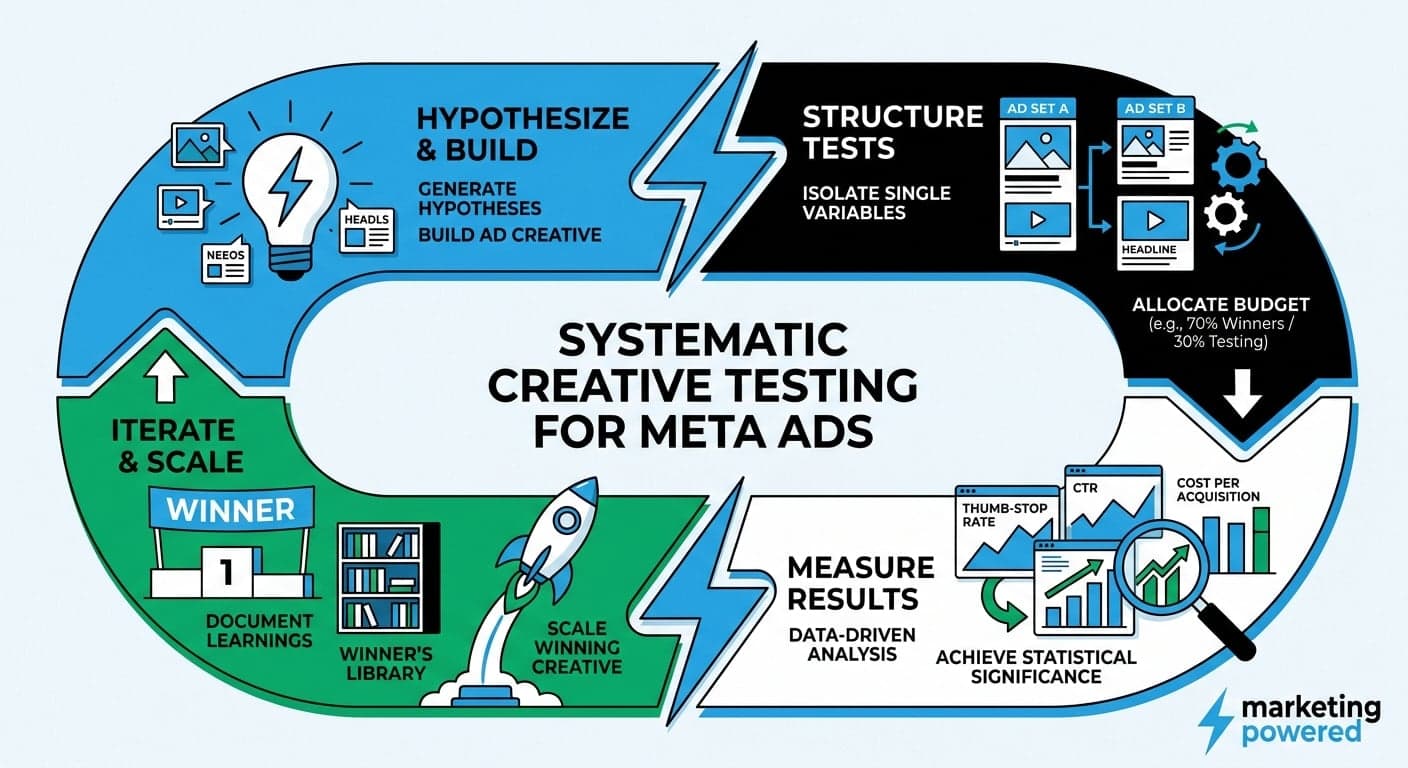
Why systematic testing outperforms intuition-based creative decisions
Creative testing for Meta Ads is the systematic process of evaluating multiple ad creative variations to identify which elements drive measurable performance improvements. Rather than guessing which headline, image, or video will resonate with your audience, creative testing meta ads strategies let the data dictate your creative direction. This approach replaces intuition-based decisions with statistically significant insights that compound over time.
The challenge most advertisers face is not a lack of creative ideas. It is the absence of a structured system to validate those ideas before scaling spend. Without a testing framework, teams often default to one of two failure modes: either they run the same stale creative until performance collapses, or they churn through new concepts so quickly that they never gather enough data to learn what actually works.
Meta's algorithm rewards advertisers who feed it diverse, high-performing creative. According to Meta's own advertising research, campaigns with greater creative diversity see lower cost per result and improved delivery efficiency. The algorithm needs options to optimize against. A single ad set with one creative variant is asking the machine learning system to work with one hand tied behind its back.
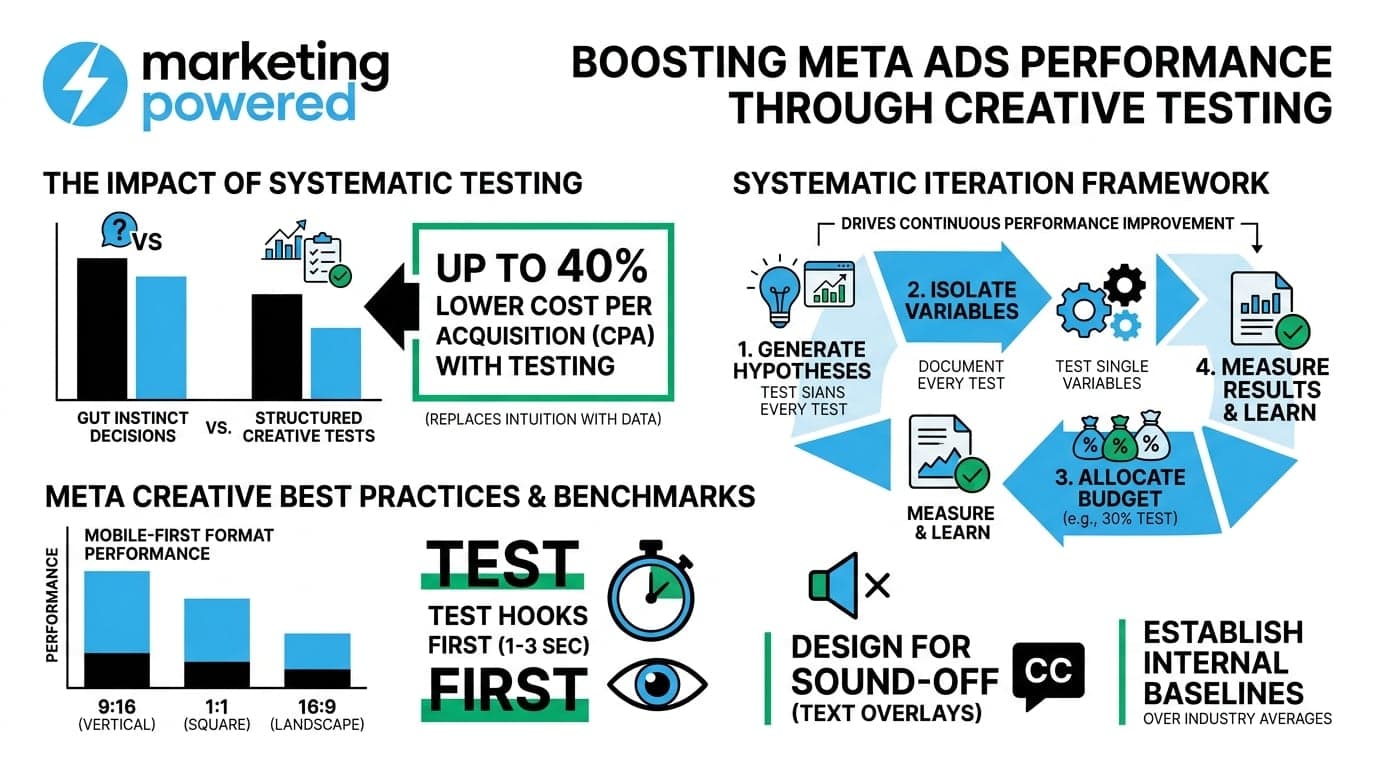
The cost of not testing is substantial. Advertisers who rely on gut instinct typically see 20-40% higher cost per acquisition compared to those running structured creative tests. That inefficiency compounds across every dollar spent. For advertisers managing six or seven figures in monthly Meta spend, the difference between a 15% and 25% cost per acquisition is not marginal. It is the difference between profitable scale and a budget that burns faster than it builds a pipeline.
Setting Up a Creative Testing Framework
Free Audit
Want a straight read on where your budget is leaking?
The foundational structure for repeatable creative insights
A creative testing framework is not a single campaign. It is an operational system that produces compounding insights over time. The framework should define how you generate hypotheses, structure tests, allocate budget, measure results, and feed learnings back into your next round of creative development. Without this structure, testing becomes ad hoc experimentation that never builds institutional knowledge.
Start with clear objectives. Every test should answer a specific question. Are you testing to find a winning hook? To validate a new visual style? To determine whether user-generated content outperforms polished production? Vague objectives like 'see what works' produce vague results. Define your hypothesis before you build the creative.
Your KPI selection must match your objective. Top-of-funnel awareness tests might optimize for thumb-stop rate (the percentage of users who pause on your ad for at least 3 seconds) or cost per 1,000 impressions reached. Mid-funnel consideration tests often focus on click-through rate or cost per landing page view. Bottom-funnel conversion tests should optimize for cost per conversion event, whether that is a lead form submission, a phone call, or a purchase.
- Define a single variable per test. Testing a new headline against a new image simultaneously tells you nothing about which change drove the result. Isolate variables.
- Set minimum sample sizes before launching. Meta recommends at least 50 conversion events per ad set per week to exit the learning phase. For creative tests, aim for statistical significance rather than calendar-based timelines.
- Establish a budget allocation rule. A common structure dedicates 70% of spend to proven winners and 30% to testing new concepts. Adjust based on your risk tolerance and performance stability.
- Document every test in a central repository. Include the hypothesis, creative assets, audience, budget, duration, results, and the decision made. This log becomes your institutional memory.
- Build a creative production pipeline that can keep pace with your testing cadence. If your framework calls for testing 4-6 new concepts per week but your design team can only produce 2, the bottleneck is not in Ads Manager.
Structuring Tests Within Meta Ads Manager
Meta provides native tools for creative testing, but the platform's defaults do not always serve rigorous experimentation. Understanding when to use A/B testing, dynamic creative, and Advantage+ creative versus standard ad sets gives you control over how insights are generated.
The A/B test feature in Ads Manager lets you split traffic evenly between two or more ad sets and measure performance with statistical confidence. Use this for high-stakes tests where you need clean data: a new creative direction, a significant messaging shift, or a landing page comparison. The limitation is that A/B tests require a dedicated budget and run as separate experiments from your always-on campaigns.
Dynamic Creative allows you to upload multiple headlines, images, videos, and descriptions, then lets Meta's algorithm assemble combinations and optimize toward your objective. This is efficient for finding winners within a defined set of assets, but it obscures which specific combination drove performance. Use dynamic creative for rapid iteration, not for building a learning library.
Advantage+ creative applies automatic enhancements to your ads: adjusting brightness, adding music to videos, or testing different aspect ratios. These optimizations can improve performance, but they also reduce your control over the final creative output. For brand-sensitive advertisers or those in regulated industries like behavioral health or mental health, automatic enhancements may introduce compliance risks. Review the specific enhancements Meta applies and disable any that conflict with your brand guidelines or regulatory requirements.
Best Practices for Meta Creative Testing
Strategy
Ready to map a growth plan built for your vertical?
Proven methodologies that produce actionable insights
Meta's creative testing best practices in 2026 reflect a platform that has shifted heavily toward machine learning optimization and privacy-first measurement. The tactics that worked in 2020, when granular audience targeting and deterministic attribution were possible, no longer apply. Today's best practices account for broader audiences, algorithmic creative selection, and probabilistic conversion modeling.
Test hooks before anything else. The first 1-3 seconds of a video ad determine whether the user stops scrolling. The headline and primary text of a static ad serve the same function. Before testing color palettes, actor selection, or call-to-action button text, validate that your hook stops the scroll. A compelling hook with mediocre production will outperform a polished creative with a weak opening.
According to Meta's creative best practices documentation, mobile-first creative formatted for vertical (9:16) or square (1:1) aspect ratios consistently outperforms landscape content repurposed from other channels. Design for the thumb, not the mouse. Sound-off viewing remains dominant, so text overlays and captions are not optional.
- Refresh creative before fatigue sets in. Monitor frequency and performance decay. When the cost per result increases 15-20% from baseline, introduce new variants rather than waiting for complete collapse.
- Test messaging angles, not just visual execution. The same product can be positioned around a pain point, aspiration, social proof, or urgency. Each angle resonates with different audience segments.
- Use naming conventions that make analysis possible. Include the test hypothesis, date, and variable in your ad names. 'Spring_Sale_V3' tells you nothing six months later. 'Hook_UGC_vs_Studio_Apr2026' tells you exactly what you were testing.
- Segment results by placement. An ad that performs well in Feed may underperform in Stories or Reels. Meta's automatic placements optimize for volume, not for per-placement learning.
- Build a 'winner's library' of proven creative elements. When a hook, format, or angle wins consistently, document it and reuse the pattern. Creative testing should produce reusable frameworks, not one-off winners.
Industry Benchmarks and Performance Context
Benchmark data provides context for interpreting your test results. According to WordStream's 2024 Facebook Ads benchmarks, average click-through rates across industries range from 0.5% to 1.5%, with cost per click varying from $0.50 to over $3.00 depending on vertical competitiveness. Healthcare and legal advertisers typically see higher costs due to regulatory complexity and audience sensitivity.
For advertisers in regulated healthcare verticals, creative testing carries additional constraints.
Google's healthcare and medicines policy and Meta's advertising policies for health restrict certain claims and targeting approaches. Behavioral health advertisers cannot use retargeting, which limits the standard 'awareness to conversion' funnel structure. Creatives must work harder in top-of-funnel placements because you cannot follow users across the web. This constraint makes rigorous creative testing even more valuable: every impression must count because you cannot recapture lost attention through retargeting.
Your internal benchmarks matter more than industry averages. A 1.2% CTR might be excellent for one account and mediocre for another. Track your own historical performance, establish baselines for each campaign objective, and measure creative tests against those baselines rather than generic industry data.
Analyzing and Iterating on Results
Email Us
Prefer to talk it through over email?
Turning raw data into actionable creative direction
Data without interpretation is just noise. The analysis phase of creative testing transforms performance metrics into creative direction for your next round of tests. This is where most advertisers fail. They run tests, declare winners, and move on without extracting the underlying insight that made one creative outperform another.
Start with statistical significance. Meta's A/B test feature provides confidence intervals, but if you are analyzing results from standard ad sets, you need to determine whether performance differences reflect real creative superiority or random variation. Tools like Evan Miller's A/B test calculator help validate whether your sample size supports confident conclusions. Declaring a winner after 500 impressions and 3 conversions is not testing. It is guessing with extra steps.
Look beyond the primary KPI. A creative might win on cost per click but lose on cost per conversion if it attracts low-intent clicks. Analyze the full funnel: impression to click, click to landing page view, landing page view to conversion event. Breakdowns often reveal that a 'losing' creative actually attracts higher-quality traffic that converts at better rates downstream.
Building an Iteration Cadence
Creative iteration should follow a structured cadence, not reactive impulses. Establish a rhythm that matches your budget, production capacity, and learning velocity. For most advertisers spending $50,000 or more monthly on Meta, a weekly or bi-weekly iteration cycle balances speed with statistical rigor.
Each iteration cycle should include three phases. First, analyze completed tests and document findings. Second, generate hypotheses for the next round based on those findings. Third, brief and produce the creative assets needed to test those hypotheses. If any phase bottlenecks, the entire system slows down. Production delays are the most common constraint; build a buffer inventory of test-ready creative so analysis insights do not wait weeks for execution.
Categorize your iterations by risk level. Low-risk iterations test minor variations on proven winners: a new headline on a winning visual, a color shift on a performing static, a different opening frame on a top-performing video. These tests have a high probability of maintaining performance while potentially finding incremental gains. High-risk iterations test fundamentally new concepts: a new messaging angle, a new format, a new creative style. These tests may fail, but when they win, they unlock new performance ceilings. A healthy testing portfolio balances both.
Document not just what won, but why you think it won. The hypothesis you form about causation guides future tests. If a user-generated-content style video beats a studio production, your hypothesis might be that authenticity signals outperform polish for your audience. Test that hypothesis by running additional UGC variants. If they also outperform, you have validated a creative principle you can apply systematically. If they do not, your original hypothesis was wrong, and the win was driven by something else. Either outcome produces learning.
Innovative Tools and Strategies in 2026
Free Audit
Want a straight read on where your budget is leaking?
Emerging capabilities for advanced creative testing
The creative testing infrastructure available in 2026 has evolved significantly from even two years prior. AI-native solutions now enable rapid creative generation, automated performance prediction, and real-time optimization at scales that were previously impossible. Understanding these tools helps you allocate testing resources more efficiently.
Generative AI tools for ad creative have matured beyond novelty. Platforms can now produce variations of existing creative assets, generate new concepts from text prompts, and adapt winning creative to new formats automatically. The limitation is quality control: AI-generated creative requires human review to ensure brand consistency, messaging accuracy, and regulatory compliance. For advertisers in sensitive verticals, this review step is non-negotiable. A compliance violation from AI-generated copy carries the same consequences as one written by a human.
Predictive creative scoring uses machine learning to estimate ad performance before you spend media dollars. These tools analyze creative elements against historical performance data and predict metrics like click-through rate or engagement. They do not replace actual testing, but they can filter out likely underperformers before they consume budget. Think of predictive scoring as a hypothesis prioritization layer: test your highest-scored concepts first.
- Multi-variant optimization routes individual users to different creative variants based on predicted performance, moving beyond static A/B splits. This approach requires sufficient traffic volume to train the optimization model, typically 1,000+ conversions per week.
- Creative intelligence platforms aggregate performance data across accounts and verticals to identify trending formats, hooks, and styles. These benchmarks inform hypothesis generation but should not replace your own testing.
- Automated creative refresh tools monitor performance decay and generate new variants when fatigue indicators appear, maintaining performance without manual intervention.
- Cross-platform creative testing extends Meta learnings to other channels. A hook that wins on Meta often performs well on TikTok, YouTube Shorts, and other short-form video environments, though each platform requires format adaptation.
Integrating Creative Testing with Broader Strategy
Creative testing does not exist in isolation. It connects to audience strategy, landing page optimization, and full-funnel attribution. The most sophisticated advertisers treat creative testing as one component of an integrated performance system.
Audience and creative interact. A message that resonates with one audience segment may fall flat with another. When you find a winning creative, test whether it performs consistently across different audience definitions or whether it requires audience-specific variants. Conversely, when testing new audiences, start with proven creative to isolate whether performance differences stem from the audience or from a creative-audience mismatch.
Landing page continuity matters. If your ad promises a specific benefit or uses a particular visual style, the landing page must deliver on that promise. Creative testing that ignores landing page alignment often produces misleading results: an ad might drive high click-through rates but poor conversion rates because the landing page breaks the narrative thread. Test creative and landing page combinations together when possible.
Attribution complexity affects how you measure creative winners. Meta's default attribution settings (7-day click, 1-day view) may not match your actual conversion timeline. For advertisers with longer sales cycles, such as behavioral health treatment centers, where the path from ad click to admission can span weeks, standard attribution windows undercount true performance. Consider extending attribution windows or supplementing with server-side tracking and CRM integration to capture the full picture.
For case studies of how integrated creative testing, audience strategy, and attribution systems produce measurable results, our team has documented performance improvements across accounts managing seven figures in monthly spend. The principles in this guide reflect operational experience, not theoretical frameworks.
Ready to Build a Creative Testing System That Compounds?
If you are managing significant Meta Ads spend and want to discuss how a structured creative testing framework applies to your specific vertical, audience, and compliance requirements, we are available for a focused conversation. We will cover your current testing approach, identify gaps, and outline how a systematic methodology could improve cost efficiency and creative performance.
Questions, answered.
Creative testing in Meta Ads is the systematic process of running controlled experiments with different ad creative elements to determine which variations produce the best performance. This includes testing headlines, images, videos, ad copy, calls to action, and format choices. By isolating individual variables and measuring results against defined KPIs, advertisers replace intuition-based creative decisions with data-driven insights that improve cost efficiency and conversion rates over time.
Setting up a creative testing framework starts with defining clear objectives and selecting KPIs that match those objectives. Establish a budget allocation rule (typically 70% to proven winners, 30% to testing), set minimum sample sizes for statistical significance, and create a documentation system to track hypotheses, results, and decisions. Build a creative production pipeline that can sustain your testing cadence and integrate Meta's native testing tools (A/B tests, dynamic creative, Advantage+) based on your specific testing needs.
Best practices for 2026 emphasize mobile-first vertical creative, hook testing before other variables, and statistical rigor in result analysis. Refresh creatively proactively before fatigue collapses performance. Use naming conventions that enable future analysis. Segment results by placement to understand where creative performs best. Build a winner's library of proven creative elements for reuse, and integrate AI tools for creative generation and predictive scoring while maintaining human oversight for brand and compliance review.
Iterative analysis transforms individual test results into compounding creative intelligence. Without analyzing why a creative won (not just that it won), you cannot build reusable frameworks or predict future performance. Iteration identifies underlying principles (authenticity outperforms polish, urgency outperforms aspiration) that guide efficient hypothesis generation. A structured iteration cadence also ensures that insights move quickly from analysis to production to deployment, maintaining competitive advantage.
Current tools include Meta's native A/B testing and dynamic creative features, generative AI platforms for rapid creative variation, and predictive scoring systems that estimate performance before spend. Multi-variant optimization tools route users to predicted best-performing variants in real time. Creative intelligence platforms provide cross-account benchmarks for hypothesis generation. For advertisers in regulated verticals, compliance review tools that flag policy violations before launch prevent costly ad rejections and account restrictions.
Ready to see what AI-native marketing can do for your treatment center?
Request a free audit of your paid media, landing pages, attribution, and compliance posture. You'll get a straight assessment of where the opportunities are.
or email us at info@marketingpowered.ai