Guide
Ultimate Guide to Behavioral Health Paid Media
The operator-level playbook for treatment centers running $50K to $2M+ monthly in paid acquisition.
Introduction to Behavioral Health Paid Media
Why standard agency playbooks fail in addiction treatment marketing
Behavioral health paid media operates under a different set of rules than nearly any other vertical in digital advertising. Treatment centers face platform restrictions that most advertisers never encounter: no retargeting on Google or Meta for addiction services, heightened ad review scrutiny, LegitScript certification requirements, and the constant risk of account suspension for policy violations that standard agencies do not understand.
The economics are also distinct. A single admission can represent $15,000 to $60,000 or more in revenue depending on length of stay, payer mix, and level of care. That revenue potential justifies aggressive cost-per-click bids, but it also attracts competitors willing to pay $150 to $400 per click for high-intent keywords. Without a disciplined strategy, treatment centers burn through budgets on unqualified clicks while competitors with sharper targeting capture the admits.
Traditional marketing approaches fall short for several reasons. Generic PPC agencies lack the vertical knowledge to navigate behavioral health advertising restrictions. They do not understand the difference between PHP and IOP, cannot speak to payer verification workflows, and often trigger compliance violations that result in ad disapprovals or account suspensions. The learning curve costs treatment centers months of wasted spending.
This guide provides the strategic framework Marketing Powered uses to manage $1.5M to $2M monthly in Google Ads across behavioral health accounts. The playbook covers audience targeting in a no-retargeting environment, Google Ads optimization specific to treatment centers, compliance protocols that protect your account, and attribution systems that track performance through to admission. Every section reflects operator experience, not theoretical agency advice.
The goal is straightforward: help you build a paid media operation that generates qualified admission calls at a sustainable cost, without compliance risk. Whether you manage campaigns in-house or evaluate agency partners, this guide gives you the foundation to make informed decisions about your paid acquisition strategy.
Building a Successful Paid Media Strategy
Free Audit
Want a straight read on where your budget is leaking?
Foundation elements for treatment center paid acquisition
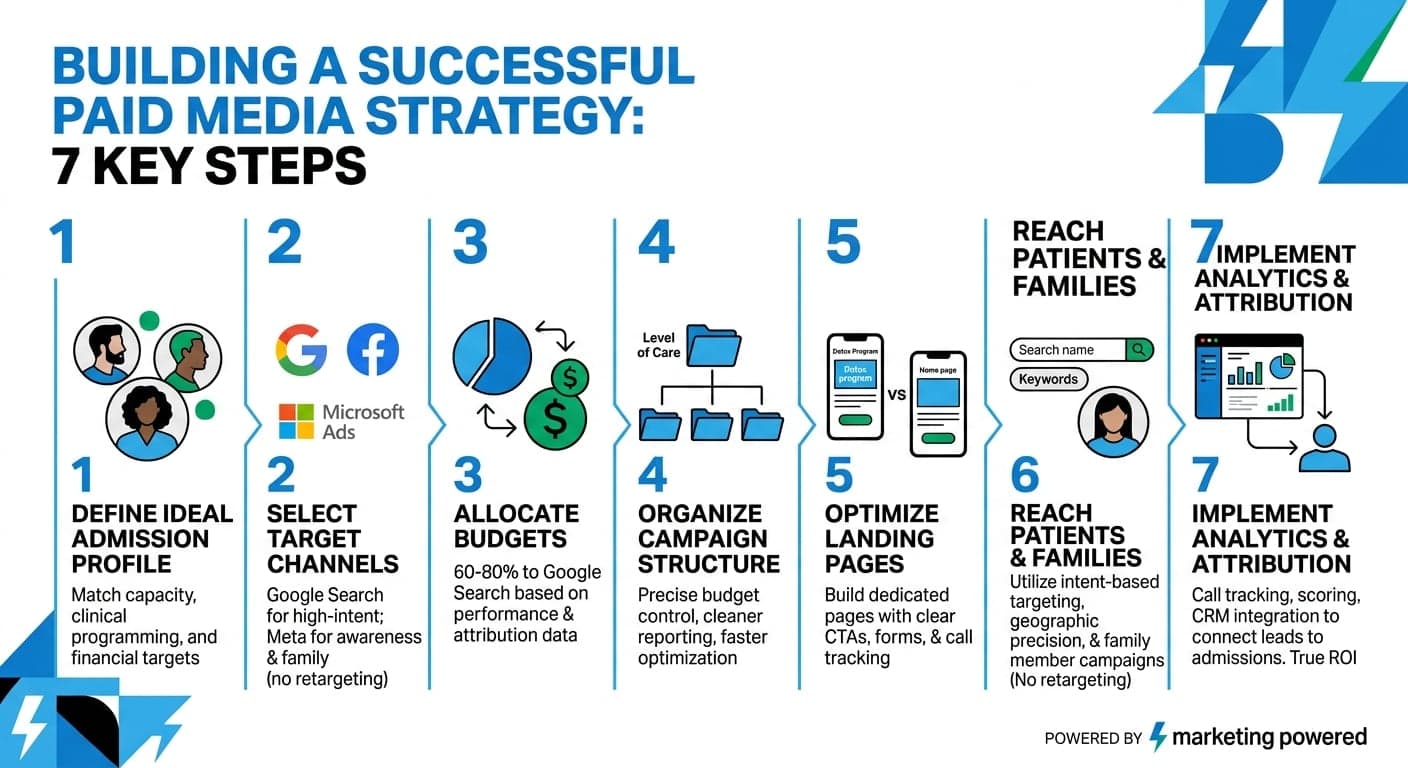
A successful rehab paid media strategy starts with clarity on three questions: Who are you trying to reach? What action do you want them to take? How will you measure whether the campaign worked? Treatment centers that skip this foundation work end up with campaigns optimized for the wrong outcomes.
The first step is defining your ideal admission profile. Not every lead is worth the same amount. A self-pay patient seeking 90-day residential treatment generates different revenue than an out-of-network IOP patient with limited benefits. Your paid media strategy should reflect those economics. Build campaigns around the admission types that match your capacity, clinical programming, and financial targets.
Channel selection follows audience definition. Google Search remains the primary channel for high-intent behavioral health acquisition because it captures people actively searching for treatment. Meta (Facebook and Instagram) works for family member targeting and awareness campaigns, but cannot retarget due to platform healthcare vertical restrictions. Microsoft Ads offers lower CPCs with smaller volume. Programmatic display can build awareness but requires careful placement to avoid brand safety issues.
Budget allocation across channels should match your attribution data. Most treatment centers find that 60-80% of attributable admissions come from Google Search. Allocate accordingly, then test the incremental budget in secondary channels with clear measurement protocols.
Campaign structure matters more in behavioral health than in most verticals. Organize campaigns by level of care (detox, residential, PHP, IOP), by substance or condition (alcohol, opioid, dual diagnosis), and by geographic target. This structure allows precise budget control, cleaner reporting, and faster optimization. A treatment center running one campaign for all services cannot identify which programs generate the best return.
Landing page strategy is the other half of the equation. Treatment center paid media fails when ads drive to the generic homepage experience. Build dedicated landing pages for each major campaign theme. A search for 'alcohol detox near me' should land on a page specifically about your detox program, not your general admissions page. Include clear calls to action, insurance verification forms, and direct phone numbers with call tracking.
The technology stack supporting your campaigns determines how much insight you have into performance. At minimum, you need call tracking with recording and scoring, form submission tracking, CRM integration that connects leads to admission outcomes, and attribution modeling that accounts for multi-touch journeys. Without this infrastructure, you cannot calculate true cost per admission or identify which campaigns actually generate revenue.
Targeting Audiences Effectively
Reaching patients and families in a no-retargeting environment
Audience targeting in behavioral health requires different tactics than standard digital marketing. The retargeting strategies that drive results in e-commerce and B2B are prohibited for addiction treatment advertising. Google and Meta both restrict behavioral health advertisers from building remarketing audiences based on site visits or conversion events. This constraint forces treatment centers to rely on intent signals, demographic targeting, and contextual placements.
Search intent remains the most reliable targeting mechanism. Someone searching 'inpatient rehab for alcohol addiction' has declared their intent explicitly. Your job is to appear for that search with relevant ad copy and a landing page that matches their query. Keyword strategy should prioritize high-intent terms: treatment type plus substance, treatment type plus location, and condition-specific queries. Broad match keywords in behavioral health typically waste budget on informational searches that do not convert.
Geographic targeting requires precision. Most treatment centers draw patients from specific regions based on referral relationships, payer contracts, and clinical reputation. Build campaigns targeting your primary service area first, then expand to secondary markets where you have admission history. Avoid the temptation to target nationally without the budget to compete. National campaigns for high-intent keywords can exhaust $50,000 monthly without generating meaningful volume.
Family member targeting represents a distinct opportunity. Many treatment admissions originate with a concerned family member searching for help. These searches often use different language: 'how to help someone with addiction,' 'signs my husband is an alcoholic,' 'intervention services near me.' Build separate campaigns targeting family member queries with landing pages that speak to their concerns and guide them toward admission conversations.
Demographic layering can improve efficiency when used carefully. Income targeting helps prioritize self-pay prospects. Age targeting can focus spending on demographics that match your clinical programming. Parental status targeting works for adolescent treatment centers. Apply these layers incrementally and measure the impact on lead quality before expanding.
Audience exclusions protect the budget from wasted clicks. Exclude job seekers, students researching for papers, and competitors monitoring your ads. Use negative keyword lists aggressively to filter out informational queries, competitor brand searches you do not want to bid on, and irrelevant geographic modifiers.
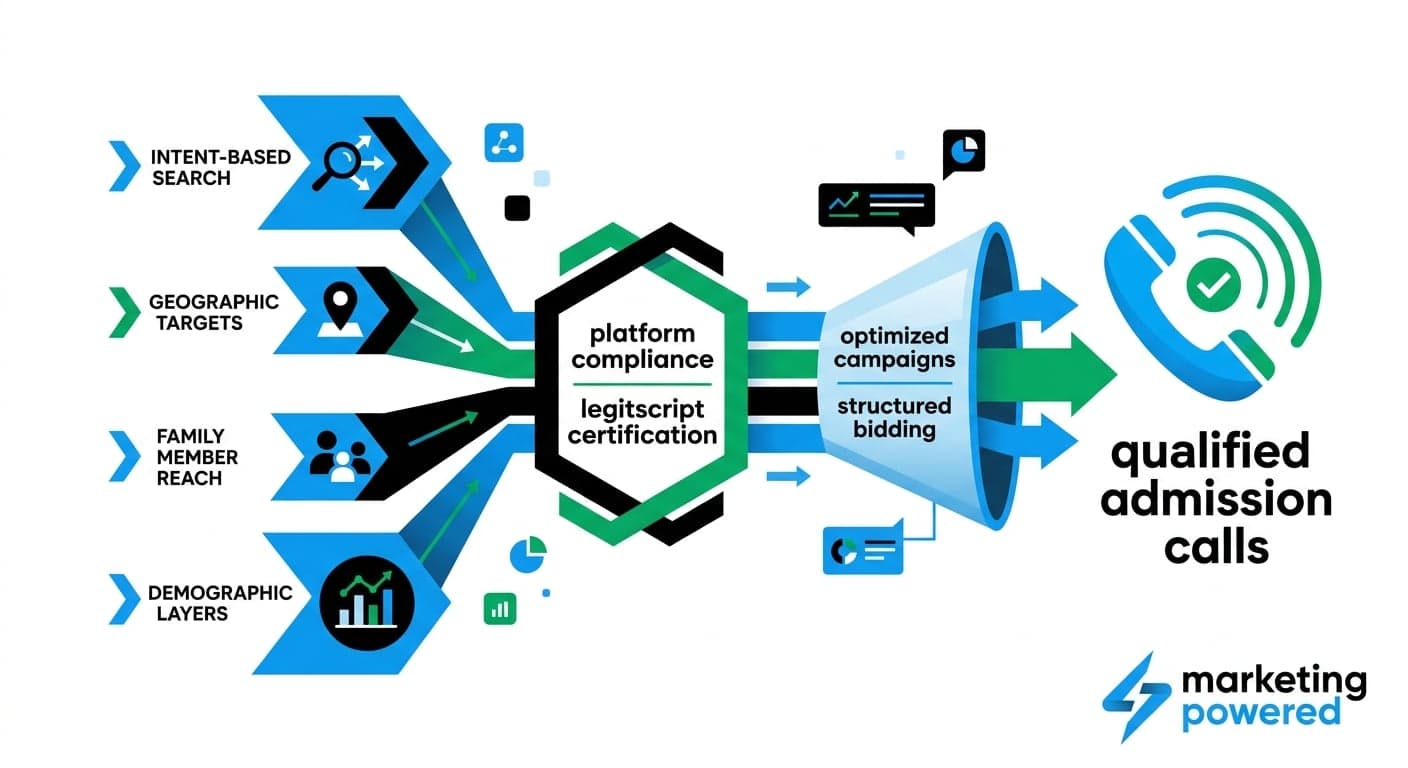
The combination of intent-based targeting, geographic precision, family member campaigns, and aggressive exclusions creates a treatment center paid media approach that generates qualified calls without relying on prohibited retargeting tactics.
- High-intent search keywords: treatment type + substance, treatment type + location, condition-specific queries
- Geographic campaigns: primary service area first, expand to secondary markets with admission history
- Family member campaigns: separate creative and landing pages targeting concerned family queries
- Demographic layering: income, age, and parental status targeting applied incrementally
- Aggressive exclusions: negative keyword lists, audience exclusions for non-patient traffic
Strategy
Ready to map a growth plan built for your vertical?
Optimizing Google Ads for Treatment Centers
Advanced tactics for the primary acquisition channel
Google Ads drives the majority of paid admissions for most treatment centers. Optimizing performance requires understanding both the platform mechanics and the behavioral health-specific constraints that shape what works.
Account structure should separate campaigns by intent level, service line, and geography. High-intent campaigns targeting 'rehab near me' and 'addiction treatment center' keywords deserve dedicated budgets and aggressive bid strategies. Informational campaigns targeting 'signs of addiction' or 'how long is detox' require different expectations and softer conversion goals. Mixing these intent levels in the same campaign obscures performance data and leads to poor optimization decisions.
Keyword strategy in behavioral health balances volume against qualification. Exact match and phrase match keywords provide control but limit reach. Broad match can work with sufficient negative keyword coverage and smart bidding, but requires careful monitoring. Most treatment centers perform best with a core of exact-match high-intent terms supplemented by phrase match variations for geographic and modifier coverage.
The Google Ads optimization process starts with search term analysis. Review the actual queries triggering your ads weekly. Add converting search terms as keywords. Add irrelevant terms to negative keyword lists. This ongoing hygiene prevents budget waste and improves match rate over time.
Ad copy must balance compliance with persuasion. Google's healthcare advertising policies prohibit certain claims and require specific disclosures for LegitScript-certified advertisers. Within those constraints, effective ad copy emphasizes your differentiators: accreditation, staff credentials, specific programs, insurance acceptance, and location advantages. Avoid generic claims that every competitor makes. Test multiple ad variations to identify which messages resonate with your audience.
Responsive Search Ads (RSAs) now dominate Google's ad formats. Provide 10-15 headline variations and 4 description variations that can combine in compliant ways. Pin critical compliance language to ensure it always appears. Monitor asset performance reports to identify which headlines drive results and replace underperformers.
Bid strategy selection depends on your data volume and goals. Manual CPC bidding provides maximum control but requires constant management. Target CPA bidding can optimize toward conversions, but needs sufficient conversion volume (typically 30+ per month per campaign) to function well. Target ROAS bidding requires revenue data fed back to Google, which demands a strong attribution infrastructure.
Landing page optimization directly impacts Quality Score and conversion rate. Treatment center landing pages should load in under 3 seconds, display clearly on mobile devices, include prominent phone numbers with click-to-call functionality, and feature insurance verification forms above the fold. Test headline variations, form lengths, and trust signal placement to improve conversion rates.
Call tracking and recording are non-negotiable for treatment center attribution. Most behavioral health conversions happen by phone. Without call tracking, you cannot connect ad spend to admission outcomes. Implement dynamic number insertion on landing pages, score calls for lead quality, and integrate call data with your CRM to track through to admission.
Performance tracking should focus on metrics that matter: cost per qualified call, cost per verified admission lead, and ultimately cost per admission. Click-through rate and cost per click are input metrics, not outcomes. A campaign with high CPCs that generates admissions at $2,000 each outperforms a low-CPC campaign that generates unqualified leads.
- Separate campaigns by intent level, service line, and geography
- Weekly search term analysis and negative keyword hygiene
- RSA creative with 10-15 headlines and pinned compliance language
- Bid strategy matched to conversion volume: manual CPC for new accounts, Target CPA at 30+ monthly conversions
- Landing pages under 3-second load time with click-to-call and insurance verification above the fold
- Dynamic number insertion and call scoring connected to CRM admission tracking
Compliance and Ethical Considerations
Email Us
Prefer to talk it through over email?
Protecting your accounts and your reputation
Compliance in behavioral health advertising is not optional. Google, Meta, and Microsoft all classify addiction treatment as a restricted category with specific requirements. Violating these policies results in ad disapprovals, account suspensions, and potential permanent bans. Beyond platform compliance, treatment centers must consider HIPAA regulations, state advertising laws, and ethical standards that protect vulnerable populations.
LegitScript certification is required for addiction treatment advertising on Google Ads and Microsoft Advertising. The certification process reviews your clinical licensing, business practices, and advertising materials. Treatment centers must demonstrate legitimate operation and compliance with applicable laws. Maintain your certification actively; lapses result in immediate ad suspension.
Google's healthcare and medicines policy explicitly prohibits retargeting for addiction treatment services. You cannot build remarketing audiences based on visits to treatment-related pages, nor can you use customer match lists for addiction treatment campaigns. This restriction applies across Google Ads, Display, Video 360, and YouTube. Violations can result in account suspension without warning.
HIPAA considerations extend into your advertising operations. Call recordings that capture protected health information must be stored securely and accessed only by authorized personnel. Form submissions containing health information require appropriate security measures. Lead data shared with agencies or CRM systems must be governed by Business Associate Agreements. Marketing Powered maintains a HIPAA-conscious infrastructure specifically for this reason.
Ad copy compliance requires avoiding prohibited claims. Do not promise specific outcomes, guarantee insurance coverage, or make comparative claims you cannot substantiate. Avoid language that could be interpreted as targeting people in crisis for commercial exploitation. The ethical standard is clear: advertising should connect people who need treatment with legitimate providers, not manipulate vulnerable populations.
Documentation protects you during platform reviews and regulatory inquiries. Maintain records of your LegitScript certification, clinical licenses, ad creative approvals, and compliance training. When Google flags an ad or requests verification, rapid response with proper documentation resolves issues faster.
The compliance burden is real, but it also creates a competitive advantage. Treatment centers that invest in compliant infrastructure and processes maintain stable advertising operations while competitors cycle through account suspensions and rebuilds.
- LegitScript certification: required for Google Ads and Microsoft Advertising, must be maintained continuously
- No retargeting: prohibition applies to site visitors, customer match lists, and similar audiences for addiction treatment
- HIPAA-conscious infrastructure: secure call recording storage, BAAs with vendors, restricted PHI access
- Ad copy restrictions: no outcome guarantees, no unsubstantiated comparisons, no crisis exploitation language
- Documentation: maintain certification records, license copies, and creative approval history
Measuring Success and Adjusting Strategies
Attribution, analysis, and continuous improvement
Measurement in behavioral health paid media must extend beyond platform metrics to admission outcomes. Treatment centers that optimize for clicks or even calls without tracking through to revenue make decisions based on incomplete data. Building proper attribution infrastructure is the foundation for strategic improvement.
The attribution chain for treatment center marketing typically includes: ad impression, ad click, landing page visit, phone call or form submission, intake conversation, verification of benefits, admission, and completed treatment. Marketing attribution should, at a minimum, connect ad spend to admission. Advanced attribution tracks through to payer reimbursement and actual revenue collected.
Call tracking provides the critical link between advertising and intake. Implement unique tracking numbers for each major campaign or traffic source. Record calls with appropriate disclosures and score them for lead quality. A call from someone seeking treatment for themselves or a family member is a qualified lead. A call from a job seeker or vendor is not. Your cost-per-lead calculations should reflect only qualified calls.
CRM integration connects marketing data to admission outcomes. When a lead converts to an admitted patient, that outcome data should flow back to your marketing systems. This connection enables true cost-per-admission calculations and identifies which campaigns, keywords, and ads generate actual revenue.
Multi-touch attribution recognizes that most treatment decisions involve multiple touchpoints. A patient might search for information, visit your site, leave, discuss with family, return via a branded search, call, and then be admitted days later. Single-touch attribution that credits only the last click misses the full picture. Implement attribution modeling that accounts for assisted conversions and awareness-building touchpoints.
Regular performance analysis should answer specific questions: Which campaigns generate the lowest cost per admission? Which geographic targets produce the highest-value patients? Which ad copy variations drive the most qualified calls? Which landing pages convert best? Use this analysis to reallocate budget toward top performers and improve or eliminate underperforming elements.
Testing and iteration drive continuous improvement. Test new keywords, ad copy variations, landing page designs, and bid strategies with controlled experiments. Measure results against your baseline metrics before rolling changes out broadly. The treatment centers that improve their paid media performance over time are those that treat optimization as an ongoing discipline, not a one-time setup.
Marketing Powered tracks attribution through to admission across all accounts we manage. This discipline, built on $50M+ in managed behavioral health media spend, enables the kind of performance analysis that actually improves outcomes over time.
- Call tracking with dynamic number insertion and lead quality scoring
- CRM integration connecting leads to admission outcomes for true cost-per-admission reporting
- Multi-touch attribution modeling to capture assisted conversions and the full patient journey
- Weekly performance analysis: cost per qualified call, cost per admission, geographic and creative breakdowns
- Controlled testing protocol: one variable at a time, measured against baseline before broad rollout
Free Audit
Want a straight read on where your budget is leaking?
Ready to Improve Your Paid Media Performance?
Request a complimentary audit of your current paid media strategy. We will review your account structure, compliance posture, and attribution infrastructure, and identify specific opportunities to reduce cost per admission and improve lead quality. Our team manages $1.5M to $2M monthly in behavioral health Google Ads and brings operator-level expertise to every engagement.
Questions, answered.
Behavioral health paid media refers to paid advertising strategies specifically designed for addiction treatment centers, mental health facilities, and related healthcare providers. These campaigns operate under platform restrictions that do not apply to most industries, including LegitScript certification requirements, prohibition on retargeting, and heightened ad review scrutiny. Effective behavioral health paid media requires vertical-specific expertise in compliance, audience targeting without remarketing, and attribution systems that track through to admission outcomes.
Treatment centers benefit from paid media through increased visibility to people actively searching for treatment services, targeted reach to specific geographic areas and demographic segments, and measurable return on marketing investment. Unlike referral-dependent models, paid media provides a predictable lead flow that scales with budget. Centers with strong paid media operations can fill census gaps, launch new programs with immediate visibility, and reduce dependence on volatile referral relationships.
Common challenges include high cost-per-click rates driven by competitive bidding (often $150 to $400 or more for high-intent keywords), platform compliance requirements that trigger ad disapprovals and account suspensions, the prohibition on retargeting that limits standard digital marketing tactics, difficulty attributing admissions back to specific campaigns, and low lead quality from broad targeting. These challenges require specialized expertise to navigate. Treatment centers working with generalist agencies often experience compliance violations and wasted spend that experienced behavioral health marketers avoid.
Marketing Powered maintains compliance through LegitScript certification awareness, HIPAA-conscious infrastructure for handling lead data, and deep familiarity with Google and Meta healthcare advertising policies. Our processes include ad copy review against platform requirements, landing page audits for compliance issues, call recording storage that meets security standards, and documentation protocols that support rapid response to platform reviews. This compliance discipline comes from managing $50M or more in behavioral health media spend under these restrictions.
Marketing Powered brings operator-level experience to behavioral health paid media, not generic agency knowledge. Our track record includes operator-side multi-market growth, managing $1.5M to $2M monthly in Google Ads across treatment center accounts, and building attribution systems that track through to admission. Our founder holds court-certified expert witness credentials in advertising strategy. We combine this experience with AI-native infrastructure that improves campaign optimization, audience analysis, and performance reporting beyond what traditional agencies deliver.
Ready to see what AI-native marketing can do for your treatment center?
Request a free audit of your paid media, landing pages, attribution, and compliance posture. You'll get a straight assessment of where the opportunities are.
or email us at info@marketingpowered.ai