Guide
Exploring AI Discovery Optimization and Its Replacement of Traditional SEO
Traditional SEO built your digital foundation. But as AI-powered search engines reshape how audiences discover brands, the rules have changed. AI discovery optimization represents the next frontier—where generative engine optimization, LLM SEO, and brand citation strategies determine who gets recommended and who gets overlooked. This comprehensive guide breaks down exactly what's shifting, why it matters, and how forward-thinking organizations can adapt before competitors claim the advantage.
Understanding AI Discovery Optimization
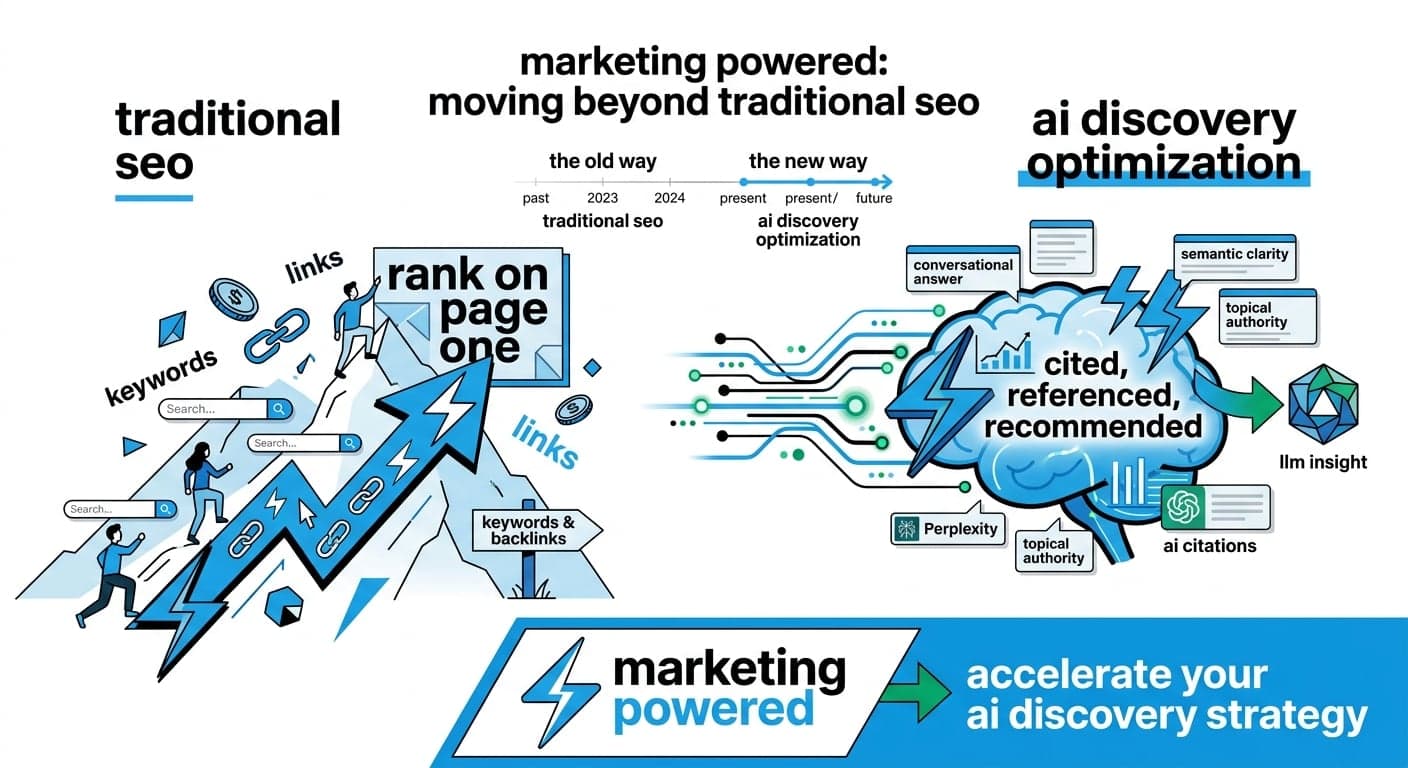
The Fundamental Shift from Ranking to Recommendation
For over two decades, SEO operated on a straightforward premise: optimize your content for search engine algorithms, earn higher rankings, and capture clicks from users scrolling through results pages. This model built empires. It created entire industries around keyword research, backlink acquisition, and technical optimization. And while these practices still hold value, they no longer represent the complete picture of digital discovery.
AI discovery optimization fundamentally reimagines how brands achieve visibility in an era where users increasingly receive synthesized answers rather than lists of links. When someone asks ChatGPT for treatment center recommendations, queries Perplexity about behavioral health marketing strategies, or receives an AI Overview in Google search results, they're experiencing a different kind of discovery—one where being cited matters more than being ranked.
The distinction is critical. Traditional SEO optimizes for algorithmic sorting of web pages. AI discovery optimization positions your brand to be referenced, recommended, and cited within AI-generated responses themselves. This isn't a subtle evolution; it's a paradigm shift that demands new frameworks, new metrics, and new strategic priorities.
Consider the mechanics: Large language models synthesize information from vast training datasets and real-time web access to generate contextually relevant responses. They don't present ten blue links—they present answers. Brands that appear within those answers gain unprecedented credibility and visibility. Brands that don't risk becoming invisible to growing segments of their audience.
At Marketing Powered, we've operated as an AI-native agency since 2022, managing over $50M in behavioral health and mental health marketing spend while tracking attribution through to actual admissions. This operational depth revealed early signals that discovery patterns were shifting. Our clients who invested in AI discovery optimization strategies saw their brands referenced in AI responses at rates that translated directly to qualified lead generation—proof that this isn't theoretical positioning but measurable business impact.
- Traditional SEO optimizes for ranking position; AI discovery optimization targets citation and recommendation within AI-generated responses
- LLMs synthesize information rather than sort links, creating new visibility dynamics
- Brand authority signals now influence whether AI systems reference your organization
- Early adopters gain compounding advantages as AI search adoption accelerates
- Attribution must evolve to track AI-referred traffic and conversions
The Role of Generative Engine Optimization
Free Audit
Want a straight read on where your budget is leaking?
How GEO Functions Within AI Discovery Strategies
Generative engine optimization—commonly abbreviated as GEO—represents the tactical discipline of optimizing content specifically for inclusion in AI-generated responses. Where traditional SEO targets search engine result pages, GEO targets the output of generative AI systems like ChatGPT, Google's AI Overviews, Perplexity, Claude, and the growing ecosystem of AI-powered discovery interfaces.
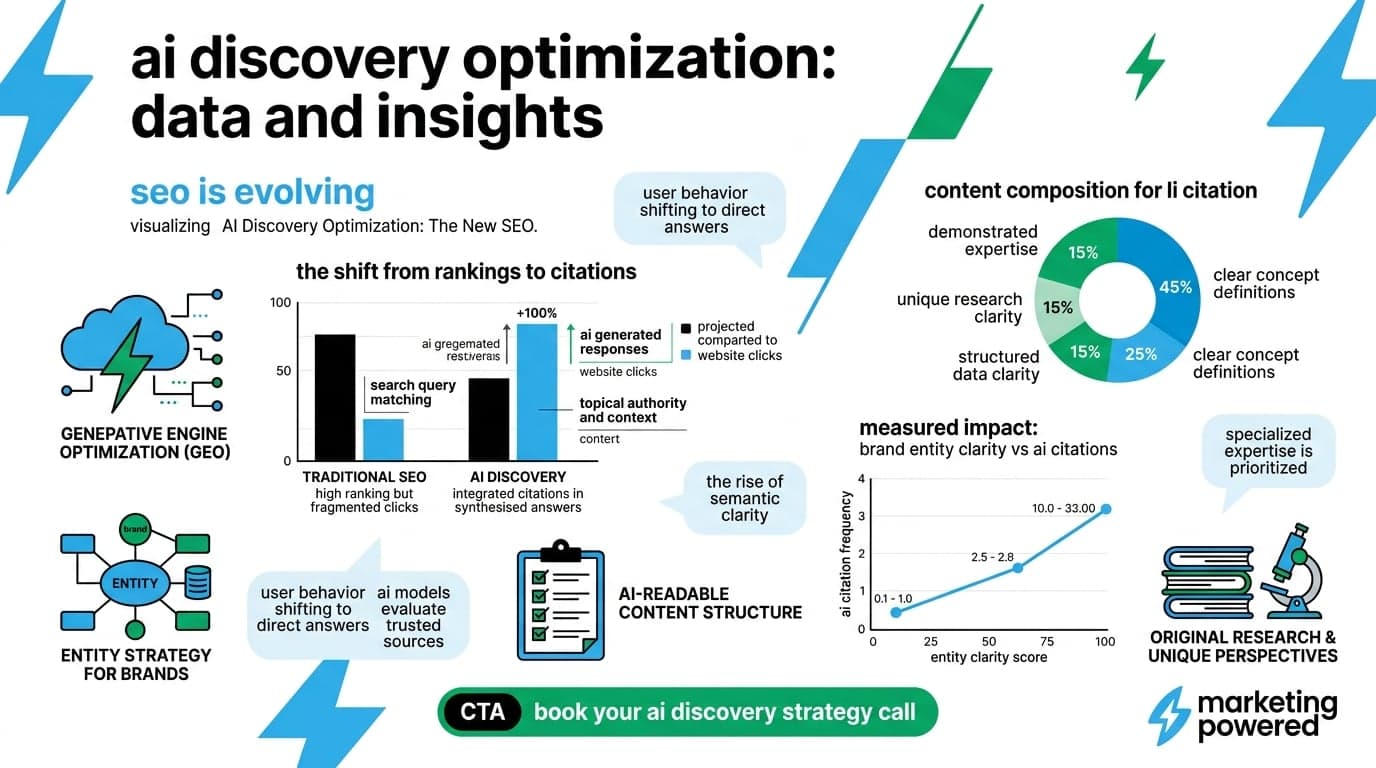
The mechanics differ substantially from conventional optimization. Generative engines don't evaluate content based on keyword density or even traditional relevance signals alone. They assess authority, comprehensiveness, factual accuracy, and contextual alignment with user intent. They favor sources that provide complete, well-structured information that can be synthesized into coherent responses.
This creates both opportunities and challenges for organizations accustomed to traditional SEO frameworks. The opportunity lies in the fact that quality content—genuinely authoritative, well-researched, and comprehensive—gains outsized advantages in GEO contexts. The challenge is that many conventional SEO tactics provide minimal benefit or even backfire when applied to generative optimization.
Consider how LLMs process and cite information. When a user asks an AI system about mental health marketing strategies, the model draws from its training data and any real-time web access to construct a response. Sources that consistently provide accurate, detailed, and authoritative information on the topic become more likely to be referenced. This means E-E-A-T signals—experience, expertise, authoritativeness, and trustworthiness—carry even greater weight in GEO than in traditional SEO.
Our work with behavioral health marketing clients has demonstrated this principle repeatedly. Organizations that invested in comprehensive, expert-driven content saw their brands cited in AI responses at significantly higher rates than competitors relying on thin, keyword-optimized pages. One treatment center network we partnered with increased their AI-referred traffic by building authoritative resource libraries that positioned them as category experts—content that LLMs consistently referenced when users queried related topics.
GEO also introduces new considerations around content structure. AI systems favor information that's clearly organized, logically structured, and easily extractable. This doesn't mean abandoning narrative quality for robotic formatting—rather, it means ensuring your content architecture allows AI systems to identify, extract, and cite relevant information efficiently.
- GEO targets inclusion in AI-generated responses rather than SERP rankings
- Authority and comprehensiveness outweigh traditional ranking factors
- E-E-A-T signals carry amplified importance for generative optimization
- Content structure must facilitate AI extraction and citation
- Brand citation in AI responses creates compounding visibility advantages
- Quality thresholds for GEO success exceed traditional SEO requirements
Impact of AI on Traditional SEO Practices
What's Changing and What Still Matters
The emergence of AI discovery optimization doesn't render traditional SEO obsolete—it transforms its role within a broader digital visibility strategy. Understanding what's changing versus what remains valuable allows organizations to allocate resources effectively rather than abandoning proven practices prematurely or clinging to tactics that no longer deliver returns.
Traditional SEO practices that retain value include technical optimization, site architecture, page speed, mobile responsiveness, and accessibility standards. Search engines still crawl and index websites. Users still click through to web pages. And the technical foundation that enables search visibility also supports AI system access to your content. Organizations that neglect technical SEO fundamentals will struggle with both traditional and AI-driven discovery.
What's diminishing in impact is the hyper-focus on keyword targeting and traditional link building as primary drivers of visibility. AI systems care less about exact-match keyword placement and more about topical authority and semantic relevance. They evaluate content quality at levels that make thin, keyword-stuffed pages nearly worthless for GEO purposes while rewarding comprehensive, expert-driven resources.
The shift also affects how we measure success. Traditional SEO metrics—rankings, organic traffic, click-through rates—tell an incomplete story when significant discovery happens through AI-mediated responses. Organizations need attribution frameworks that capture AI-referred traffic, track brand citation frequency in AI outputs, and measure downstream conversions from these emerging channels.
At Marketing Powered, our behavioral health marketing and mental health marketing clients benefit from attribution systems that track the full journey—from initial AI-referred discovery through to admission. This level of tracking revealed that AI-referred leads often demonstrate higher intent and faster conversion timelines than traditional organic traffic, likely because AI recommendations carry implicit endorsement that builds trust before users even reach your website.
LLM SEO—the practice of optimizing specifically for large language model visibility—also introduces new competitive dynamics. Organizations that establish early authority in AI training datasets and citation patterns gain advantages that compound over time. As AI systems learn to trust and reference certain sources, those sources receive ongoing visibility benefits that late movers struggle to replicate.
- Technical SEO fundamentals remain essential for both traditional and AI discovery
- Keyword-centric tactics provide diminishing returns compared to topical authority
- New attribution frameworks must capture AI-referred traffic and conversions
- AI-referred leads often show higher intent and faster conversion patterns
- Early authority establishment creates compounding advantages in AI systems
Strategy
Ready to map a growth plan built for your vertical?
Implementing AI Discovery Optimization in Organizations
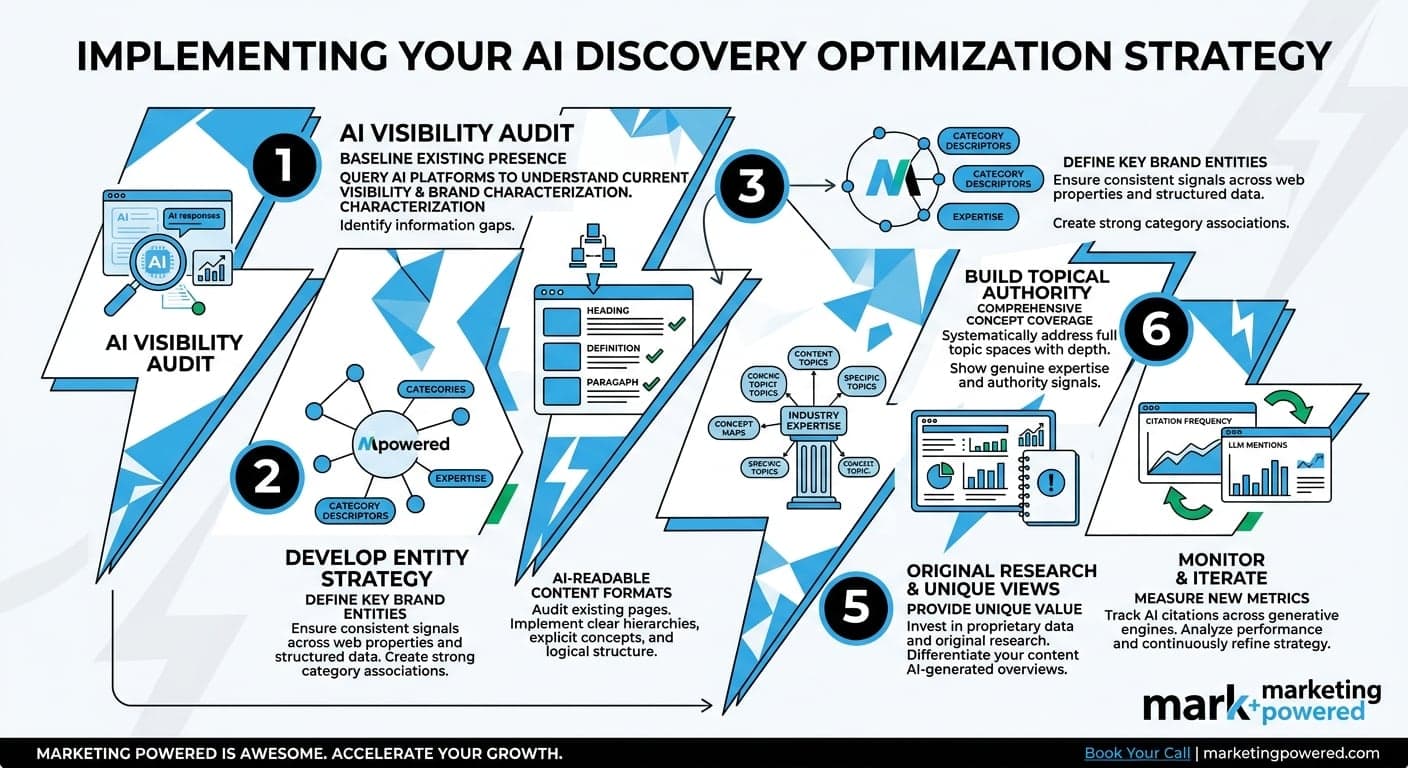
Practical Steps for Transitioning to AI-Focused Strategies
Transitioning from traditional SEO to comprehensive AI discovery optimization requires strategic planning, resource reallocation, and organizational alignment. The organizations that execute this transition effectively share common characteristics: they start with clear objectives, build on existing strengths, implement incrementally, and measure rigorously.
The first step involves auditing your current digital presence through an AI discovery lens. How does your brand appear when users query AI systems about topics relevant to your business? Are you cited, recommended, or mentioned in AI-generated responses? If not, what sources are being referenced instead? This baseline assessment reveals gaps and priorities that shape your implementation roadmap.
Content strategy requires significant evolution. AI discovery optimization demands comprehensive, authoritative content that establishes genuine expertise rather than surface-level pages targeting individual keywords. This often means consolidating thin content into definitive resources, investing in expert-authored material, and building content architectures that demonstrate topical depth across your domain.
For behavioral health marketing and treatment center marketing specifically, this translates to content that addresses the full spectrum of questions families, referral partners, and prospective patients might explore. Organizations that position themselves as authoritative resources on treatment modalities, outcomes, insurance navigation, and recovery support create the kind of comprehensive presence that AI systems favor when generating recommendations.
Technical implementation includes structured data markup that helps AI systems understand and extract information from your content. Schema implementation, clear heading hierarchies, and well-organized FAQ sections make your content more accessible to AI systems seeking authoritative sources to cite. These technical elements don't guarantee citation but remove barriers that might otherwise prevent it.
Attribution infrastructure must evolve alongside content and technical changes. Implementing tracking that identifies AI-referred traffic, monitoring brand citation frequency across AI platforms, and connecting these signals to downstream conversion metrics allows you to measure ROI and optimize investment allocation. Without proper attribution, you're operating blind in an increasingly important channel.
Organizational alignment matters as much as tactical execution. AI discovery optimization spans traditional SEO, content marketing, PR, and brand strategy. Siloed teams pursuing disconnected objectives will struggle to build the coherent authority signals that AI systems reward. Cross-functional collaboration—with clear ownership and shared metrics—enables the coordinated effort successful implementation requires.
- Audit current AI visibility by testing how your brand appears in AI-generated responses
- Evolve content strategy toward comprehensive, authoritative resources
- Implement structured data and clear content architecture for AI accessibility
- Build attribution systems that track AI-referred traffic and conversions
- Align cross-functional teams around shared AI discovery objectives
- Start with high-priority topics where you can establish genuine authority
- Monitor competitor citation patterns to identify competitive opportunities
Real-World Applications and Case Studies
Email Us
Prefer to talk it through over email?
Measurable Outcomes from AI Discovery Optimization
Theory matters less than results. Organizations across industries have implemented AI discovery optimization strategies with measurable impact on visibility, traffic quality, and business outcomes. These real-world applications demonstrate both the potential and the practical considerations that shape successful implementation.
In the behavioral health marketing space, we've observed treatment centers that invested early in AI discovery optimization achieve significant advantages over competitors still focused exclusively on traditional SEO. One network we partnered with built comprehensive resource libraries addressing every stage of the treatment journey—from initial recognition of symptoms through long-term recovery support. This content established them as an authoritative source that AI systems consistently referenced when users queried related topics.
The results extended beyond visibility metrics. AI-referred traffic demonstrated higher engagement rates, longer session durations, and faster movement through conversion funnels. When users arrived via AI recommendation, they came with a level of pre-established trust that traditional organic traffic rarely matched. This translated to improved lead quality and more efficient admission processes—exactly the outcomes that matter for treatment center marketing.
Brand citation in AI responses created additional benefits beyond direct traffic. As AI systems consistently referenced the organization in responses to relevant queries, brand awareness and perceived authority increased across their market. Referral partners mentioned encountering the brand in their own AI research. Prospective patients arrived already familiar with the organization's reputation. These second-order effects amplified the direct traffic benefits.
Implementation timelines varied based on starting position and resource allocation, but organizations that committed to comprehensive AI discovery optimization typically saw measurable citation improvements within three to six months. Full competitive advantage development required longer investment horizons, but early movers established positions that later entrants found difficult to displace.
The financial dynamics also proved favorable. While building authoritative content required upfront investment, the ongoing cost of maintaining AI visibility compared favorably to continuous paid media spend. Organizations that achieved strong brand citation in AI responses effectively created organic acquisition channels that delivered qualified leads without per-click costs—a particularly valuable outcome for behavioral health marketing where paid acquisition costs have risen significantly.
- Treatment center networks achieved measurable AI citation improvements within 3-6 months
- AI-referred traffic demonstrated higher engagement and faster conversion rates
- Brand citation created second-order benefits including referral partner awareness
- Comprehensive resource libraries established sustainable authority positions
- Cost per acquisition compared favorably to rising paid media costs in behavioral health
The Future of AI Search Optimization
Preparing for Continued Evolution
AI discovery optimization isn't a destination—it's an ongoing adaptation to continuously evolving AI capabilities and user behaviors. Organizations that succeed long-term build systems and capabilities for continuous learning rather than implementing fixed tactics and hoping they remain effective.
Several trends will shape AI search optimization in coming years. Multimodal AI systems will expand discovery beyond text to include images, video, and audio content. AI agents will execute complex tasks on behalf of users, making brand trust and verification even more critical. Real-time information access will increase the importance of fresh, updated content over static resources.
For behavioral health marketing and mental health marketing specifically, these trends create both opportunities and responsibilities. AI systems that recommend treatment options carry significant influence over vulnerable populations making critical decisions. Organizations that demonstrate genuine expertise, transparent practices, and verified outcomes will earn preferential citation as AI systems increasingly prioritize trustworthy sources for sensitive topics.
At Marketing Powered, our position as an AI-native agency—operating with AI integration since 2022, managing substantial behavioral health marketing budgets, and maintaining awareness of compliance requirements including LegitScript certification contexts and HIPAA considerations—positions us to help organizations navigate this evolution. Our founder's experience scaling operations and serving as a court-certified expert witness reflects the depth of category understanding that effective AI discovery optimization requires.
The organizations that thrive in this new landscape will be those that view AI discovery optimization not as a replacement for marketing fundamentals but as an evolution of how those fundamentals manifest. Quality content, genuine expertise, authentic authority, and measurable results—these principles don't change. How they're expressed and measured does. Adapting successfully requires both strategic vision and tactical execution, combining long-term authority building with continuous optimization based on emerging data.
- Multimodal AI will expand discovery to images, video, and audio content
- AI agents will increase importance of brand trust and verification
- Real-time information access will reward fresh, updated content
- Sensitive topics like behavioral health will see increased trust verification
- Successful organizations build capabilities for continuous adaptation
Free Audit
Want a straight read on where your budget is leaking?
Ready to Position Your Brand for AI Discovery?
The shift from traditional SEO to AI discovery optimization represents one of the most significant changes in digital marketing since the emergence of search engines themselves. Organizations that adapt now gain advantages that compound over time—while those that wait risk invisibility in an increasingly AI-mediated discovery landscape. At Marketing Powered, we combine AI-native capabilities with deep behavioral health marketing expertise to help treatment centers, mental health organizations, and growth-focused enterprises build sustainable AI discovery positions. Let's discuss your strategy, compliance requirements, lead quality objectives, and channel mix.
Questions, answered.
AI discovery optimization is the strategic practice of positioning your brand to be cited, recommended, and referenced within AI-generated responses. Unlike traditional SEO, which focuses on ranking in search engine results pages, AI discovery optimization targets inclusion in the synthesized answers that AI systems provide to user queries. This involves building genuine authority, creating comprehensive content, and structuring information for AI accessibility.
Generative engine optimization—or GEO—functions by optimizing content specifically for inclusion in outputs from AI systems like ChatGPT, Google's AI Overviews, and Perplexity. GEO prioritizes topical authority, content comprehensiveness, factual accuracy, and clear information structure over traditional keyword targeting. Success requires creating genuinely expert content that AI systems recognize as authoritative sources worth citing.
Traditional SEO methods aren't obsolete, but their effectiveness is diminishing as discovery patterns shift. When users receive synthesized answers from AI systems rather than clicking through lists of links, ranking position matters less than being cited within those answers. Keyword-focused tactics provide minimal benefit for AI citation, while thin content optimized for traditional ranking signals may be entirely ignored by generative systems seeking authoritative sources.
Organizations should begin with an AI visibility audit, testing how their brand appears in AI-generated responses to relevant queries. From there, content strategy should evolve toward comprehensive, expert-driven resources that establish genuine authority. Technical implementation includes structured data and clear content architecture. Attribution systems must capture AI-referred traffic. Most importantly, cross-functional teams need alignment around shared AI discovery objectives.
Brand citation in AI responses delivers multiple benefits: direct traffic from users who follow up on recommendations, pre-established trust that improves conversion rates, increased brand awareness as users encounter your organization across AI platforms, and referral partner awareness that influences professional recommendations. For behavioral health marketing, these benefits translate to higher-quality leads and more efficient admission processes.
Ready to see what AI-native marketing can do for your treatment center?
Request a free audit of your paid media, landing pages, attribution, and compliance posture. You'll get a straight assessment of where the opportunities are.
or email us at info@marketingpowered.ai