Resources
Mastering Creative Testing for Conversion Optimization
Systematic creative iteration turns ad spend into qualified admissions. Learn the frameworks that separate high-performing campaigns from wasted budget.
What is Creative Testing?
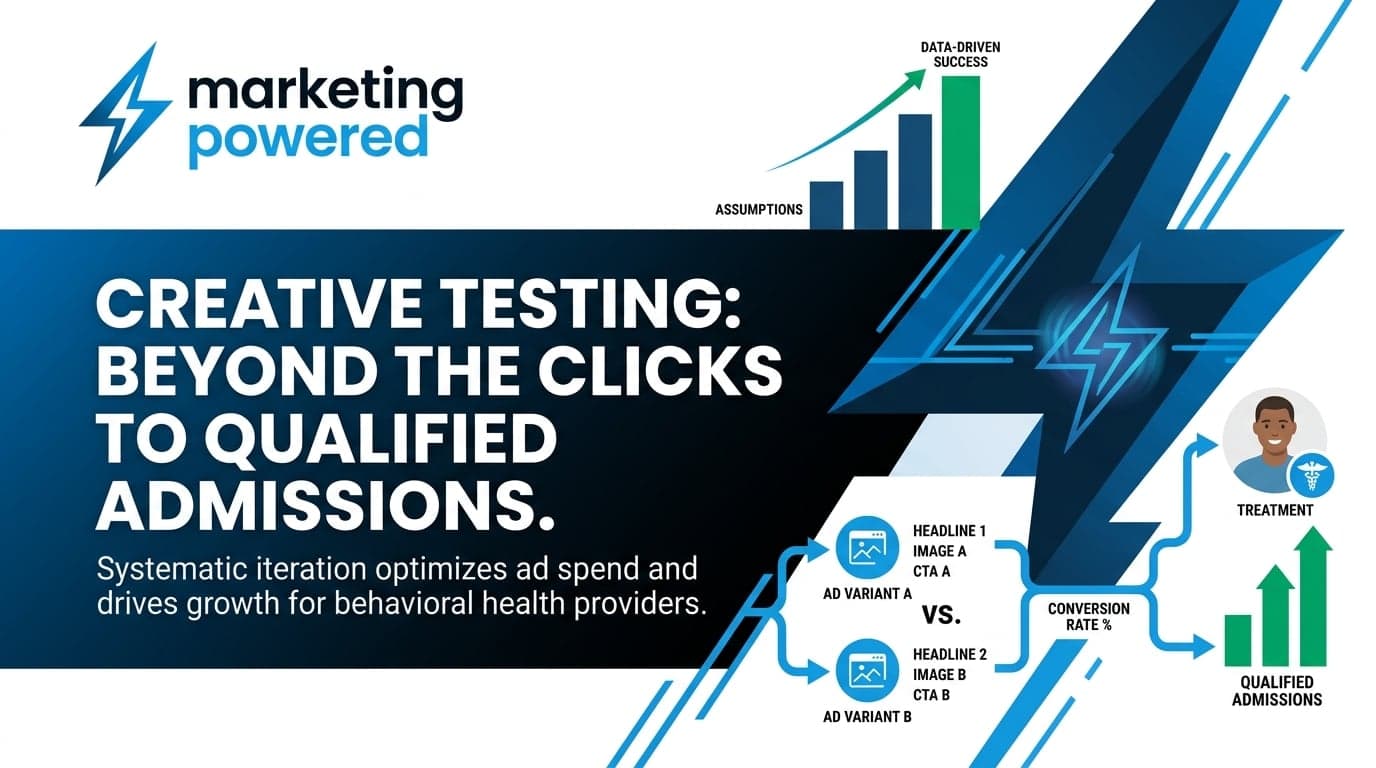
Creative testing is the systematic process of evaluating different ad elements to determine which combinations generate the strongest conversion performance. Rather than relying on assumptions about what resonates with your audience, creative testing provides data-driven answers about headline effectiveness, image selection, call-to-action phrasing, and overall messaging hierarchy.
In behavioral health marketing specifically, creative testing carries additional weight. The difference between a high-converting ad and a low-performer can mean thousands of dollars in cost-per-admission variance across a single month. With behavioral health marketing operating under strict platform restrictions, every creative asset must work harder to connect with individuals and families seeking treatment.
The elements available for testing span the full creative spectrum: headlines and subheadlines, primary images and video thumbnails, body copy length and tone, CTA button text and placement, color schemes and visual hierarchy, and landing page messaging alignment. Each variable can be isolated or combined to understand its contribution to conversion outcomes.
The Role of Ad Creative Strategy
A structured ad creative strategy provides the foundation for meaningful creative testing. Without strategic direction, testing becomes random experimentation that consumes budget without generating actionable insights.
An effective strategy starts with audience segmentation. For treatment centers, this means understanding the distinct motivations of self-referrals versus family members researching on behalf of a loved one. Each segment responds to different emotional triggers, proof points, and urgency cues. According to SAMHSA's National Survey on Drug Use and Health, treatment-seeking behavior varies significantly by demographic and substance type, making audience-specific creative essential.
Strategy also dictates testing velocity. Organizations managing significant paid media budgets can run multiple concurrent tests, while smaller programs may need sequential testing frameworks. The goal is consistent: isolate variables, measure impact, and scale what works while cutting what does not.
Techniques for Effective Creative Testing
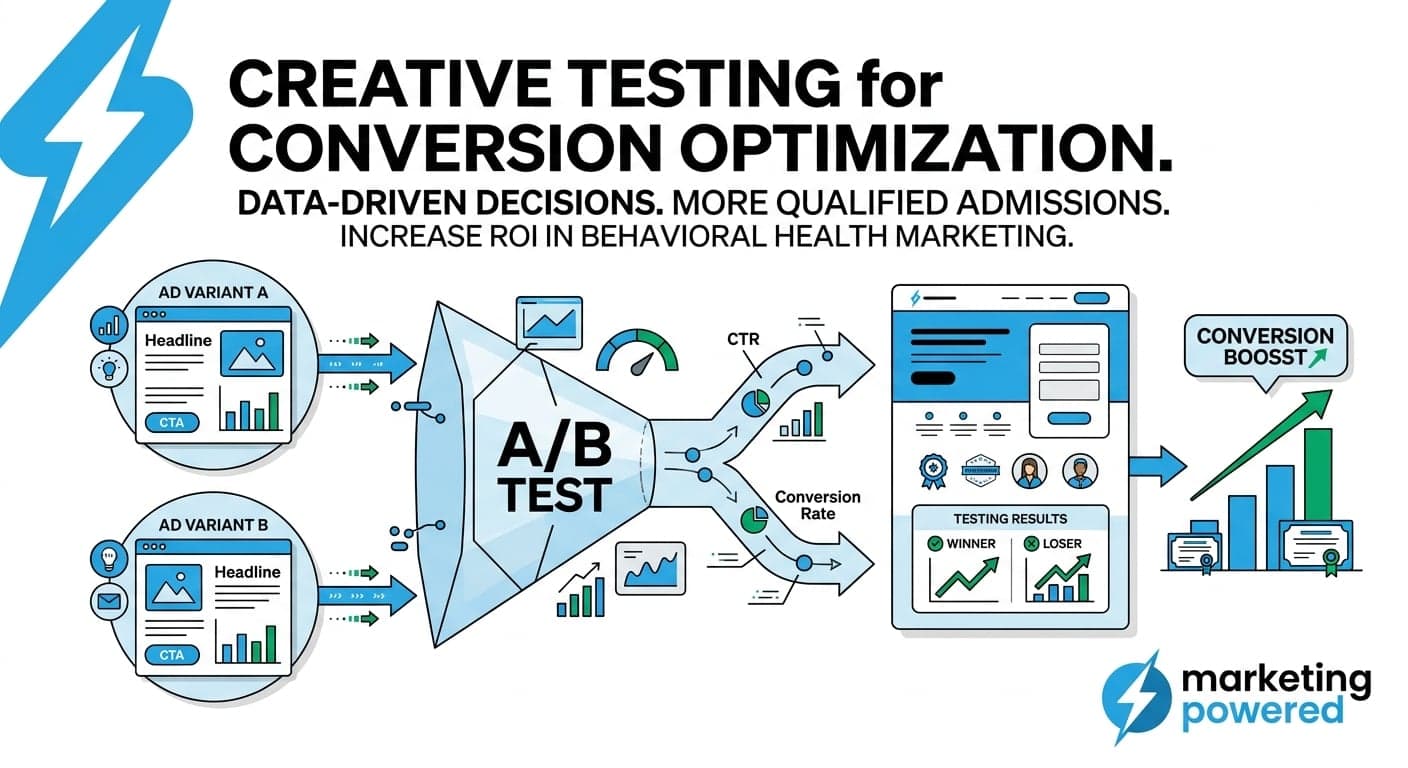
A/B testing remains the most accessible entry point for creative testing. The method isolates a single variable between two ad variants, with traffic split evenly to determine statistical significance. For behavioral health campaigns, A/B tests work well for headline comparisons, image selection, and CTA language.
Multivariate optimization extends this approach by testing multiple variables simultaneously. Machine learning algorithms route traffic to the highest-performing combinations in real time, accelerating the path to conversion-optimized creative. This technique is particularly valuable for landing pages where headline, hero image, form length, and trust signals all interact to influence conversion rates.
Statistical rigor matters. According to Google's best practices for experiment design, tests require sufficient sample size and duration to produce reliable results. Ending tests prematurely based on early data leads to false conclusions and misallocated budget.
For inpatient programs and other high-value conversion goals, even small improvements in conversion rate compound into significant admission volume over time. A 15% improvement in landing page conversion rate, sustained across a $1.5M to $2M monthly media spend, translates to meaningful census impact.
Free Audit
Want a straight read on where your budget is leaking?
Implementing Conversion-Focused Creative Iterations
Creative iteration with a conversion focus requires disciplined prioritization. Not every test idea deserves a budget. Start with the elements most likely to influence conversion decisions: above-the-fold messaging, form friction, and trust signal placement.
In behavioral health advertising, trust signals carry outsized importance. Families evaluating treatment options are making one of the most significant decisions of their lives. Creative iterations that introduce accreditation badges, staff credentials, or testimonial elements often outperform variants focused purely on promotional messaging.
Practical iteration examples include testing admission-focused headlines against education-focused alternatives to reveal audience intent alignment, testing short-form versus long-form landing pages to show whether your traffic prefers quick conversion paths or needs more information before committing, and testing phone number prominence versus form-first layouts to indicate whether your audience skews toward immediate voice contact or prefers digital inquiry.
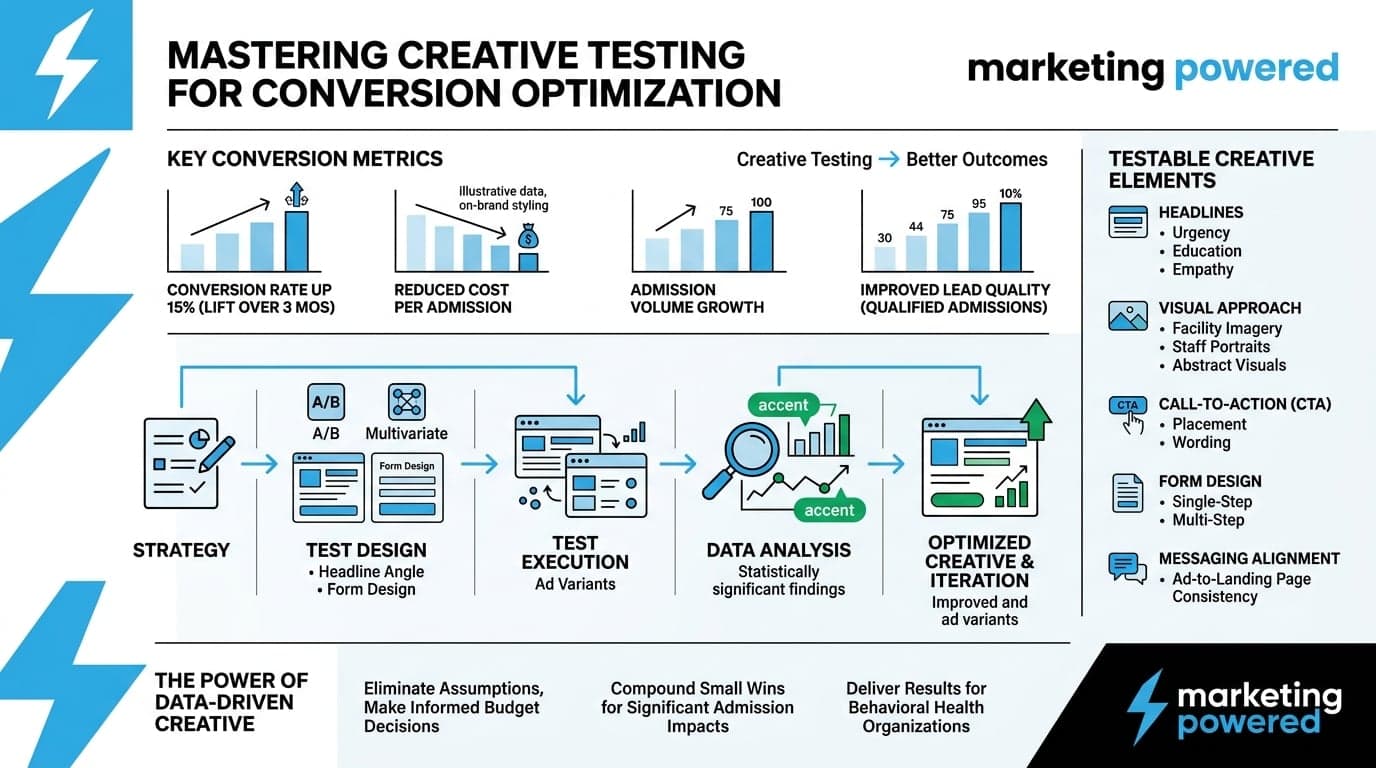
- Headline angle: urgency versus education versus empathy framing
- Visual approach: facility imagery versus staff portraits versus abstract supportive visuals
- Form design: single-step versus multi-step qualification
- Trust placement: above-fold accreditation versus testimonial integration versus outcome statistics
Measuring Success in Creative Testing
Conversion rate is the primary metric, but surface-level conversion tracking misses the full picture. For treatment centers, the metric that matters is cost per qualified admission, not cost per form fill.
Effective measurement requires attribution that tracks from ad impression through admission. This means connecting advertising data to intake outcomes, a capability that requires both technical infrastructure and HIPAA-conscious data handling practices.
When reviewing successful creative testing programs, the pattern is consistent: organizations that measure downstream conversion quality, not just top-of-funnel volume, make better creative decisions and achieve lower cost per admission over time.
- Click-through rate (CTR) as an indicator of creative relevance
- Conversion rate by creative variant
- Cost per conversion segmented by creative element
- Lead-to-admission rate to identify quality differences between creative approaches
- Return on ad spend (ROAS) at the creative level
Continue Building Your Marketing Foundation
Creative testing is one component of a comprehensive behavioral health marketing strategy. Explore our full resource library for insights on paid media, attribution, compliance, and conversion optimization tailored to treatment centers and mental health practices.
Questions, answered.
Creative testing is a structured process of evaluating different ad elements, including headlines, images, copy, and CTAs, to identify which combinations generate the strongest conversion performance. The goal is to replace assumptions with data, allowing marketers to allocate budget toward proven creative approaches rather than guessing what resonates with their audience.
A well-developed ad creative strategy ensures testing efforts align with audience segments and business objectives. Strategic planning identifies which variables to test, establishes hypothesis frameworks, and prioritizes tests likely to produce the largest conversion impact. Without a strategy, testing becomes random experimentation that consumes budget without generating actionable insights.
A/B testing isolates single variables for clear comparison, while multivariate optimization tests multiple elements simultaneously using machine learning to identify winning combinations. Both require sufficient sample size and test duration to achieve statistical significance. The right technique depends on traffic volume, budget, and the complexity of elements being evaluated.
Creative that prioritizes conversion outcomes directly impacts cost per acquisition and return on ad spend. For behavioral health organizations, where each admission represents significant lifetime value, even modest conversion improvements compound into substantial revenue impact over time. Conversion-focused creative also improves lead quality by attracting individuals more likely to complete the admission process.
Primary metrics include conversion rate by creative variant and cost per conversion. For treatment centers, downstream metrics matter more: cost per qualified admission and lead-to-admission rate reveal whether creative changes improve volume or quality. Click-through rate indicates initial creative relevance, while ROAS at the creative level shows overall financial impact.
Ready to see what AI-native marketing can do for your treatment center?
Request a free audit of your paid media, landing pages, attribution, and compliance posture. You'll get a straight assessment of where the opportunities are.
or email us at info@marketingpowered.ai