Resources
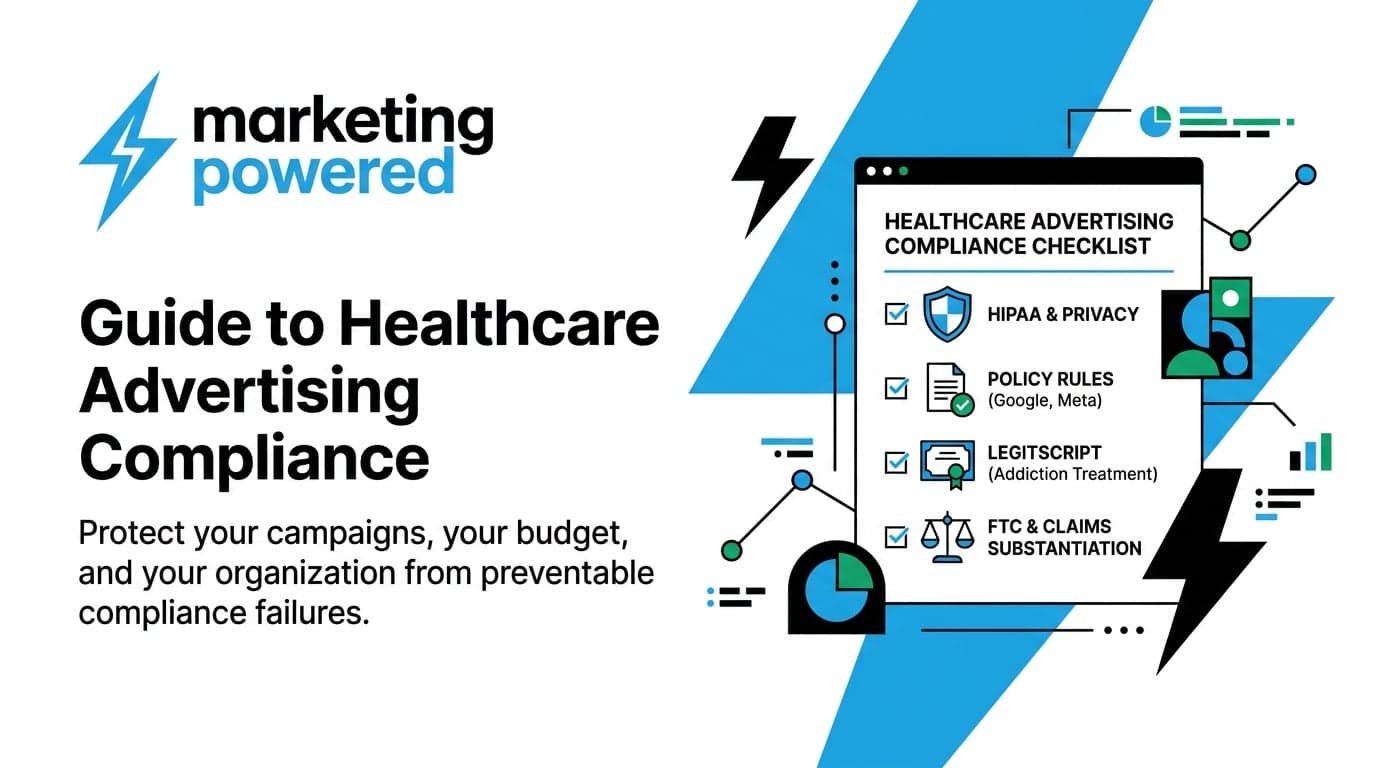
Guide to Healthcare Advertising Compliance
Protect your campaigns, your budget, and your organization from preventable compliance failures.
Understanding Healthcare Advertising Compliance
Healthcare advertising compliance is not optional. It is the foundation that determines whether your campaigns run, get flagged, or expose your organization to regulatory action. For behavioral health and mental health providers, the stakes are higher: stricter platform policies, additional certification requirements, and federal regulations that carry real consequences for violations.
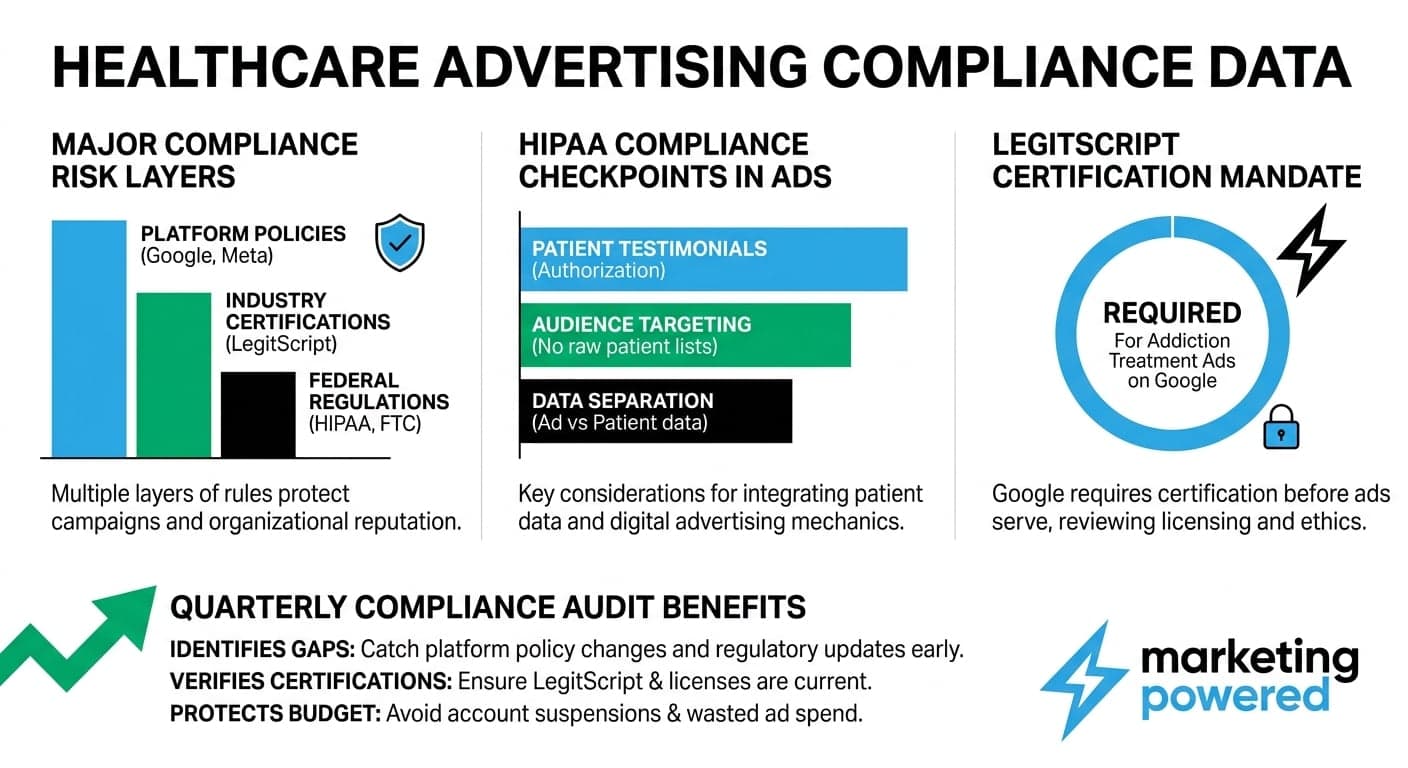
At its core, healthcare advertising compliance means ensuring every ad, landing page, and targeting strategy meets the requirements set by federal regulations (HIPAA, FTC), industry certifications such as LegitScript, and platform-specific policies from Google, Meta, and Microsoft. Failure at any layer creates risk. An ad that violates HIPAA can result in fines up to $1.5 million per violation category per year according to HHS Office for Civil Rights guidance. An ad that violates platform policy simply does not run, and repeated violations can result in account suspension.
The complexity compounds when you operate in what Google and Meta classify as sensitive verticals. Behavioral health, addiction treatment, and mental health services face additional restrictions that general healthcare advertisers do not. Retargeting is prohibited. Certain claims are banned. Certification requirements like LegitScript for addiction treatment advertising on Google add another compliance layer before your first ad can even serve.
Understanding these requirements is not just about avoiding penalties. It is about building advertising infrastructure that can scale without interruption. Organizations that treat compliance as an afterthought find themselves rebuilding campaigns, losing momentum, and explaining gaps to leadership. Those that build compliance into their process from the start protect both their budgets and their reputations.
Essential Regulatory Requirements
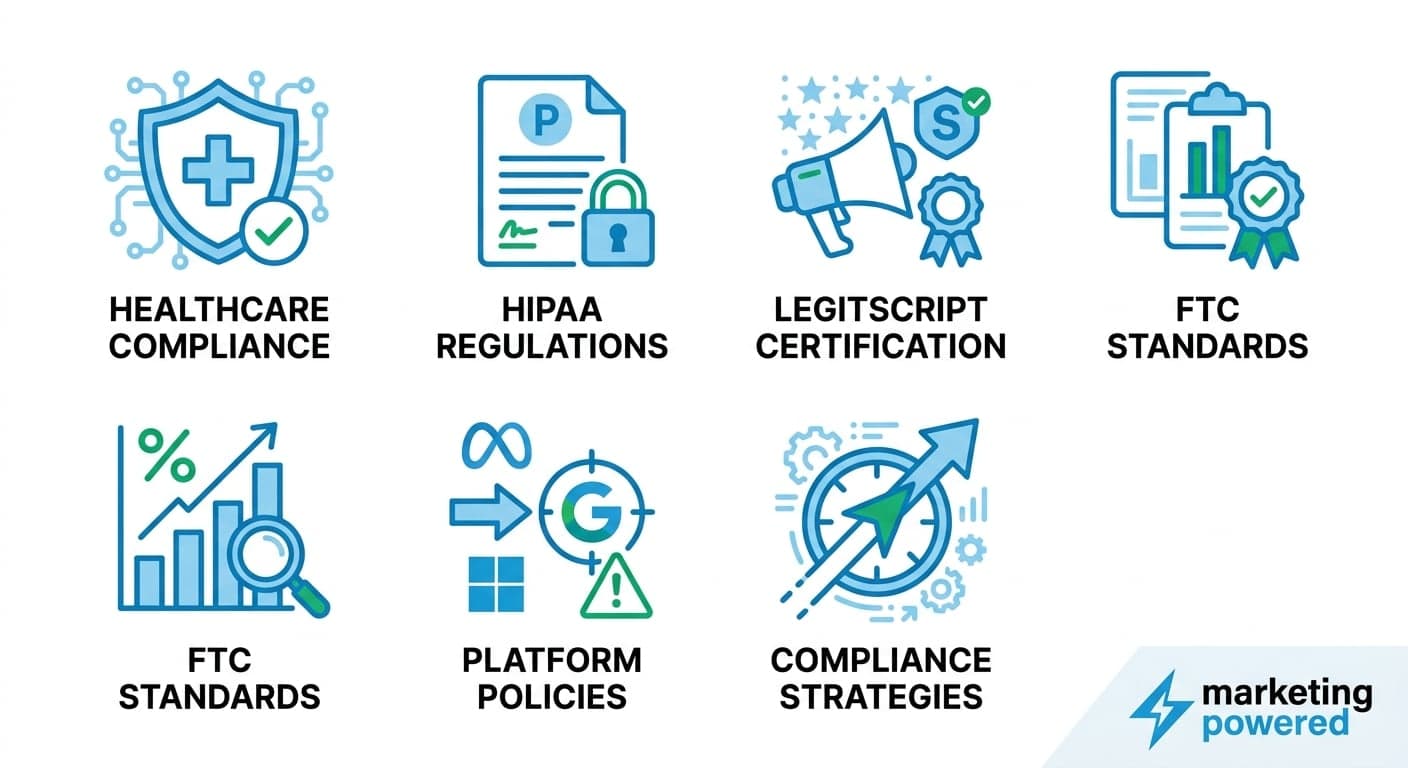
Three regulatory frameworks govern most healthcare advertising compliance decisions: HIPAA, LegitScript certification, and FTC advertising standards.
HIPAA restricts how you can use patient information in advertising. This affects everything from audience targeting (no uploading patient lists to ad platforms without a compliant process) to testimonials (no identifying information without explicit authorization). The HHS HIPAA Privacy Rule sets the baseline, but practical application requires understanding how these rules interact with digital advertising mechanics.
LegitScript certification is required for addiction treatment advertisers on Google. Without it, your ads will not serve. The certification process reviews your organization's licensing, accreditation, and business practices. It is not a rubber stamp. LegitScript's certification standards require documentation of state licensure, accreditation status, and adherence to ethical advertising practices.
FTC advertising standards prohibit deceptive claims across all industries, but healthcare faces additional scrutiny. Claims about treatment outcomes, success rates, or comparative effectiveness require substantiation. The FTC Health Products Compliance Guidance provides baseline requirements that apply regardless of platform.
Non-adherence carries consequences beyond fines. Google account suspensions can take weeks to resolve. LegitScript decertification removes your ability to advertise on the largest search platform. HIPAA violations trigger mandatory breach notification processes that damage patient trust.
Platform-Specific Advertising Rules
Each advertising platform interprets healthcare compliance differently. What runs on Microsoft Advertising may get rejected on Google. What Google approves may violate Meta's Special Ad Categories requirements.
Google Ads classifies addiction treatment, mental health services, and certain medical procedures as sensitive verticals. Addiction treatment advertisers must hold LegitScript certification and complete Google's application process. Mental health advertisers face restrictions on claims and targeting. Retargeting users who visited treatment-related pages is prohibited under Google's healthcare and medicines policy.
Meta (Facebook and Instagram) requires healthcare advertisers to comply with Special Ad Categories restrictions, which limit targeting options significantly. You cannot target based on health conditions, and lookalike audiences are restricted. Meta's advertising policies for healthcare prohibit before-and-after images, claims about specific outcomes, and content that implies knowledge of a user's health status.
Microsoft Advertising generally follows similar restrictions but has different certification requirements and review processes. LinkedIn, owned by Microsoft, adds B2B targeting options but maintains healthcare content restrictions.
The practical implication: ad creative and targeting strategies that work on one platform often require modification for others. A compliant Google campaign is not automatically compliant on Meta. Building platform-specific compliance into your campaign development process prevents rejection cycles and wasted spend.
Free Audit
Want a straight read on where your budget is leaking?
Strategies for Ensuring Compliance
Compliance is a process, not a one-time checklist. Regulations change. Platform policies update. What was compliant six months ago may trigger a rejection today.
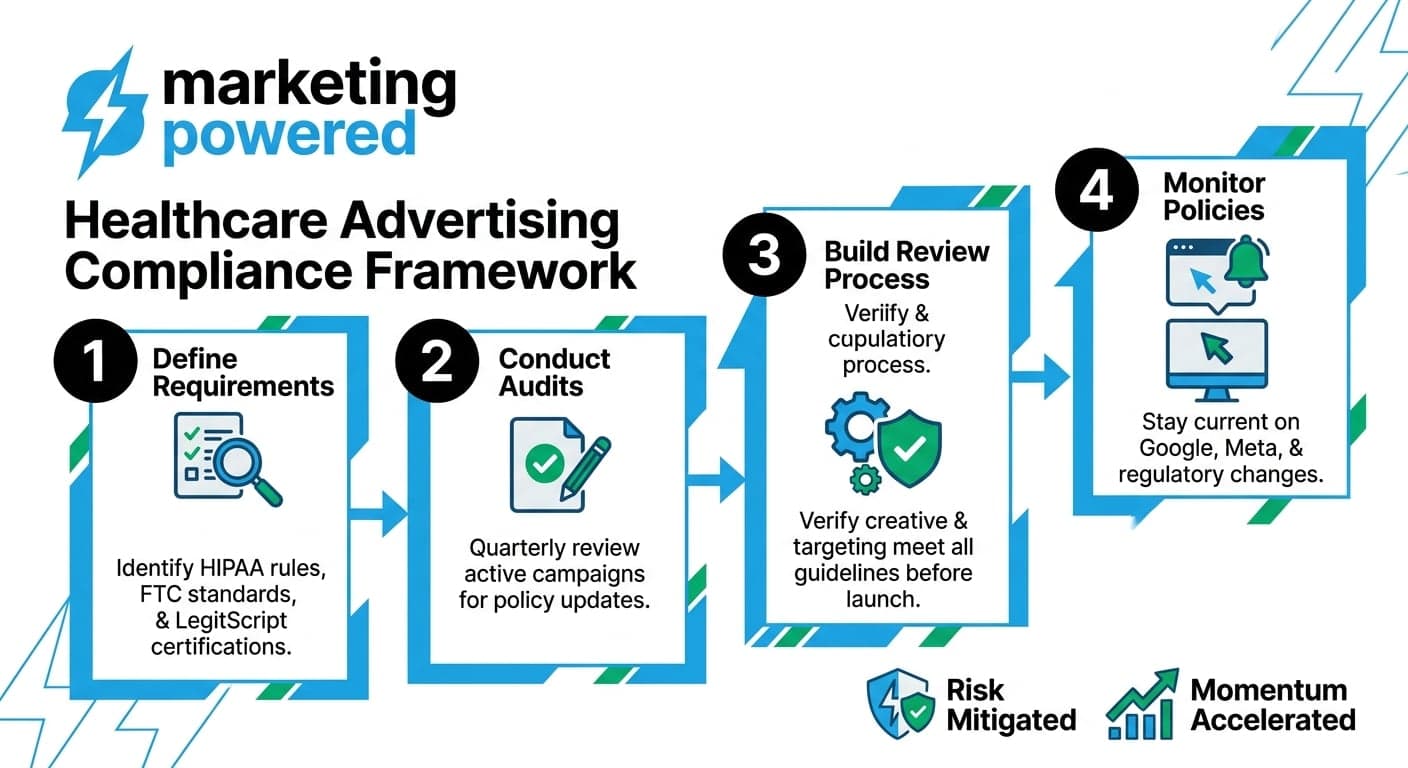
Conduct regular compliance audits. Review active campaigns quarterly against current platform policies. Check that certifications (LegitScript, state licensure) remain current and linked to your advertising accounts. Audit landing pages for claims that may have been compliant when written but now violate updated guidelines.
Build compliance review into campaign development. Before any ad goes live, verify it meets HIPAA requirements for health information, platform-specific content restrictions, and FTC substantiation standards. Document approvals so you can demonstrate compliance if challenged.
Monitor policy updates actively. Subscribe to Google Ads policy update notifications, Meta Business Help Center updates, and LegitScript communications. Policy changes often have implementation deadlines measured in weeks, not months.
Maintain separation between patient data and advertising data. This is the simplest way to avoid HIPAA complications in digital advertising. If patient lists never enter your advertising platforms, you eliminate an entire category of compliance risk.
Partnering with Experts for Compliance
Managing healthcare advertising compliance internally requires dedicated resources, continuous education, and direct experience with platform enforcement. Many organizations find that partnering with a specialized agency reduces risk and improves campaign performance.
Marketing Powered has managed over $50M in behavioral health and mental health media spend. We have operated under LegitScript certification requirements, Google's sensitive vertical restrictions, and Meta's Special Ad Categories since before most agencies understood these frameworks existed. Our team has scaled organizations through multi-market growth while maintaining compliance across every campaign.
When you work with a team that understands both the regulatory requirements and the practical realities of ad policy compliance, you avoid the trial-and-error cycle that costs budget and momentum. You get campaigns built for approval from the start, with documentation and processes that protect your organization.
If you are responsible for ensuring your healthcare advertising meets all regulatory requirements, a compliance audit is the starting point. We review your current campaigns, identify gaps, and provide a clear path to compliant, effective advertising.
Get Your Compliance Audit
Stop guessing whether your healthcare advertising meets regulatory requirements. Our compliance audit reviews your current campaigns against HIPAA, LegitScript, and platform-specific policies, then delivers a clear action plan for compliant, effective advertising.
Questions, answered.
HIPAA governs patient information use in advertising, including targeting and testimonials. LegitScript certification is required for addiction treatment advertising on Google. FTC standards prohibit deceptive claims and require substantiation for health-related outcomes. For behavioral health and mental health advertisers, all three frameworks apply simultaneously, and platform-specific policies add additional requirements on top of federal regulations.
Facebook (Meta) requires healthcare advertisers to comply with Special Ad Categories restrictions, which limit targeting options and prohibit lookalike audiences based on health data. Avoid before-and-after images, claims about specific treatment outcomes, and any content that implies knowledge of a user's health condition. Review Meta's advertising policies for healthcare before launching campaigns and build compliance review into your creative approval process.
A compliance audit reviews your active campaigns, landing pages, and advertising account configurations against current regulatory requirements and platform policies. The audit identifies gaps where your current practices may violate HIPAA, LegitScript standards, or platform rules. It also verifies that certifications are current and properly linked to your advertising accounts. Regular audits (quarterly is recommended) catch issues before they result in account suspensions or regulatory action.
Healthcare advertising compliance requires specialized knowledge that most general marketing agencies lack. An agency with direct experience in behavioral health and mental health verticals understands LegitScript certification processes, Google's sensitive vertical restrictions, and HIPAA implications for digital advertising. This experience translates to campaigns built for approval from the start, faster resolution when issues arise, and documented processes that protect your organization during audits or reviews.
Ready to see what AI-native marketing can do for your treatment center?
Request a free audit of your paid media, landing pages, attribution, and compliance posture. You'll get a straight assessment of where the opportunities are.
or email us at info@marketingpowered.ai