Resources
Master Behavioral Health SEO Strategies
A specialized approach to search visibility for treatment centers, built on $50M+ in managed behavioral health media spend and operator-level compliance knowledge.
Understanding Behavioral Health SEO
Behavioral health SEO differs from general healthcare marketing in ways that matter to your admission numbers. Standard local SEO playbooks miss the compliance requirements, sensitive content restrictions, and patient privacy considerations that define this vertical. A treatment center cannot approach search optimization the same way a dental practice or urgent care clinic would.
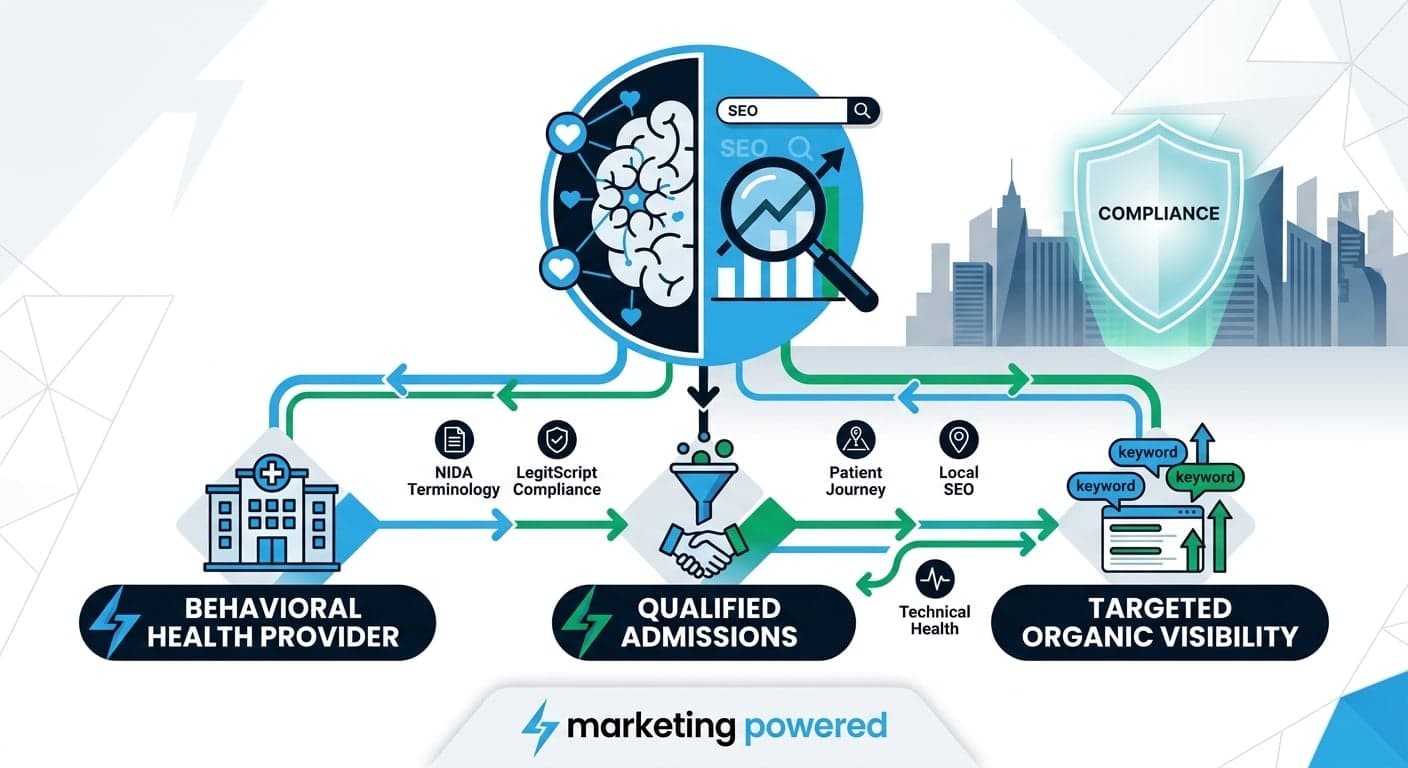
The behavioral health space operates under heightened scrutiny. Google classifies addiction treatment and mental health services as a sensitive healthcare vertical, which affects how content is indexed and how ads can be served. LegitScript certification is required for paid advertising, and that compliance posture should extend to organic content strategy as well.
Keyword research in this space requires understanding search intent at a granular level. Someone searching 'alcohol detox near me' has different needs than someone searching 'signs of alcohol addiction in a family member.' Both queries matter, but they sit at different points in the decision journey and require different content approaches.
Patient privacy adds another layer. Content must educate and convert without crossing into territory that could expose protected health information or make claims that violate HIPAA guidelines. This is where generalist SEO agencies often fail: they optimize for traffic without understanding the regulatory environment that governs what you can and cannot say.
Effective SEO Strategies for Behavioral Health
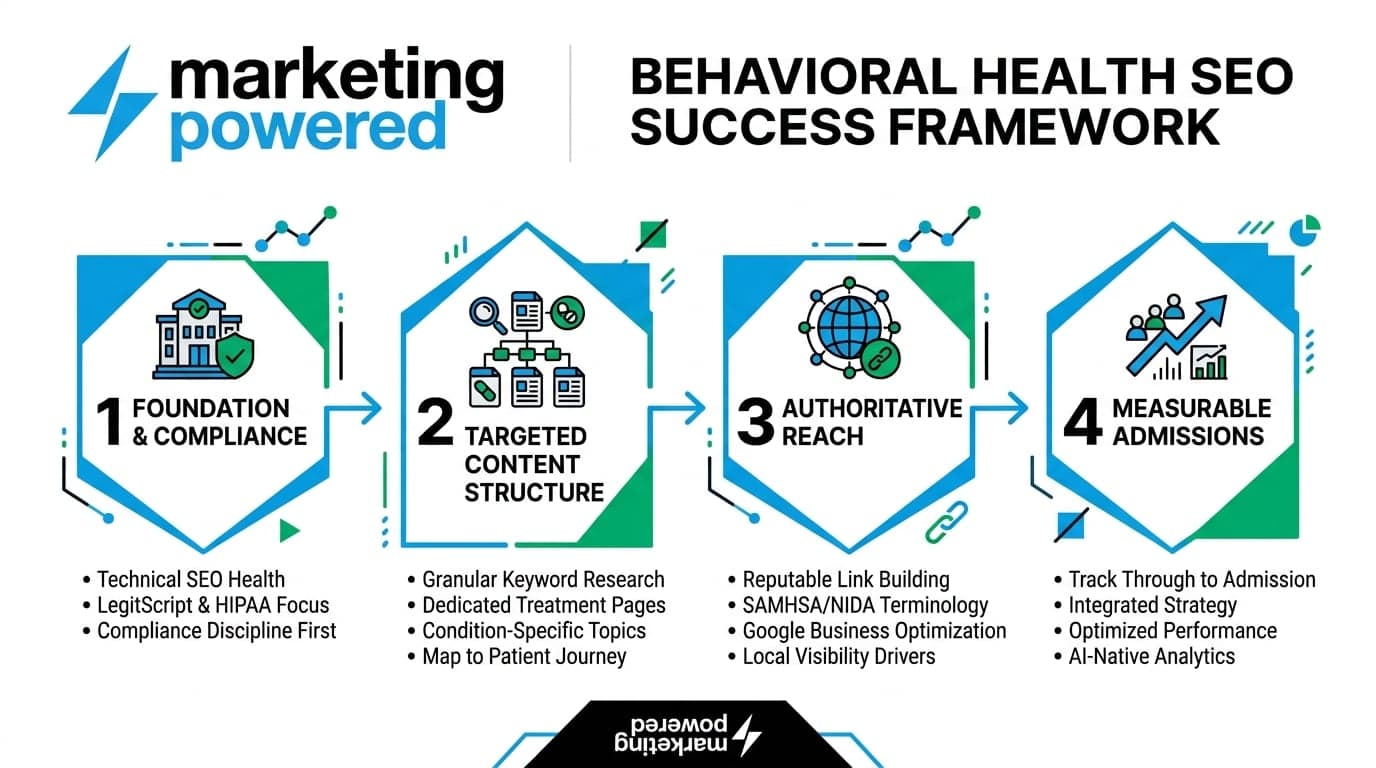
On-page optimization for behavioral health starts with content architecture. Your site needs dedicated pages for each treatment modality, each substance or condition you treat, and each location you serve. This structure captures long-tail search queries while demonstrating topical authority to search engines.
Technical SEO fundamentals apply here as they do elsewhere: fast page load times, mobile responsiveness, clean URL structures, and proper schema markup. But the content layer is where differentiation happens. Treatment centers that publish authoritative, clinically accurate content outperform those relying on thin service pages.
Off-page strategies in behavioral health require careful partner selection. Link building in this vertical means earning citations from reputable healthcare directories, clinical resources, and community organizations. Quality signals from authoritative domains carry more weight than volume from low-quality sources. In behavioral health, a link from SAMHSA or a state health department resource page is worth more than dozens of generic directory listings.
Local SEO deserves particular attention. Most treatment centers serve defined geographic areas, and 'near me' searches drive significant admission inquiries. Google Business Profile optimization, consistent NAP (name, address, phone) data across directories, and location-specific landing pages form the foundation of local visibility.
We have managed behavioral health solutions across facilities ranging from single-location outpatient centers to multi-state treatment networks. The strategies scale, but the compliance discipline remains constant.
SEO for Addiction Treatment Centers
Addiction treatment SEO operates under even tighter constraints than general behavioral health marketing. Google's policies specifically address addiction treatment advertising, and that scrutiny extends to organic content that could be seen as misleading or exploitative.
Content for addiction treatment must balance clinical accuracy with accessibility. The National Institute on Drug Abuse (NIDA) provides evidence-based terminology and treatment descriptions that can anchor your content strategy. Using clinically recognized language signals credibility to both search engines and prospective patients researching treatment options.
Keyword targeting for addiction treatment should map to the patient journey. Early-stage queries often focus on recognizing symptoms or understanding options. Mid-funnel queries compare treatment approaches or investigate specific facilities. Late-stage queries are location-specific and action-oriented. Your content architecture should address each stage.
Our work with addiction treatment strategies has shown that facilities publishing comprehensive, condition-specific content consistently outperform those with generic service pages. A detailed page on medication-assisted treatment for opioid use disorder, for example, captures search volume that a general 'drug rehab' page cannot.
Attribution matters here. We track through to admission, not just to form fill. During operator-side multi-market growth, SEO was part of an integrated strategy where every channel's contribution to actual admissions was measured and optimized.
Free Audit
Want a straight read on where your budget is leaking?
Avoiding Compliance Pitfalls in Behavioral Health SEO
Compliance failures in behavioral health SEO create real business risk. A content violation can result in ad account suspension, LegitScript decertification, or regulatory action. The cost of fixing these problems far exceeds the cost of building compliance into your strategy from the start.
HIPAA considerations affect content in ways many marketers overlook. Patient testimonials require proper authorization. Case studies must be anonymized carefully. Even stock photography selection matters: images should not depict identifiable individuals in treatment contexts without documented consent. The HHS Office for Civil Rights provides guidance on marketing communications under HIPAA that every behavioral health marketer should review.
LegitScript certification is mandatory for Google Ads in the addiction treatment space, but the standards it represents should inform organic content as well. Claims must be substantiated. Outcomes cannot be guaranteed. Language must be accurate and non-exploitative.
Content moderation extends to user-generated content. If your site includes forums, comment sections, or patient review features, you need moderation protocols that prevent the inadvertent publication of PHI or inappropriate claims.
We bring LegitScript and HIPAA awareness to every engagement. Our compliance approach treats regulation as a foundation, not an afterthought. This is operator experience, not just agency knowledge.
Further Resources and Next Steps
Behavioral health SEO requires sustained attention. Search algorithms evolve, competitors adjust their strategies, and regulatory requirements shift. A point-in-time optimization project helps, but an ongoing strategy delivers compounding returns.
For teams building internal SEO capability, our behavioral health marketing guides provide frameworks you can apply immediately. For those seeking a deeper partnership, our case studies demonstrate what an integrated strategy looks like in practice.
The next step depends on where you are. If you have an existing SEO program and want to identify gaps, an audit provides a clear picture of technical issues, content opportunities, and competitive positioning. If you are building from scratch, a strategy session maps the path from the current state to measurable organic growth.
Marketing Powered has managed $50M+ in behavioral health and mental health media spend. We have scaled facilities from startup to multi-state networks. We track attribution through to admission, not just to a click. And we have been AI-native since 2022, which means our analytical capabilities extend beyond what traditional agencies can offer.
Whether you are optimizing an existing site or planning a new digital presence, the conversation starts with understanding your specific situation, your compliance requirements, and your growth targets.
Request an SEO Audit
Get a clear picture of your current organic visibility, technical SEO health, and content opportunities. We will assess your competitive positioning, identify compliance gaps, and outline a path to measurable growth in qualified admission inquiries.
Questions, answered.
Behavioral health SEO is search engine optimization tailored to the specific requirements of treatment centers, mental health practices, and addiction treatment facilities. It differs from general healthcare SEO in its compliance requirements (LegitScript, HIPAA), content restrictions under Google's sensitive healthcare vertical policies, and the need for clinically accurate terminology that matches how patients actually search for treatment options.
Targeted SEO increases visibility for high-intent searches like 'drug rehab near me' or 'outpatient mental health treatment [city].' When your facility appears in these results with authoritative, relevant content, you capture inquiries from patients actively seeking treatment. We track attribution through to admission, so SEO performance is measured by actual patient volume, not just traffic or form fills.
Yes. Addiction treatment SEO requires condition-specific content pages, location-targeted landing pages, and careful keyword selection that aligns with NIDA and SAMHSA terminology. Content must avoid outcome guarantees and exploitative language. Technical optimization should support LegitScript certification requirements, and link building should prioritize authoritative healthcare and recovery resources.
Compliance failures create tangible business risk: ad account suspensions, LegitScript decertification, HIPAA violations, and reputational damage. Google classifies behavioral health as a sensitive vertical with specific content and advertising restrictions. Building compliance into your SEO strategy from the start protects your marketing investment and your facility's credibility.
Ready to see what AI-native marketing can do for your treatment center?
Request a free audit of your paid media, landing pages, attribution, and compliance posture. You'll get a straight assessment of where the opportunities are.
or email us at info@marketingpowered.ai