Resources
Your Comprehensive Guide to AI in Marketing
Practical applications, automation tools, and compliance considerations for healthcare marketers ready to implement AI-driven strategies.
Introduction to AI in Marketing
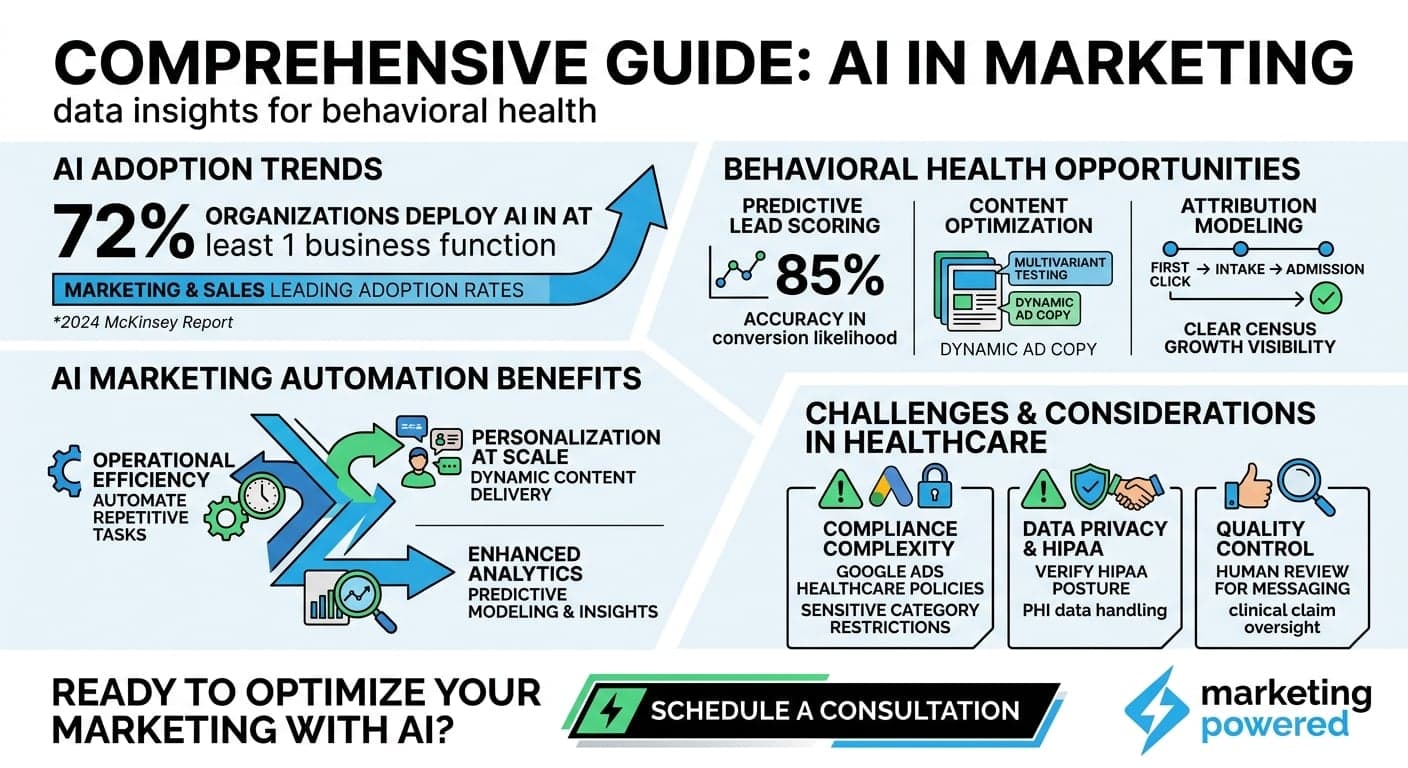
This AI marketing guide exists because the gap between organizations using AI effectively and those still relying on manual processes grows wider every quarter. According to a 2024 McKinsey report on AI adoption, 72% of organizations now deploy AI in at least one business function, with marketing and sales leading adoption rates.
For behavioral health and mental health marketing organizations, AI presents specific opportunities: predictive lead scoring that identifies high-intent prospects, content optimization that respects compliance boundaries, and attribution modeling that tracks the full journey from first click to admission.
The shift is not theoretical. Marketing Powered has been AI-native since 2022, managing over $50M in behavioral health and mental health media spend with AI systems built on proprietary infrastructure. This guide covers the practical applications, tools, and considerations that matter for healthcare marketers ready to move beyond experimentation.
Key Applications of AI in Marketing
AI in marketing extends far beyond chatbots and basic automation. The applications that generate measurable results fall into distinct categories, each with specific use cases for healthcare organizations.
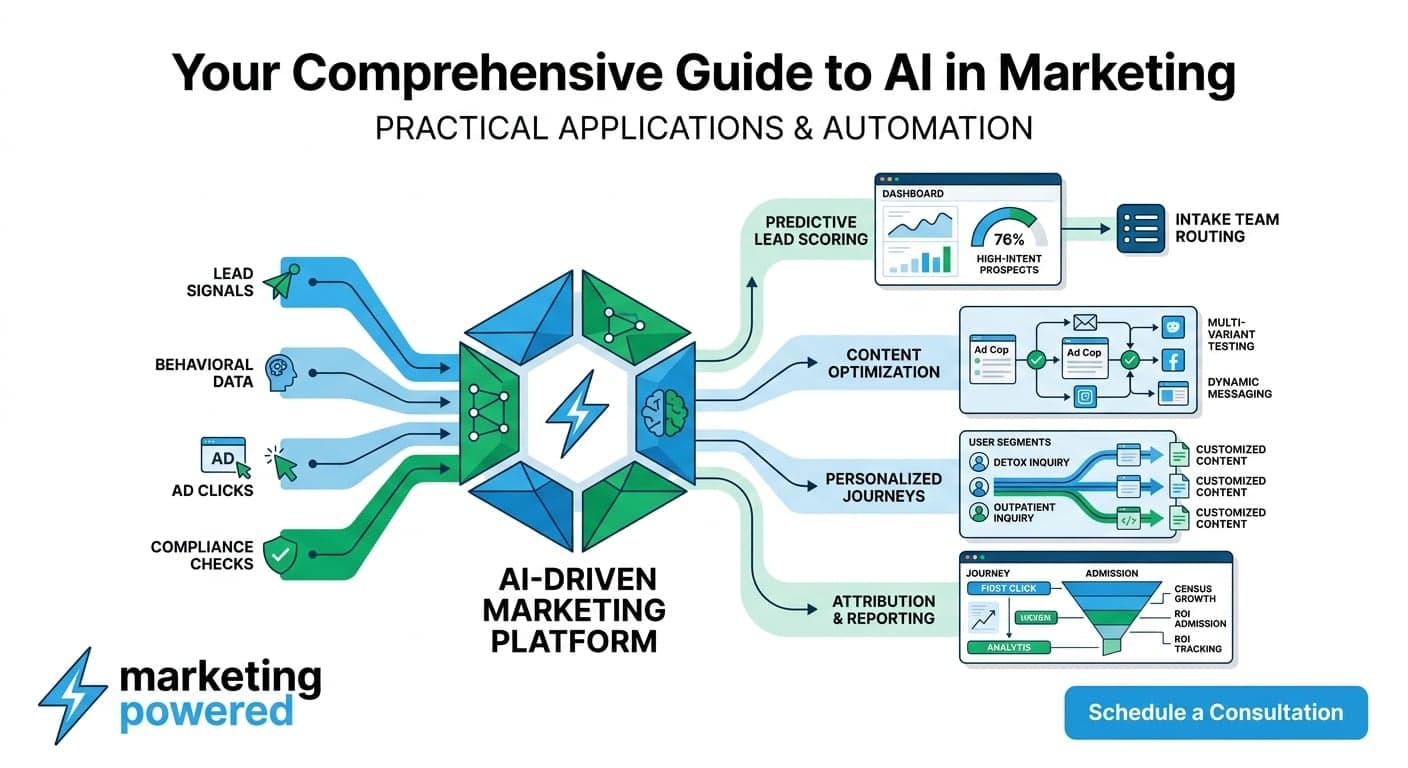
- Predictive analytics and lead scoring: AI models analyze behavioral signals to score leads based on the likelihood to convert. For treatment centers, this means intake teams spend time on prospects who match your ideal patient profile rather than chasing low-quality inquiries.
- Content creation and optimization: Generative AI produces ad copy variations, landing page content, and email sequences at scale. Multi-variant optimization then tests these variations against real traffic, routing each visitor to the version most likely to convert based on their characteristics.
- Personalized marketing at scale: AI enables dynamic content delivery based on user behavior, demographics, and intent signals. A prospect researching detox programs sees different messaging than someone exploring outpatient options.
- Attribution and analytics: Machine learning models process complex, multi-touch journeys to assign credit accurately. Marketing Powered tracks attribution through to admission, giving operators clear visibility into which channels and campaigns generate actual census growth.
- Customer service automation: AI-powered systems handle initial inquiries, qualify leads, and route conversations to human staff when appropriate. This extends intake capacity without adding headcount.
AI Marketing Automation Tools
The AI marketing resources available today range from enterprise platforms to specialized point solutions. Understanding the landscape helps you choose tools that fit your organization's scale and compliance requirements.
CRM and marketing automation platforms: Systems like HubSpot, Salesforce Marketing Cloud, and ActiveCampaign now embed AI for lead scoring, send-time optimization, and predictive analytics. These platforms work well for organizations with established marketing operations.
Ad platform AI features: Google's Performance Max and Meta's Advantage+ campaigns use machine learning to optimize bidding, targeting, and creative delivery. For paid media services in healthcare verticals, these tools require careful configuration to respect sensitive category restrictions.
Specialized AI tools: Platforms like Jasper, Copy.ai, and Persado focus on content generation. Analytics tools like Pecan and 6sense add predictive capabilities to existing data stacks.
The distinction that matters: most agencies wrap commercial APIs and call it AI capability. Marketing Powered runs proprietary AI systems on owned infrastructure, a Mac Studio M3 Ultra cluster with local inference that maintains data sovereignty. PHI never leaves controlled environments. This architecture supports HIPAA-conscious operations that commercial SaaS tools cannot match.
Free Audit
Want a straight read on where your budget is leaking?
Challenges and Considerations
AI adoption in healthcare marketing carries specific risks that generic implementation guides overlook.
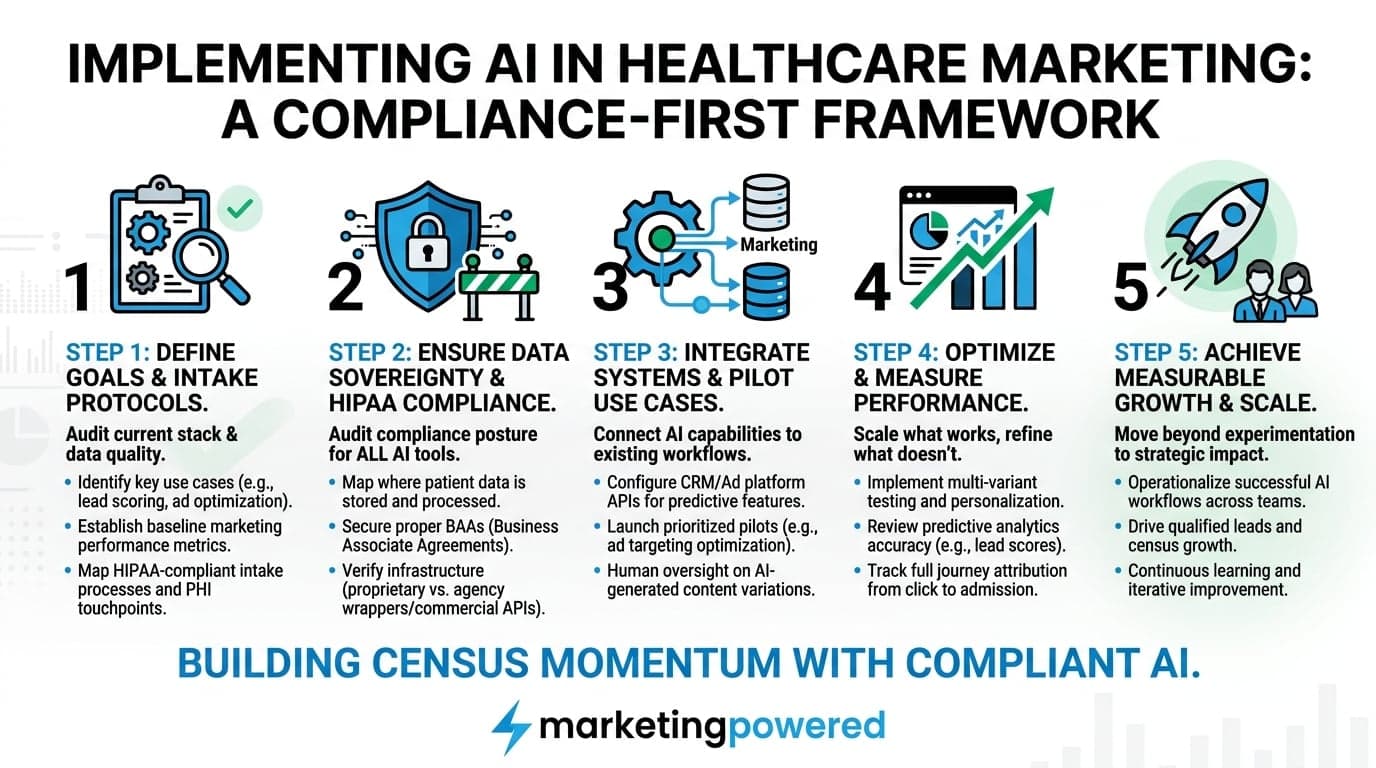
Compliance complexity: Google Ads healthcare policies restrict targeting and messaging for behavioral health advertisers. Mental health falls under sensitive category rules that prohibit retargeting. AI systems must be configured to respect these boundaries, or you risk account suspension.
Data privacy and HIPAA: AI tools that process patient information create business associate obligations. Many commercial platforms lack the infrastructure for compliant healthcare data handling. Before connecting any AI tool to your CRM or intake systems, verify its HIPAA posture.
Quality control: AI-generated content requires human review, especially for healthcare messaging. Clinical claims, outcome language, and treatment descriptions need expert oversight to avoid compliance violations and maintain trust.
Integration with existing workflows: AI tools deliver value when they connect to your actual processes. Standalone experiments rarely scale. Plan for integration with your CRM, ad platforms, and attribution systems from the start.
Resources and Next Steps
Building AI capability in healthcare marketing requires both technical infrastructure and strategic expertise. The organizations seeing results combine internal learning with specialized partners who understand the vertical.
Start with our AI-edge services overview to understand how proprietary AI infrastructure differs from agency wrappers on commercial tools. Review our case studies to see specific outcomes, including how we managed operator-side multi-market growth with AI-powered media optimization.
For hands-on learning, explore our web development and paid media resources. When you are ready to discuss implementation for your organization, request an audit or schedule a consultation to review your current stack, compliance posture, and growth objectives.
Ready to Implement AI in Your Marketing Strategy?
Schedule a consultation to discuss strategy, compliance requirements, lead quality, and channel mix. We will review your current operations and identify where AI-driven optimization can generate measurable growth for your organization.
Questions, answered.
AI in marketing delivers three primary benefits: operational efficiency through automation of repetitive tasks, personalization at scale through dynamic content and targeting, and enhanced analytics through predictive modeling and attribution. For behavioral health organizations specifically, AI enables better lead scoring to identify high-intent prospects, compliance-aware content optimization, and attribution tracking from first click through admission.
AI enhances marketing automation by optimizing send times based on individual user behavior, scoring leads automatically based on conversion likelihood, personalizing content dynamically for each recipient, and identifying patterns in campaign performance that human analysts miss. The key difference from traditional automation: AI systems learn and improve continuously rather than executing static rules.
Common AI marketing tools include CRM platforms with embedded AI (HubSpot, Salesforce), ad platform features (Google Performance Max, Meta Advantage+), content generation tools (Jasper, Copy.ai), and predictive analytics platforms (Pecan, 6sense). For healthcare marketers, tool selection must account for data privacy requirements and sensitive vertical restrictions that limit what commercial platforms can handle compliantly.
AI marketing tools scale across organization sizes. Many platforms offer tiered pricing that makes entry-level AI capabilities accessible to smaller practices. The key consideration is not budget but readiness: organizations need clean data, defined processes, and clear goals before AI tools deliver meaningful value. Starting with one focused use case, like ad optimization or email send-time testing, often works better than broad implementation.
AI improves customer experience through faster response times via automated initial contact, more relevant messaging through personalization, and smoother journeys through predictive routing. For treatment centers, this translates to intake processes that match prospects' needs with appropriate program information, reducing friction during a high-stakes decision.
Ready to see what AI-native marketing can do for your treatment center?
Request a free audit of your paid media, landing pages, attribution, and compliance posture. You'll get a straight assessment of where the opportunities are.
or email us at info@marketingpowered.ai