Research
LLM Advertising Early Signals: An In-Depth Research Study
A comprehensive research study examining the emerging patterns, adoption indicators, and strategic implications of advertising within large language model interfaces.
Introduction to LLM Advertising
Understanding the foundation of a new advertising paradigm
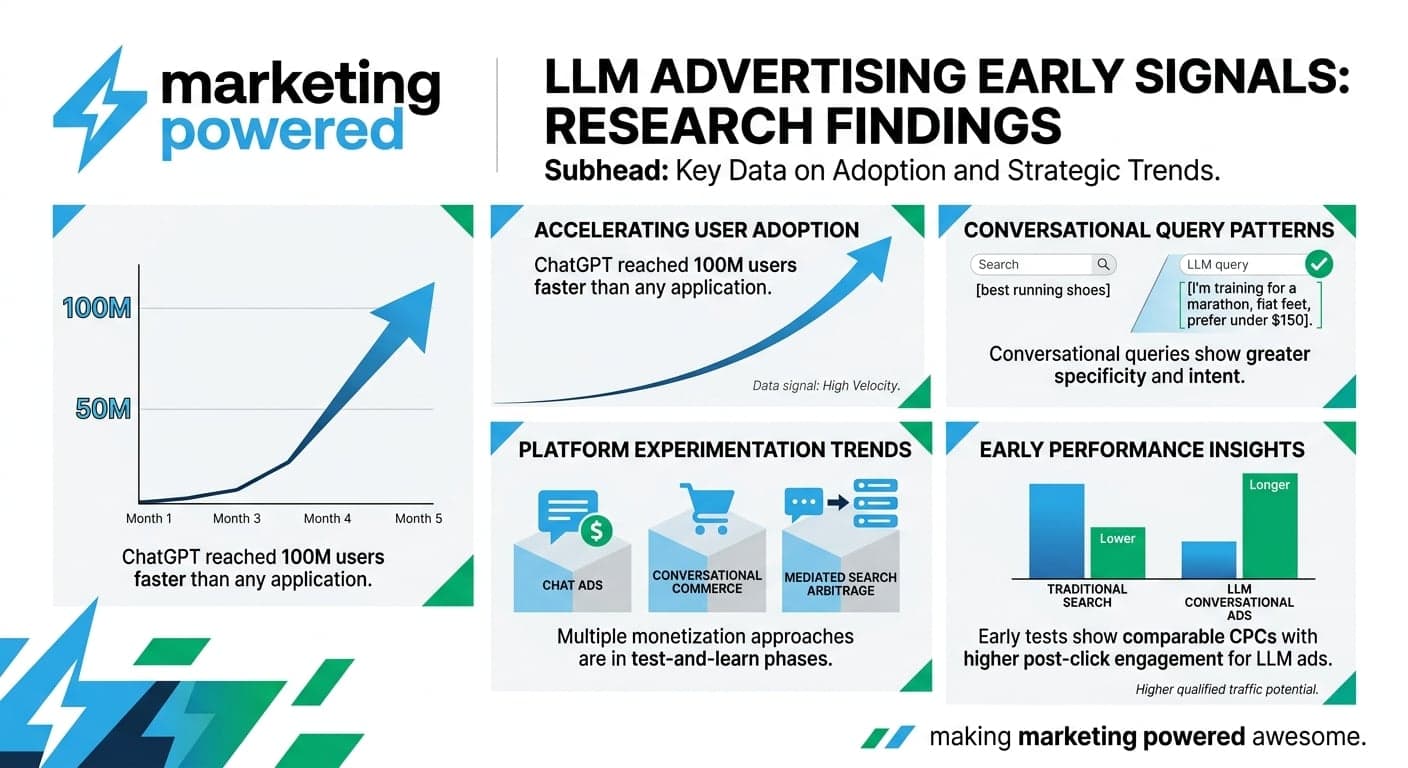
Large language models have moved from research curiosity to consumer utility in under three years. ChatGPT reached 100 million users faster than any application in history, according to a Reuters analysis published in early 2023. That velocity created something advertisers have not seen since the early days of search: a new surface where intent, context, and purchase consideration converge in a single interaction. LLM advertising early signals are now visible across platform announcements, patent filings, and beta tests. The question is no longer whether advertising will appear in AI assistants. The question is how, when, and under what constraints.
For advertising executives and media analysts, the strategic imperative is clear. Early movers in search advertising captured category positions that remained defensible for decades. The same dynamic is forming around LLM interfaces. Recognizing the patterns now, before standardized ad units and auction mechanics solidify, creates optionality that late entrants will not have.
This study synthesizes publicly available data, platform announcements, and observable market behavior to map the early signals in LLM advertising. We examine current trends, analyze specific indicators, present industry insights, address adoption challenges, and offer a forward-looking framework for strategic planning. The goal is not prediction for its own sake. The goal is decision-quality insight for executives allocating budget, evaluating partnerships, and positioning their organizations for a channel that does not yet have a rate card.
Marketing Powered approaches this research from an operator perspective. Our team has managed significant media spend in behavioral health and mental health verticals, navigating Google's sensitive vertical restrictions and platform policy changes that reshape channel economics overnight. That experience informs how we read early signals: not as abstract trends, but as indicators that will eventually determine cost structures, compliance requirements, and competitive positioning.
Current Trends in LLM Advertising
Free Audit
Want a straight read on where your budget is leaking?
Mapping the observable patterns across platforms and markets
The LLM advertising trends emerging in 2024 and early 2025 cluster around three observable patterns: sponsored context injection, conversational commerce integration, and AI-mediated search arbitrage. Each pattern represents a distinct approach to monetizing attention within language model interfaces, and each carries different implications for advertisers.
Sponsored context injection appears in systems where brand or product information is included in the model's response based on commercial relationships. Microsoft's early experiments with Bing Chat included retailer integrations that surfaced product recommendations within conversational answers. The company positioned these as chat ads that would appear alongside organic responses. The signal here is format experimentation: platforms are testing how commercial content can appear without breaking the conversational flow that makes LLMs useful.
Conversational commerce integration takes a different approach. Rather than inserting ads into responses, this pattern embeds transaction capability directly into the conversation. A user asking an AI assistant about running shoes might receive a response that includes a purchase path, not a link to a retailer's site, but a direct add-to-cart action within the interface. Amazon's Rufus, launched in early 2024, demonstrates this pattern. The assistant answers product questions and facilitates purchases without leaving the conversational context. For advertisers, this collapses the funnel: awareness, consideration, and conversion happen in a single exchange.
AI-mediated search arbitrage represents the most immediate revenue opportunity for LLM providers. When a language model cannot answer a question from its training data, it can route the user to a traditional search interface where established ad auction economics apply. Perplexity AI's model includes sponsored related questions that function as a bridge between conversational AI and search advertising. This hybrid approach lets platforms monetize LLM interactions without building entirely new ad infrastructure.
- Platform experimentation is accelerating. Google, Microsoft, Amazon, and emerging players like Perplexity are all testing monetization approaches, creating a fragmented but active testing environment.
- User tolerance for commercial content in AI interfaces remains an open question. Early surveys suggest users expect AI assistants to be neutral, which creates tension with advertising models that depend on commercial influence.
- Attribution complexity is increasing. When a purchase decision is influenced by an AI conversation, traditional click-based attribution fails to capture the value created in the conversational context.
- Regulatory attention is forming. FTC guidance on AI claims and the EU AI Act's transparency requirements will shape what kinds of advertising disclosures LLM providers must make.
Analyzing Early Signals in LLM Advertising
Specific indicators and their strategic significance
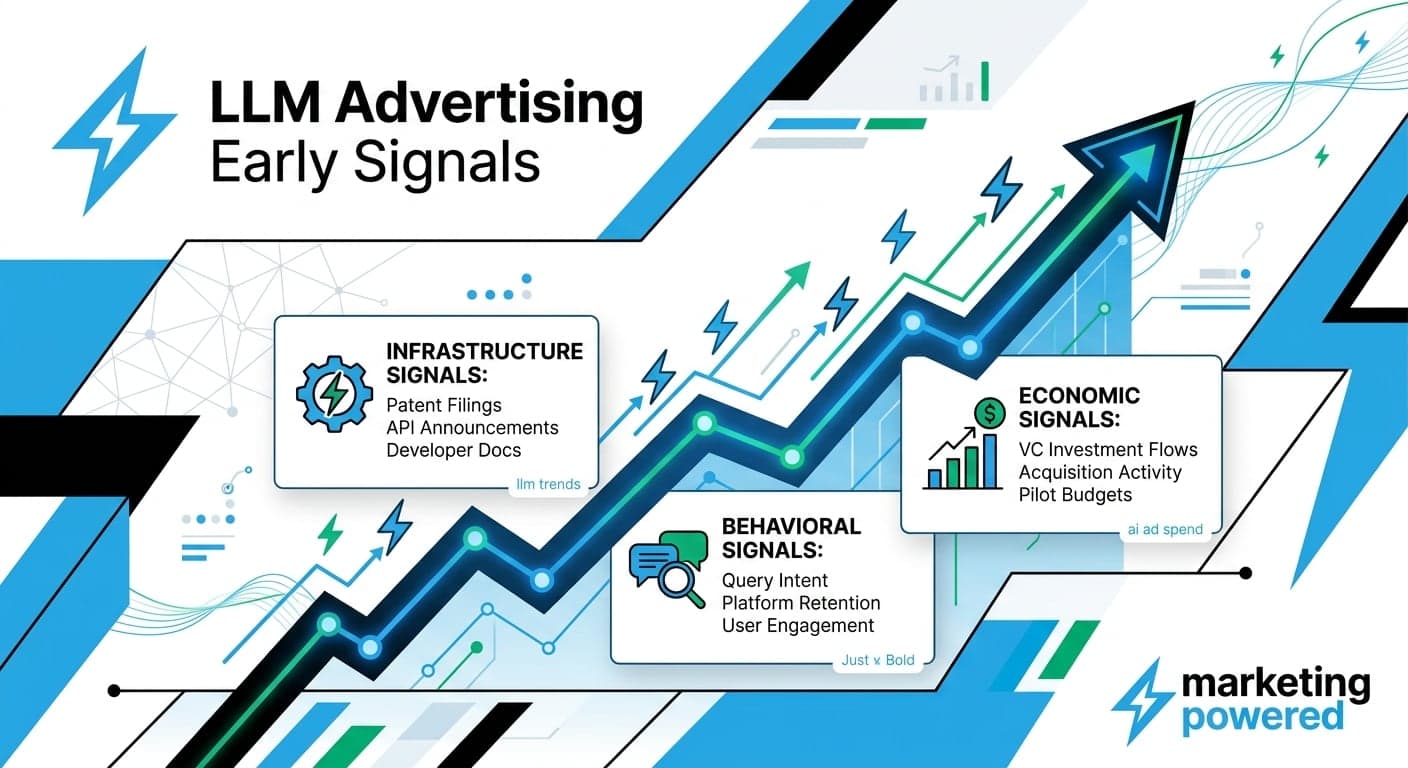
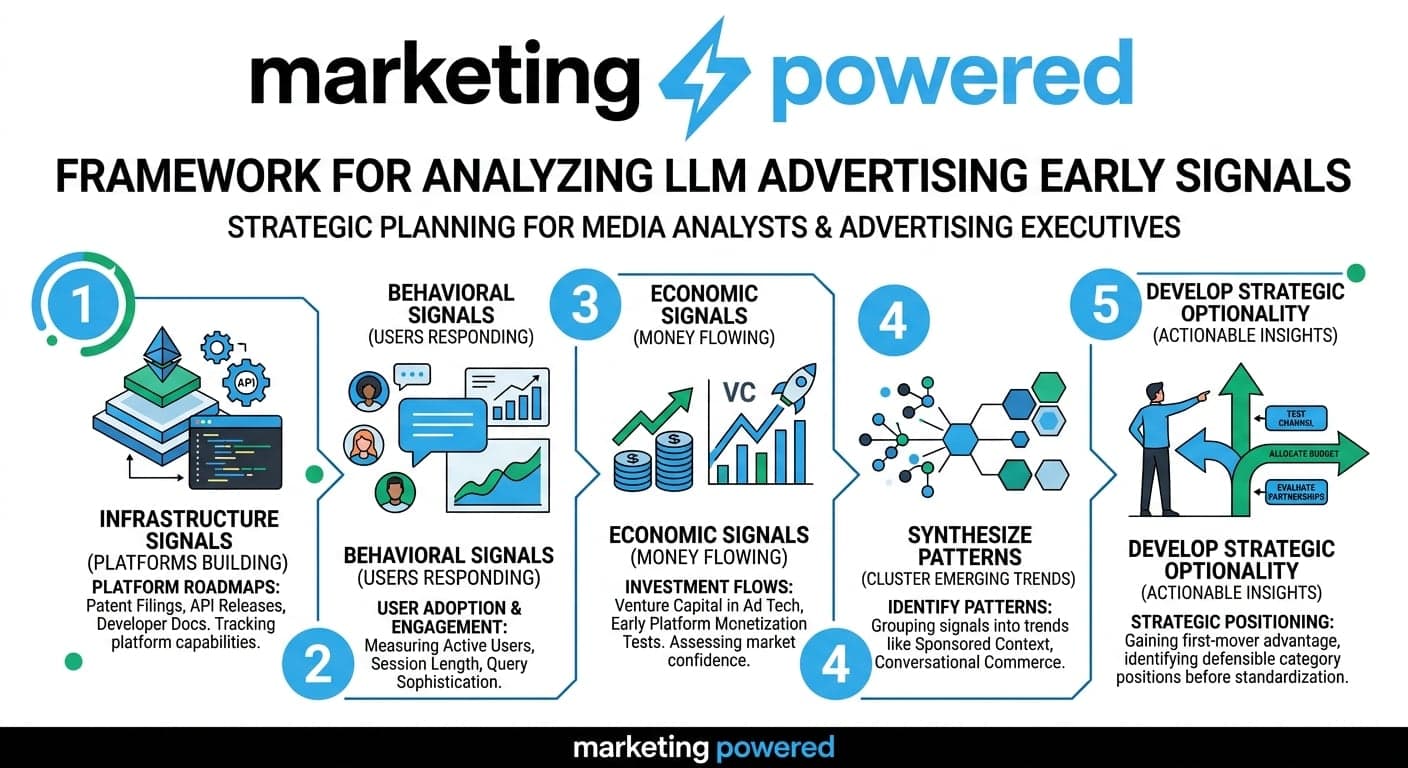
Early signals in any emerging channel fall into three categories: infrastructure signals (what platforms are building), behavioral signals (how users are responding), and economic signals (where money is flowing). LLM advertising early signals are now visible across all three categories, though with varying degrees of clarity.
Infrastructure signals are the most concrete. Patent filings, API announcements, and developer documentation reveal what platforms are building before public launch. OpenAI's plugin architecture, introduced in 2023, signaled an intent to create an ecosystem where third parties could extend ChatGPT's capabilities. While plugins were later deprecated in favor of GPTs, the signal was clear: OpenAI was exploring revenue models beyond subscription. Microsoft's Copilot integration across Office 365 represents infrastructure investment in embedded AI that could eventually support commercial messaging.
Google's Search Generative Experience, now evolved into AI Overviews, included shopping integrations from its earliest public tests. Product carousels and sponsored placements appeared within AI-generated summaries, suggesting Google views AI search as an extension of its existing ad business rather than a separate channel. This infrastructure signal indicates that the world's largest digital advertising company sees LLM interfaces as additive to, not disruptive of, its core revenue model.
Behavioral signals require more interpretation. User adoption curves for ChatGPT, Claude, Gemini, and Perplexity indicate sustained engagement with conversational AI interfaces. ChatGPT maintained over 1.5 billion monthly visits through late 2024, with Gemini and Perplexity showing strong growth trajectories. The behavioral signal is not just adoption but retention: users are returning to these interfaces for repeated interactions, creating the sustained attention that advertising models require.
More nuanced behavioral signals emerge from query composition analysis. Users ask LLMs different questions than they ask search engines. Conversational queries tend to be longer, more specific, and more likely to include purchase consideration context. A user might ask Google 'best running shoes,' but ask ChatGPT, 'I'm training for a marathon, have flat feet, and prefer shoes under $150. What should I consider?' The second query contains far more intent signal, which has direct implications for ad targeting and personalization.
Economic signals are forming around investment flows and acquisition activity. Venture capital deployment into AI advertising infrastructure companies accelerated through 2024. Companies building LLM-native ad-serving, attribution, and measurement tools have raised significant rounds, signaling investor belief that a new advertising category is forming. The economic signal is not the total capital deployed but the specificity of the use cases being funded: these are not general AI companies but advertising infrastructure companies built for LLM interfaces.
Strategy
Ready to map a growth plan built for your vertical?
Case Studies and Industry Insights
Practical applications and observable results from early LLM advertising implementations
Case studies in LLM advertising remain limited by the channel's nascency. Most implementations are beta tests, pilot programs, or controlled experiments rather than mature campaigns with published performance data. That limitation itself is a signal: the category is early enough that competitive advantage accrues to organizations willing to experiment before best practices solidify.
Microsoft's Bing Chat advertising pilot provided the first large-scale test of LLM advertising economics. Advertisers reported CPCs comparable to traditional search, but with significantly different user behavior patterns. Click-through rates on conversational ads were lower than search ads, but post-click engagement metrics, including time on site and pages per session, were higher. The interpretation is that users who click from an LLM context arrive with more formed intent, even if fewer users click overall. For advertisers optimizing for qualified traffic rather than volume, this pattern is favorable.
Perplexity AI introduced sponsored follow-up questions as its initial monetization approach. Rather than inserting ads into the AI's answers, Perplexity places commercial prompts in the suggested follow-up questions that appear after each response. An advertiser might sponsor the question 'What are the best project management tools for remote teams?' appearing after a user asks about remote work productivity. This model preserves the perceived neutrality of the AI's direct responses while creating commercial surface area. Early reports suggest advertisers are testing the format for brand awareness rather than direct response, treating it as a contextual placement more than a performance channel.
Amazon's Rufus assistant, rolled out in early 2024, represents conversational commerce rather than advertising in the traditional sense. However, the model offers insight into how LLM interfaces might eventually support brand advertising programs. Within Rufus, sponsored products receive preferential positioning in conversational recommendations. The distinction between organic AI recommendations and sponsored placements is not always clear to users, raising questions about disclosure that regulators are likely to address. For brands selling on Amazon, Rufus represents a new consideration set: products must be optimized not just for search ranking but for conversational recommendation.
Interviews with advertising executives across categories reveal consistent themes. First, measurement is the primary barrier to scaled investment. Without clear attribution models for LLM-influenced conversions, budget allocation relies on directional signals rather than rigorous ROI analysis. Second, creative development for LLM advertising remains undefined. Traditional display creative, video assets, and even search ad copy do not translate directly to conversational contexts. Third, competitive dynamics are unclear. In search advertising, auction mechanics are well understood. In LLM advertising, the rules of competition, whether first-mover advantage, bid optimization, or content quality, are still forming.
The most sophisticated advertisers are treating 2024 and 2025 as a learning period. Budget allocation to LLM advertising remains small as a percentage of total media spend, but dedicated teams are building institutional knowledge that will compound when the channel matures. This mirrors the early search advertising era, when organizations that invested in understanding the mechanics before scale arrived captured durable advantages.
Challenges and Considerations for LLM Advertising Adoption
Navigating the structural obstacles shaping the emerging channel
AI advertising adoption faces structural challenges that differ from traditional channel expansion. These are not simply execution challenges that resolve with better tools or larger budgets. They are category-defining constraints that will shape what LLM advertising becomes.
Measurement and attribution complexity is the most immediate barrier. Traditional digital advertising benefits from click-based attribution that, while imperfect, provides a consistent measurement framework. LLM advertising disrupts this framework. When a user's purchase decision is influenced by a conversational exchange that does not include a click, how is value attributed? When an LLM synthesizes information from multiple sources, including advertiser-provided content, to form a recommendation, what fraction of the conversion belongs to each input? These are active barriers to budget allocation. Until measurement frameworks mature, LLM advertising will struggle to compete for budget against channels with established attribution.
Disclosure and transparency requirements represent a regulatory constraint with direct commercial implications. Regulators globally are focused on AI transparency. The EU AI Act requires clear disclosure when users interact with AI systems. Applied to advertising, this likely means explicit labeling of sponsored content within LLM responses. The FTC's enforcement posture emphasizes that AI cannot be used to obscure material commercial relationships. For advertisers, this creates a tension: the value of LLM advertising partly depends on seamless integration with organic content, but regulatory requirements may mandate visible separation.
User trust and experience concerns constrain platform monetization strategies. Early research suggests users approach AI assistants with expectations of neutrality. A significant percentage of users express concern about AI being used for commercial purposes. If LLM advertising erodes trust in AI assistants, platforms face a strategic tradeoff between short-term monetization and long-term user engagement. This dynamic will likely constrain how aggressively platforms can commercialize their LLM interfaces.
Technical implementation barriers favor advertisers with engineering resources and platform relationships. Serving ads within LLM responses requires different infrastructure than traditional display or search advertising. Ad servers must integrate with inference pipelines. Real-time bidding must account for conversational context that extends across multiple exchanges. Creative assets must be formatted for consumption within text responses. These technical challenges are solvable but require investment.
For organizations in regulated industries, additional considerations apply. Healthcare advertisers must navigate ethical and legal requirements that include HIPAA considerations, platform-specific restrictions, and professional standards around patient communication. LLM advertising does not automatically inherit the compliance frameworks built for search and social advertising. New guidance will be required, and organizations operating in sensitive verticals should expect a lag between general LLM advertising availability and compliant implementation paths.
- Attribution frameworks for LLM-influenced conversions remain underdeveloped, creating budget allocation uncertainty for performance-focused advertisers.
- Regulatory disclosure requirements will shape ad format design, potentially limiting seamless integration with organic AI responses.
- User trust expectations for AI neutrality may constrain aggressive monetization strategies on major LLM platforms.
- Technical integration complexity favors advertisers with engineering resources and established platform relationships.
Email Us
Prefer to talk it through over email?
Future Outlook for LLM Advertising
Strategic recommendations for the emerging category
Forecasting LLM advertising evolution requires distinguishing between what is likely, what is possible, and what is uncertain. The likely outcomes are shaped by platform economics, regulatory trajectories, and user behavior patterns that are already observable. The possible outcomes include structural shifts that depend on technology development or market events that cannot be predicted with confidence.
Standardized ad units will emerge on at least one major LLM platform within the next 18 to 24 months. Google's integration of shopping ads into AI Overviews points toward a future where LLM interfaces support familiar ad formats with conversational targeting. Microsoft's Copilot ecosystem will likely include sponsored integrations for enterprise software categories. Measurement vendors will release LLM-specific attribution products, even if methodologies remain imperfect. These developments will reduce friction for advertisers comfortable with experimentation.
Budget allocation to LLM advertising will increase but remain a small percentage of total digital spend through 2026. The growth trajectory will depend on measurement maturity and competitive pressure. As early adopters demonstrate results, laggards will face pressure to follow. The dynamic resembles programmatic display adoption in the early 2010s: initial skepticism, followed by rapid scaling once proof points accumulated.
For advertising executives, four strategic recommendations follow from this analysis. First, allocate learning budget now. The goal is not immediate ROI but institutional knowledge development. Organizations that understand LLM advertising mechanics before the channel matures will execute more effectively when scale arrives. Second, invest in measurement infrastructure. Even imperfect attribution is better than none. Build systems that can track LLM-influenced conversions through proxy metrics like assisted conversions or brand search lift. Third, develop creative approaches for conversational contexts. Test what messaging formats perform in LLM interfaces, since text-based creatives that work in search may not translate directly. Fourth, monitor regulatory developments closely. Compliance requirements will shape what advertising formats are permissible, and early awareness creates lead time for adaptation.
The LLM advertising category is forming now. Organizations that build knowledge during this formative period will execute more effectively when standardized channels emerge. The patterns visible today, like platform experimentation, measurement innovation, regulatory formation, and user behavior evolution, are the early signals that will define the channel's eventual shape. Reading them accurately is the first step in strategic positioning.
Partner With a Team That Reads the Signals
The LLM advertising category is forming now. Organizations that build knowledge during this formative period will execute more effectively when standardized channels emerge. Marketing Powered brings operator experience, AI-native infrastructure, and significant managed media spend to strategic conversations about emerging channels. Whether you are evaluating pilot programs, building measurement frameworks, or positioning your organization for the next advertising surface, we can help frame the opportunity and structure the approach.
Questions, answered.
Three primary patterns define current LLM advertising trends: sponsored context injection (commercial content embedded in AI responses), conversational commerce integration (transaction capability within the conversation), and AI-mediated search arbitrage (routing users from LLM interfaces to traditional search where established ad economics apply). Platform experimentation by Google, Microsoft, Amazon, and emerging players like Perplexity is accelerating, though standardized ad formats have not yet emerged. User tolerance for commercial content in AI interfaces remains an active research question that will shape which approaches scale.
Recognizing LLM advertising early signals provides strategic optionality before the channel matures. Organizations that build institutional knowledge during the formative period, like understanding mechanics, testing creative approaches, and developing measurement frameworks, will execute more effectively when standardized ad units and auction dynamics emerge. This mirrors the early search advertising era, where first movers captured category positions that remained defensible for decades. The benefit is not immediate ROI but a positioning advantage that compounds as the channel scales.
Four structural challenges constrain LLM advertising adoption: measurement and attribution complexity (click-based attribution fails for conversational influence), disclosure and transparency requirements (regulators require clear labeling of sponsored AI content), user trust expectations (users approach AI assistants expecting neutrality), and technical implementation barriers (ad serving must integrate with inference pipelines). For regulated industries like healthcare, additional compliance considerations apply. These challenges are addressable but require investment in measurement infrastructure, creative development, and regulatory monitoring.
Published case studies remain limited due to the channel's early stage, but observable implementations provide directional insight. Microsoft's Bing Chat advertising pilot showed CPCs comparable to traditional search with higher post-click engagement metrics. Perplexity's sponsored questions model tests contextual placements that preserve AI response neutrality. Amazon's Rufus demonstrates conversational commerce where sponsored products receive preferential positioning in recommendations. Sophisticated advertisers are treating 2024-2025 as a learning period, building knowledge before the channel matures.
Standardized ad units on major LLM platforms are likely within 18 to 24 months, with Google's AI Overviews shopping integration pointing the direction. Measurement vendors will release LLM-specific attribution products. Budget allocation will increase but remain a small percentage of digital spend until measurement frameworks mature. Strategic recommendations include allocating learning budget now, investing in measurement infrastructure, developing conversational creative approaches, and monitoring regulatory developments that will shape permissible formats.
Ready to see what AI-native marketing can do for your treatment center?
Request a free audit of your paid media, landing pages, attribution, and compliance posture. You'll get a straight assessment of where the opportunities are.
or email us at info@marketingpowered.ai