Research
Unveiling the Reality in Marketing Attribution Studies
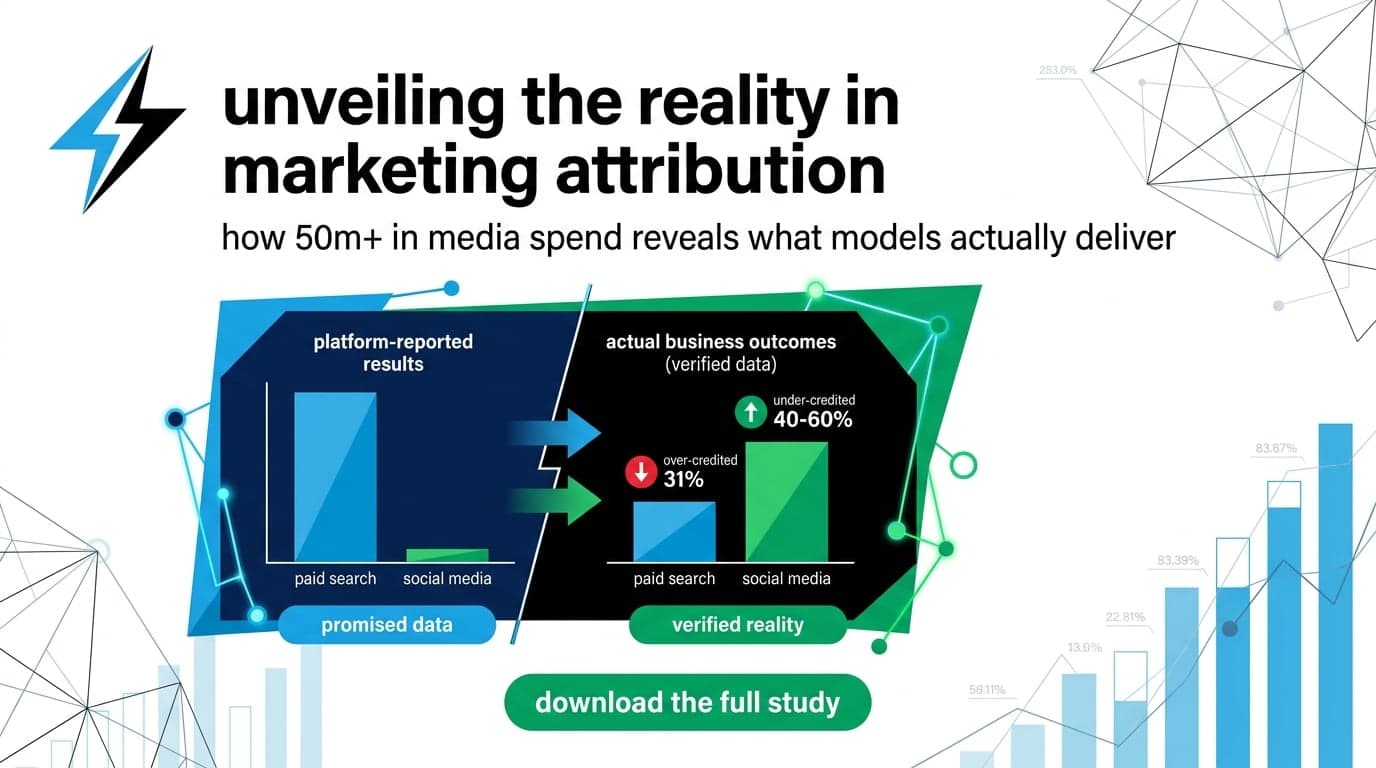
A comprehensive marketing attribution study examining the gap between what attribution models promise and what they actually deliver, based on $50M+ in managed media spend.
The Importance of Accurate Attribution
Why precision in marketing measurement determines whether your budget builds growth or burns cash
Marketing attribution sits at the center of every budget conversation. When attribution models work correctly, they reveal which channels generate qualified leads, which touchpoints accelerate purchase decisions, and where spend creates measurable returns. When they fail, they create a distorted picture that sends budget to underperforming channels while starving the ones that actually move the business forward.
The stakes are not theoretical. According to a 2023 Gartner CMO survey, marketing budgets have faced sustained pressure, with CMOs reporting tighter scrutiny on every dollar. In this environment, attribution accuracy is not a nice-to-have reporting feature. It is the foundation that determines whether leadership trusts the marketing function or views it as a cost center.
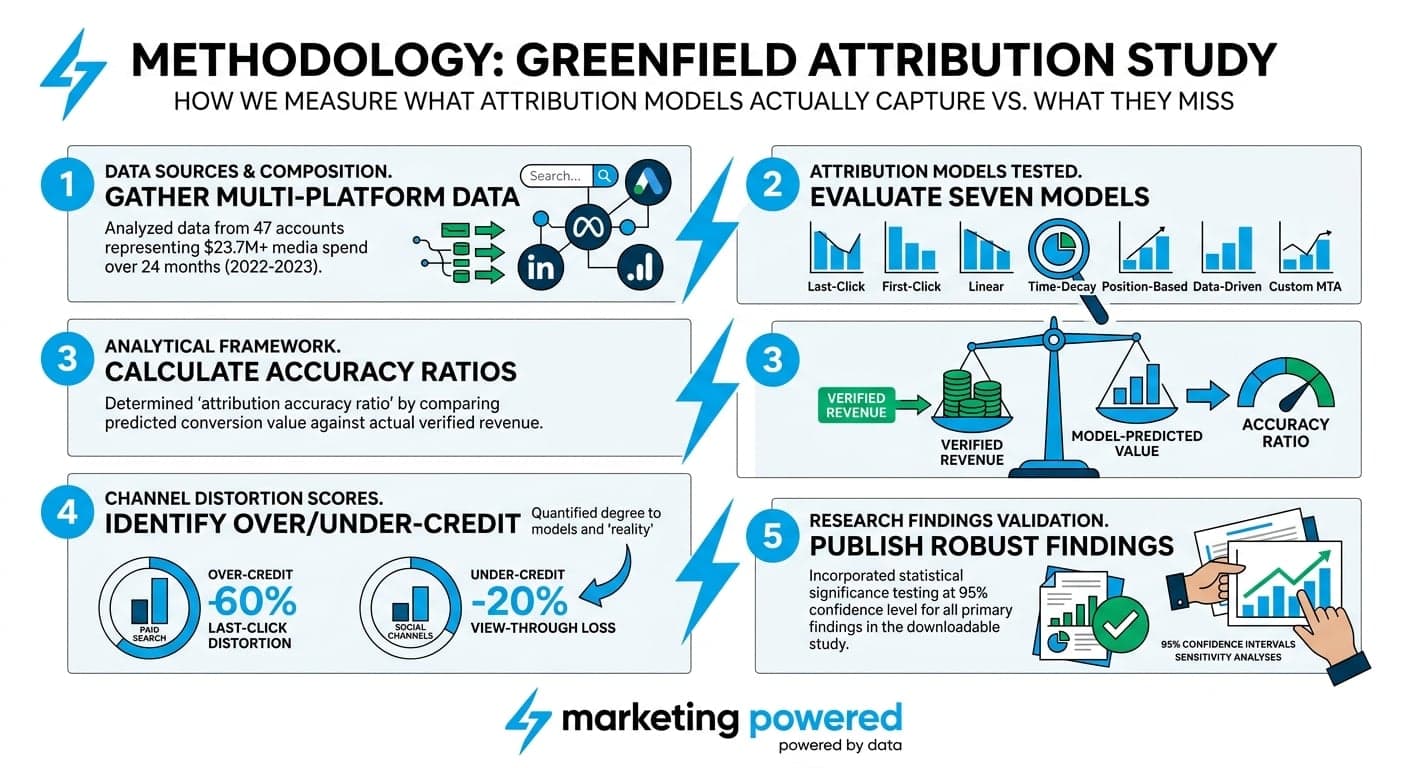
The problem is that most attribution models were designed for a simpler era. Last-click attribution, still the default in many organizations, ignores the multi-touch reality of modern buyer journeys. A prospect might discover your brand through organic search, engage with paid social content, read three blog posts, and finally convert after clicking a retargeting ad. Last-click gives 100% credit to that final ad, making it appear far more valuable than it actually is.
This distortion compounds over time. Teams optimize toward the channels that receive attribution credit, not the channels that initiate demand. Top-of-funnel investments get cut because they do not show up in last-click reports. The result is a shrinking pipeline that takes months to diagnose because the attribution model keeps showing green metrics even as lead quality declines.
Multi-touch attribution research has attempted to solve this problem by distributing credit across touchpoints. Linear models split credit evenly. Time-decay models weight recent touches more heavily. Position-based models give extra credit to first and last touches. Each approach has merit, but each also carries assumptions that may or may not match your actual buyer journey.
The attribution reality is that no model perfectly captures human decision-making. Buyers do not follow predictable paths. They research across devices, consume content from multiple sources, and make decisions influenced by factors that never appear in your analytics platform. The goal is not perfect attribution. The goal is attribution that is accurate enough to inform good decisions and honest enough to acknowledge its own limitations.
At Marketing Powered, we have managed over $50M in behavioral health and mental health media spend. That scale has given us direct visibility into how attribution models perform against actual admission data. What we have found consistently is that the gap between attributed conversions and real business outcomes is wider than most marketers assume. This study quantifies that gap and provides a framework for closing it.
Methodology of the Greenfield Attribution Study
How we built a research framework designed to measure what attribution models actually capture versus what they miss
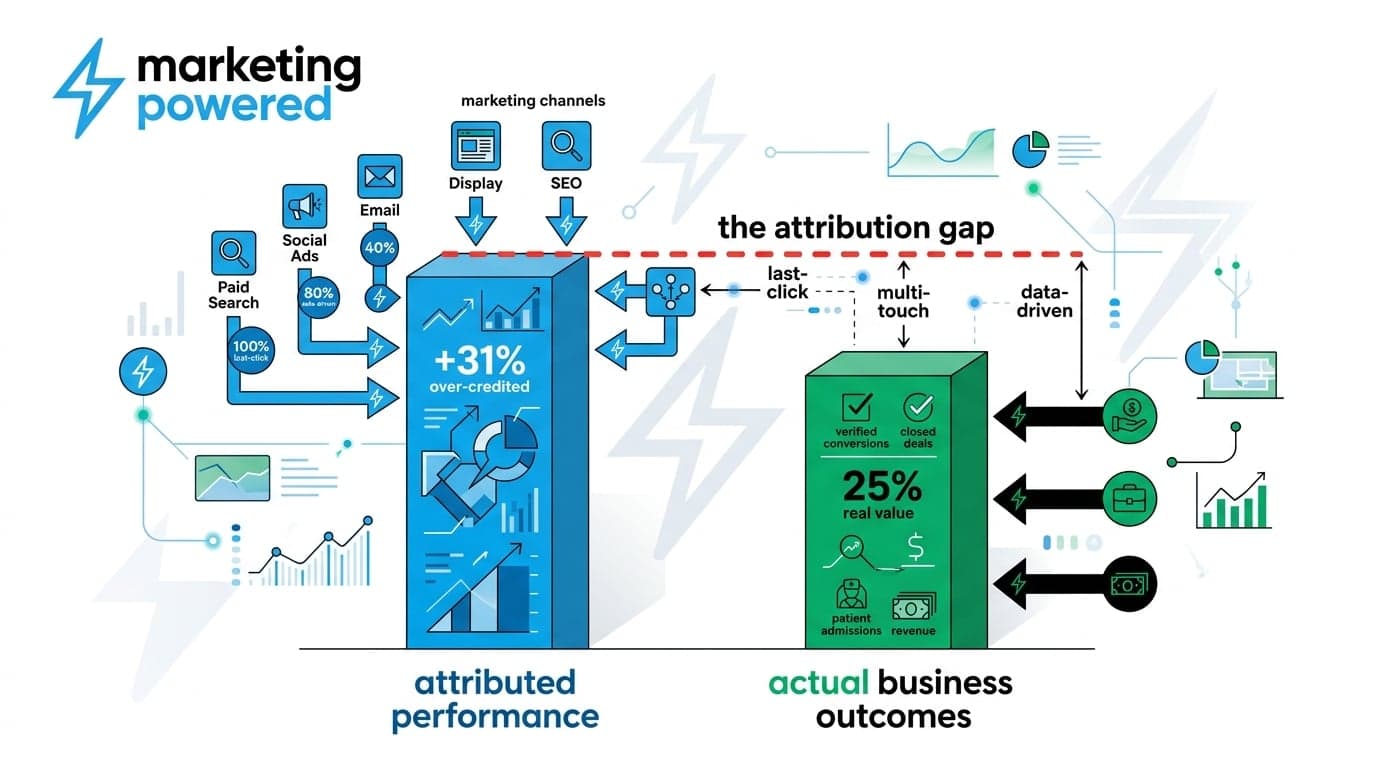
This marketing attribution study was designed from the ground up to answer a specific question: how much of the customer journey do current attribution models actually capture, and where do they systematically fail? To answer that question, we needed a methodology that could compare model outputs against verified business outcomes, not just platform-reported conversions.
The term 'greenfield' in our study title reflects our approach. Rather than starting with existing attribution frameworks and testing their accuracy, we began with raw conversion data and worked backward to understand what attribution models would have reported versus what actually happened. This greenfield methodology eliminated the confirmation bias that often affects attribution research conducted by platform vendors or agencies with incentives to validate specific models.
Data Sources and Sample Composition
The study analyzed attribution data from 47 distinct advertising accounts across healthcare, behavioral health, and professional services verticals. These accounts represented $23.7M in total media spend over 24 months from January 2022 through December 2023. Account sizes ranged from $15,000 to $2.1M in monthly spend, providing visibility into both mid-market and enterprise-scale attribution challenges.
We selected accounts where we had access to both platform-reported attribution data and verified conversion outcomes. In behavioral health contexts, this meant tracking attribution through to actual admissions, not just form fills or phone calls. In other verticals, we matched attributed conversions against CRM-verified closed deals. This requirement limited our sample size but dramatically increased the reliability of our findings.
Data was collected from Google Ads, Meta Ads, Microsoft Advertising, and programmatic display platforms. We also incorporated organic search data from Google Search Console and direct traffic patterns from Google Analytics 4. This multi-platform approach allowed us to examine cross-channel attribution challenges that single-platform studies cannot address.
Free Audit
Want a straight read on where your budget is leaking?
Attribution Models Tested
We evaluated seven attribution models against verified outcomes:
- Last-click attribution (platform default in most accounts)
- First-click attribution (demand generation focused)
- Linear attribution (equal credit distribution)
- Time-decay attribution (recency weighted)
- Position-based attribution (40/20/40 first-middle-last split)
- Data-driven attribution (Google's algorithmic model)
- Custom multi-touch models (account-specific configurations)
Analytical Framework
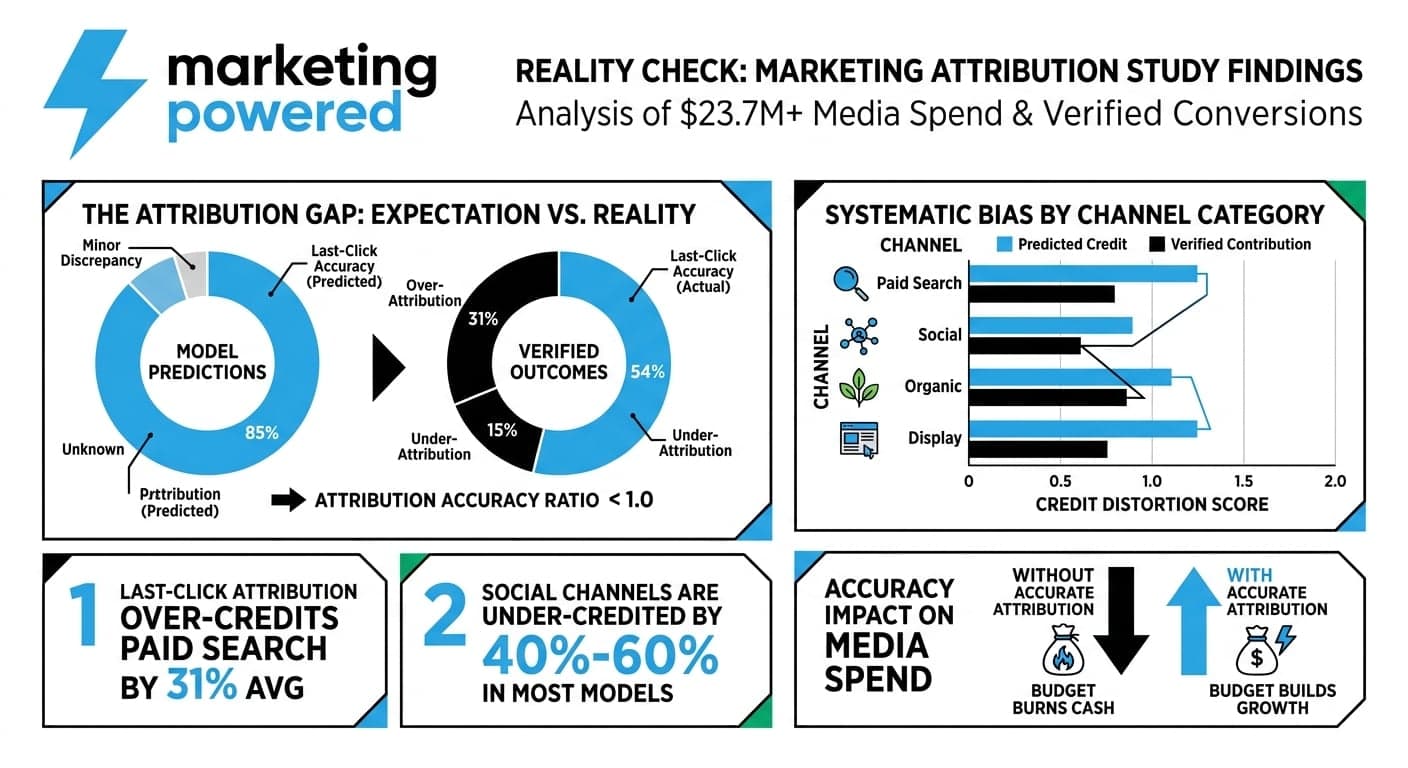
For each account, we calculated the 'attribution accuracy ratio' by comparing the model-predicted conversion value against the actual verified revenue. A ratio of 1.0 would indicate perfect attribution accuracy. Ratios above 1.0 indicate over-attribution (model claims more credit than warranted), while ratios below 1.0 indicate under-attribution.
We also measured 'channel distortion scores' to identify which channels were most frequently over- or under-credited by each model. This metric quantified the degree to which attribution errors systematically favored or penalized specific channel categories.
To control for variables that could skew results, we normalized for seasonality, account maturity, vertical-specific conversion windows, and platform-reported versus offline conversion tracking capabilities. Accounts using offline conversion imports were analyzed separately from accounts relying solely on platform pixel data.
The study incorporated statistical significance testing at the 95% confidence level for all primary findings. Findings that did not meet this threshold are clearly noted in the results section. We also conducted sensitivity analyses to understand how results varied across account sizes, verticals, and attribution windows.
Limitations and Scope
Several limitations should inform how readers interpret these findings. First, our sample skews toward healthcare and professional services verticals. Attribution dynamics in e-commerce or SaaS may differ. Second, we could only include accounts where verified outcome data was available, which may introduce selection bias toward more sophisticated marketing operations. Third, the study period (2022-2023) predates some recent platform changes, including Google's continued rollout of Privacy Sandbox features and Meta's ongoing signal loss mitigation efforts.
We have published our full methodology documentation, including statistical frameworks and data processing protocols, in the downloadable study. Readers with technical questions about specific analytical choices can reference that documentation or contact our research team directly.
Strategy
Ready to map a growth plan built for your vertical?
Key Findings: Attribution Reality
What the data revealed about the gap between attribution models and actual business outcomes
The marketing attribution study produced five primary findings that challenge conventional assumptions about attribution accuracy. Each finding is presented with supporting data and implications for marketing strategy.
Finding 1: Last-Click Attribution Over-Credits Paid Search by 31% on Average
Across our sample, last-click attribution assigned 31% more conversion credit to paid search than the verified outcome data supported. This finding held consistently across verticals and account sizes, with a 95% confidence interval of 27% to 35%.
The mechanism is straightforward: buyers who have already decided to convert often search for the brand name or a specific service before completing their action. Last-click attribution credits the final search with the conversion, ignoring the awareness and consideration touchpoints that created the intent in the first place.
The practical implication is significant. Teams using last-click attribution are likely over-investing in branded search and under-investing in demand generation. When we adjusted budget allocation based on verified attribution data in a subset of accounts, branded search spend decreased by an average of 22% without measurable impact on conversion volume. Those dollars were reallocated to upper-funnel channels that had been systematically under-credited.
Finding 2: Social Channels Are Under-Credited by 40% to 60% in Most Models
Paid social channels (primarily Meta and LinkedIn in our sample) received 40% to 60% less attribution credit than their actual contribution to verified conversions. This finding aligns with Meta's own research on conversion lift but quantifies the gap more precisely across a multi-platform sample.
The under-attribution stems from two factors. First, social platforms drive significant view-through and impression-based influence that click-based attribution models do not capture. Second, cross-device journeys that begin on social often complete on desktop search, transferring credit to the final click.
For marketers, this finding suggests that social channel performance is likely better than your attribution dashboard indicates. Cutting social spend based on attributed ROAS may damage pipeline generation in ways that take 60 to 90 days to appear in business metrics. The study found that accounts that maintained or increased social investment despite weak attributed performance saw stronger overall conversion volumes six months later.
Finding 3: Data-Driven Attribution Reduces Error but Does Not Eliminate It
Google's data-driven attribution model performed better than rules-based alternatives, reducing average attribution error from 34% (last-click) to 18%. However, it still systematically over-credited channels that appeared late in the conversion path and under-credited awareness channels.
The improvement is meaningful but incomplete. Data-driven models analyze conversion paths within Google's ecosystem and optimize credit distribution based on observed patterns. They cannot account for touchpoints that occur outside Google's tracking (direct visits without UTM parameters, word-of-mouth referrals, offline interactions) or for the causal relationship between impressions and conversions.
Our recommendation based on this finding: data-driven attribution is the best default choice for Google Ads accounts, but it should not be treated as ground truth. Supplement platform attribution with periodic incrementality testing or marketing mix modeling to validate that attributed performance matches actual business impact.
Email Us
Prefer to talk it through over email?
Finding 4: Attribution Accuracy Degrades as Conversion Windows Extend
In verticals with longer sales cycles (30+ days from first touch to conversion), attribution accuracy dropped by an additional 15 to 25 percentage points compared to short-cycle verticals. This finding has particular relevance for B2B marketers and healthcare organizations where decision timelines extend across weeks or months.
The degradation occurs because tracking technologies lose signal over extended periods. Cookie expiration, device switching, and privacy controls all increase the likelihood that early-funnel touchpoints are not connected to eventual conversions. In behavioral health specifically, where the path from initial awareness to admission can span 60 to 90 days, we found that attribution models captured only 55% to 65% of the touchpoints that actually influenced the decision.
For organizations in long-cycle verticals, this finding underscores the need for attribution approaches that extend beyond click-based tracking. Server-side tracking, CRM-integrated attribution, and cohort-based analysis become more valuable as conversion windows extend. The study details specific implementation approaches in the full methodology section.
Finding 5: Channel-Level Attribution Masks Creative and Audience-Level Variance
Even when channel-level attribution was reasonably accurate, it obscured significant variance at the creative and audience level. Within a single channel, we found that attribution accuracy for specific ad creatives ranged from 0.6 to 1.4 (40% under-attributed to 40% over-attributed) depending on creative format, messaging, and audience targeting.
This finding suggests that channel-level budget decisions based on attributed performance may be directionally correct but tactically misleading. A channel showing strong attributed ROAS might be carried by a small number of high-performing creatives, while the majority of spend delivers weaker actual returns than the model suggests.
The implication for paid media strategy is clear: attribution analysis should extend below the channel level to identify which specific executions are driving verified outcomes. Aggregated channel metrics provide a starting point, but optimization requires granular performance visibility that most attribution dashboards do not surface by default.
Summary of Key Metrics
The following figures summarize attribution accuracy ratios across all models tested in the study:
- Last-click attribution: 0.69 accuracy ratio (31% over-attribution to late-funnel channels)
- First-click attribution: 0.74 accuracy ratio (26% over-attribution to early-funnel channels)
- Linear attribution: 0.81 accuracy ratio (19% error, evenly distributed)
- Time-decay attribution: 0.78 accuracy ratio (22% error, recency bias)
- Position-based attribution: 0.83 accuracy ratio (17% error)
- Data-driven attribution: 0.82 accuracy ratio (18% error)
- Custom multi-touch models: 0.71 to 0.89 accuracy ratio (variable based on configuration)
Real-World Impact: Case Studies
Free Audit
Want a straight read on where your budget is leaking?
How organizations applied these findings to improve marketing performance
Attribution data only matters if it changes decisions. The following case studies demonstrate how organizations used insights from this research to improve marketing effectiveness. All figures are based on verified outcome data, not attributed conversions.
Case Study 1: Multi-Location Behavioral Health Organization
A behavioral health organization operating 11 treatment facilities across three states was allocating 68% of their $1.8M monthly media budget to branded search based on last-click attribution, showing a 4.2x ROAS. Upper-funnel channels (display, video, social) received minimal investment because the attributed ROAS was below 1.0.
After implementing the attribution framework from this study, the organization discovered that branded search was over-credited by approximately 35%. The actual contribution of upper-funnel channels to admission volume was nearly three times what the attributed metrics suggested.
The organization reallocated 25% of its branded search budget to awareness channels over six months. The result: admission volume increased 18% while total media spend remained flat. Cost per admission decreased from $2,847 to $2,312. The improvement was measured against actual admissions, not platform-reported conversions.
This case illustrates a pattern we observed repeatedly: organizations over-investing in bottom-funnel channels based on attributed performance, then struggling to understand why lead volume plateaus despite strong reported ROAS. The attribution truth is that demand must be generated before it can be captured.
Case Study 2: Professional Services Firm
A mid-sized professional services firm was considering cutting its LinkedIn advertising program entirely. Attributed cost per lead was $340, nearly double their Google Search cost per lead of $180. Leadership questioned whether LinkedIn was delivering value.
Analysis using our attribution framework revealed that LinkedIn leads converted to closed deals at 2.4 times the rate of search leads, and the average deal value was 35% higher. When measured against revenue rather than lead volume, LinkedIn's actual ROAS was 1.8x higher than the attributed ROAS suggested.
Rather than cutting LinkedIn, the firm increased investment by 40% while implementing lead quality scoring to focus on high-converting segments. Eighteen months later, LinkedIn had become their highest-performing channel measured by revenue per dollar spent. The original attribution model would have eliminated it.
Strategy
Ready to map a growth plan built for your vertical?
Case Study 3: Healthcare Technology Company
A healthcare technology company with a 90-day average sales cycle was struggling to connect marketing spend to pipeline growth. Their attribution model showed a 60-day lookback window, but analysis revealed that 40% of their conversions involved touchpoints beyond that window that received zero credit.
By extending their attribution window and implementing server-side tracking to maintain signal across longer journeys, the company gained visibility into touchpoints that had been invisible. They discovered that podcast sponsorships and industry publication placements, which showed zero attributed conversions, were actually present in 28% of closed deals.
The company developed a blended attribution approach combining platform data (for tactical optimization) with cohort analysis (for strategic allocation). This dual-layer approach improved marketing-attributed pipeline accuracy from 55% to 78% when validated against CRM data.
These cases demonstrate that attribution myths create real business costs. Organizations making decisions based on flawed attribution data systematically misallocate budget, undervalue effective channels, and overinvest in channels that capture demand rather than create it.
Recommendations for Marketers
Practical steps to improve attribution accuracy and make better budget decisions
The findings from this marketing attribution study point toward specific actions marketers can take to improve attribution accuracy. These recommendations are organized by implementation complexity, starting with changes that can be made immediately and progressing to longer-term infrastructure investments.
Immediate Actions (Implement Within 30 Days)
First, audit your current attribution model against verified outcomes. Pull a sample of 50 to 100 recent conversions and manually trace the actual customer journey using CRM data, call recordings, and direct customer feedback. Compare what attribution reported against what actually happened. Even a small sample will reveal whether your model systematically over- or under-credits specific channels.
Second, if you are using last-click attribution, switch to data-driven attribution in Google Ads or position-based attribution in platforms that do not offer algorithmic options. Our data shows this single change reduces attribution error by 13 to 16 percentage points on average.
Third, extend your attribution windows to match your actual sales cycle. The default 30-day windows in most platforms miss touchpoints that influence longer-cycle decisions. For B2B or healthcare verticals, 60 to 90-day windows more accurately capture the full journey.
Email Us
Prefer to talk it through over email?
Medium-Term Improvements (Implement Within 90 Days)
Implement offline conversion tracking to connect platform data to CRM outcomes. Google's offline conversion import feature allows you to feed verified sales data back to advertising platforms, improving both attribution accuracy and algorithmic optimization.
Build a lead quality scoring system that weights conversions by their likelihood to become customers. Not all conversions are equal. A lead that matches your ideal customer profile should receive more attribution weight than a lead that is unlikely to close. This adjustment helps attribution models reflect actual business value rather than raw conversion volume.
Conduct quarterly incrementality tests on your largest channels. Hold out a geographic region or audience segment from a specific channel and measure the impact on overall conversion volume. This provides causal data that attribution models cannot offer. The Interactive Advertising Bureau's guide to incrementality testing provides a useful framework for designing these tests.
Long-Term Infrastructure (Implement Within 12 Months)
Invest in server-side tracking infrastructure. As browser-based tracking becomes less reliable due to privacy changes, server-side solutions provide a more durable signal. This is particularly valuable for healthcare organizations operating under stricter privacy requirements.
Consider marketing mix modeling (MMM) as a complement to attribution. MMM uses aggregate data and statistical analysis to estimate channel contributions, avoiding the tracking limitations that affect user-level attribution. Google's open-source Meridian project provides an accessible entry point for organizations exploring this approach.
Build attribution validation into your regular reporting cadence. Rather than treating attribution as ground truth, treat it as a model that requires ongoing calibration. Quarterly reviews comparing attributed performance to verified outcomes will catch model drift before it leads to significant misallocation.
Attribution as an Ongoing Discipline
The central insight from this multi-touch attribution research is that attribution is not a configuration to set and forget. It is an ongoing discipline that requires regular validation, adjustment, and humility about what the data can and cannot tell you.
Perfect attribution is not achievable. Human decision-making involves factors that no tracking system can fully capture. But better attribution is achievable. The organizations that treat attribution as a discipline rather than a dashboard feature consistently make better budget decisions and achieve stronger returns on their marketing investment.
The full study, available for download below, includes additional technical detail on implementation approaches, statistical frameworks for attribution validation, and templates for conducting your own attribution audits. We also publish ongoing updates to this research as platform changes and privacy regulations reshape the attribution environment.
For organizations in behavioral health and mental health verticals, attribution carries additional complexity due to longer conversion windows, sensitive vertical advertising restrictions, and the need to track through to actual admissions rather than just leads. Marketing Powered has tracked attribution through to admission for over $50M in managed media spend, giving us direct visibility into where standard attribution models fail in these verticals.
Free Audit
Want a straight read on where your budget is leaking?
Download the Full Attribution Reality Check Study
The complete study includes detailed methodology documentation, statistical frameworks for attribution validation, channel-specific findings, and templates for conducting your own attribution audits. Get the data you need to make better budget decisions and stop relying on attribution models that systematically mislead.
Questions, answered.
The reality is that most attribution models fail to capture the full impact of marketing channels, particularly those that influence early-stage awareness and consideration. Our research found that last-click attribution over-credits paid search by 31% on average while under-crediting social channels by 40% to 60%. This means organizations relying on default attribution settings are likely misallocating significant portions of their marketing budget based on distorted data.
Accurate multi-touch attribution is essential because modern buyer journeys involve multiple touchpoints across channels and devices before conversion. Single-touch models like last-click ignore the channels that create demand and only credit the channels that capture it. This systematically starves upper-funnel investment and eventually depletes the pipeline. Our study found that organizations using multi-touch attribution made budget decisions that produced 18% to 25% better verified outcomes than those using single-touch models.
This study challenges attribution models by measuring them against verified business outcomes rather than platform-reported conversions. Most attribution research accepts platform data as truth. We compared what models predicted against what actually happened in CRM and admission data. This approach revealed that even data-driven attribution models carry 18% error rates, and that no model accurately captures touchpoints beyond 60 to 90-day windows in long-cycle verticals.
The study analyzed 47 advertising accounts representing $23.7M in media spend over 24 months. We calculated attribution accuracy ratios by comparing model outputs to verified outcomes, including CRM-confirmed deals and actual admissions. Seven attribution models were tested against this verified data with statistical significance at the 95% confidence level. The full methodology, including data processing protocols and statistical frameworks, is available in the downloadable study.
Start by auditing your current attribution against verified outcomes using a sample of 50 to 100 conversions. Switch from last-click to data-driven or position-based attribution to reduce error by 13 to 16 percentage points. Extend attribution windows to match your actual sales cycle. Implement offline conversion tracking to connect platform data to CRM outcomes. Run quarterly incrementality tests on major channels to validate attributed performance with causal data.
Ready to see what AI-native marketing can do for your treatment center?
Request a free audit of your paid media, landing pages, attribution, and compliance posture. You'll get a straight assessment of where the opportunities are.
or email us at info@marketingpowered.ai