Research
Discover the Annual Paid Media and AI Trends for 2026
A comprehensive analysis of the shifts reshaping paid media strategy, AI-driven automation, and performance benchmarking for forward-thinking marketing leaders.
Introduction to the 2026 Paid Media Landscape
How AI is fundamentally restructuring paid media operations, budgets, and outcomes
The annual paid media trends shaping 2026 represent a departure from incremental optimization. What marketers face now is a structural shift in how campaigns are built, deployed, measured, and refined. AI is no longer a supplementary tool bolted onto existing workflows. It sits at the center of media operations, influencing everything from audience modeling to creative generation to attribution logic.
This paid media trends report synthesizes data from platform changes, advertiser behavior shifts, and emerging AI capabilities that are redefining what performance marketing looks like. The goal is not to catalog every new feature or speculative technology. Instead, this report focuses on the trends that directly affect budget allocation, team structure, and competitive positioning.
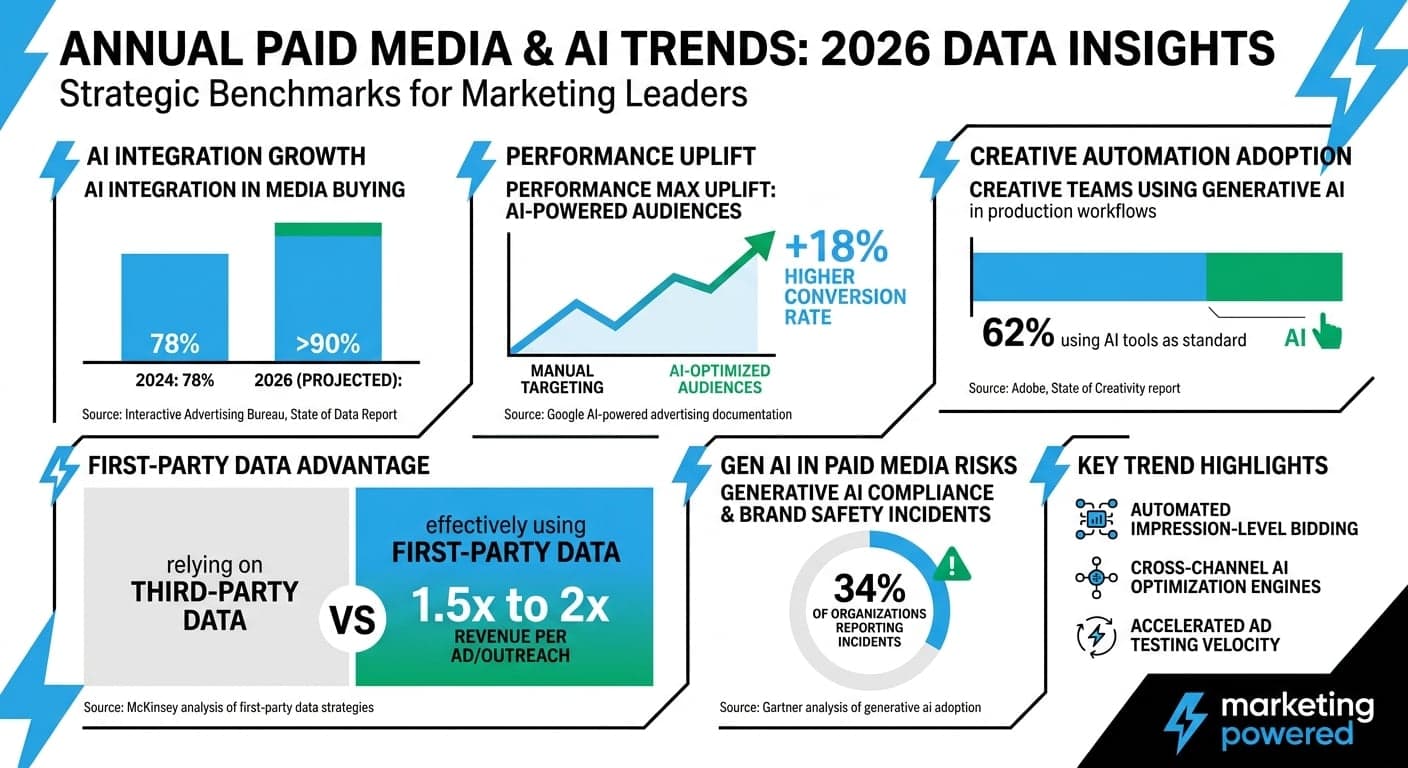
According to the Interactive Advertising Bureau's 2024 State of Data Report, 78% of advertisers reported that AI and machine learning are now integrated into at least one stage of their media buying process. That number is projected to exceed 90% by the end of 2026. The trajectory is clear: teams that treat AI as optional will find themselves outpaced by those who have embedded it into their operational DNA.
For marketing directors and CMOs evaluating their 2026 strategy, this report serves as both a benchmark and a planning tool. Each section addresses a specific dimension of the AI and paid media intersection, from automation trends to generative content to ROI measurement. The insights here are designed to inform decisions, not to impress with jargon.
What makes 2026 distinct from previous years is the convergence of three factors: mature generative AI models capable of production-quality creative output, platform-native automation that reduces manual campaign management, and attribution systems sophisticated enough to model incrementality rather than just last-touch conversions. These three capabilities, when combined, create a fundamentally different paid media environment than what existed even 18 months ago.
Marketing Powered has managed over $50M in media spend across specialized verticals, giving us a vantage point on how these trends translate into actual campaign performance. The observations in this report draw on that operational experience, combined with third-party research and platform data. This is not speculation. It is a synthesis of what is already happening at scale.
Major AI Marketing Trends in 2026
The technologies and capabilities defining competitive advantage this year
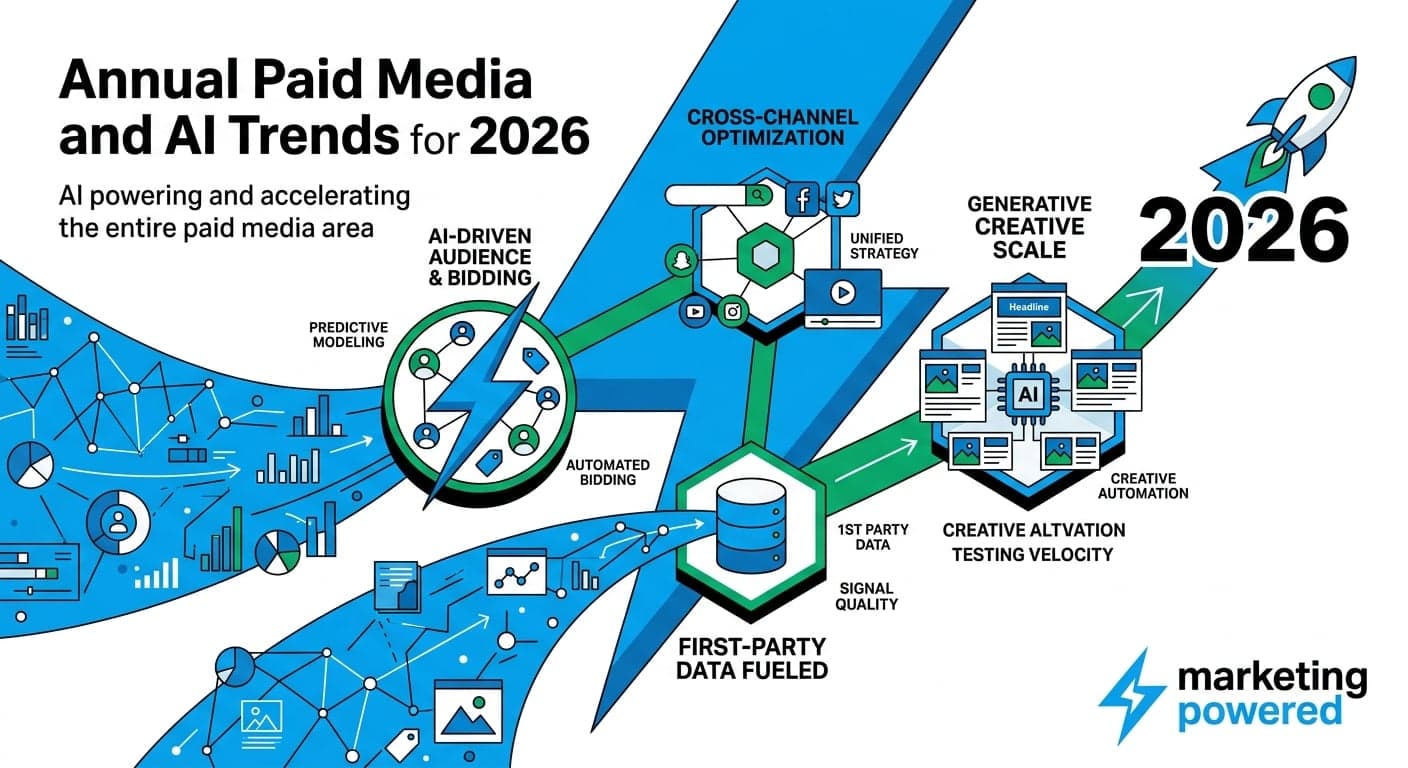
The AI marketing trends 2026 landscape is defined by practical application rather than theoretical promise. The technology has matured past the proof-of-concept stage. What matters now is implementation depth and operational integration.
Predictive audience modeling has become table stakes. Platforms including Google, Meta, and Microsoft have rolled out AI-driven audience expansion tools that outperform manual segmentation in most contexts. According to Google's AI-powered advertising documentation, Performance Max campaigns using AI-optimized audiences deliver an average of 18% higher conversion rates compared to manually targeted campaigns. The implication for marketers: audience building is less about finding the right segments and more about training models on conversion signals.
Automated bidding strategies now dominate. Manual CPC bidding is effectively obsolete for most advertisers. Meta's Advantage+ campaign structure and Google's Smart Bidding rely on machine learning to optimize bids at the impression level, adjusting for hundreds of signals that no human could process in real time. The 2026 trend is not whether to use automated bidding, but how to structure accounts to give AI systems the cleanest possible conversion data.
Cross-channel optimization is moving from concept to reality. Historically, paid search, paid social, programmatic display, and connected TV operated as separate disciplines with separate teams and separate measurement. AI-driven platforms are beginning to unify these channels under a single optimization engine. This does not mean channel expertise is irrelevant. It means the role of the strategist is shifting toward signal quality and creative testing rather than bid management.
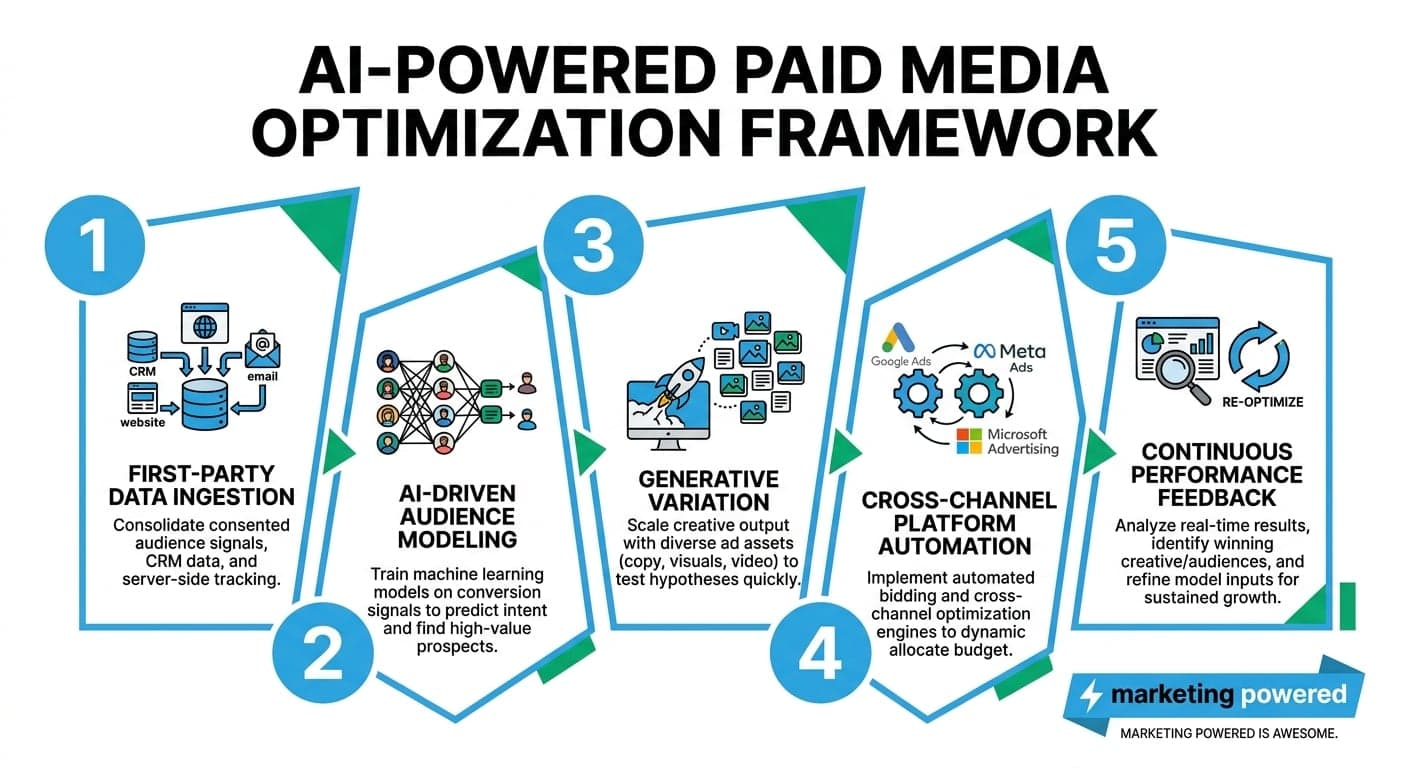
The AI marketing automation trends 2026 conversation centers on three specific capabilities. First, creative automation: AI systems can now generate ad variations at scale, test them in-market, and reallocate budget to winners without human intervention, compressing testing cycles from weeks to days. Second, audience automation: lookalike and predictive audiences are being replaced by real-time intent models that adjust targeting based on behavioral signals observed within the campaign itself. Third, budget automation: platforms are increasingly capable of reallocating spend across campaigns, ad sets, and even channels based on performance signals, reducing the need for daily manual pacing adjustments.
The rise of first-party data infrastructure is accelerating. Privacy regulations and signal loss from iOS changes have made first-party data the most valuable asset in paid media. According to McKinsey's analysis of first-party data strategies, companies that effectively use first-party data can generate 1.5 to 2 times the revenue from a single ad or marketing outreach compared to those relying on third-party data. The 2026 trend is toward CRM integration, server-side tracking, and customer data platforms that feed AI systems with clean, consented signals.
Marketing Powered has been AI-native since 2022, working with local inference models, vector databases, and retrieval-augmented generation before these technologies became mainstream. That early investment informs how we approach AI and paid media innovations for clients operating in compliance-sensitive verticals.
- Predictive audience modeling outperforms manual segmentation in most platform contexts
- Automated bidding at the impression level replaces manual CPC management
- Cross-channel AI optimization engines are unifying historically siloed media disciplines
- First-party data infrastructure is now a core competitive asset, not a nice-to-have
- Creative, audience, and budget automation are compressing testing and optimization cycles
Free Audit
Want a straight read on where your budget is leaking?
Generative AI and Its Role in Paid Media Creative
Applications, limitations, and the operational changes required for effective deployment
The generative AI marketing trends 2026 conversation has moved past novelty. Generative models are now embedded in production workflows at agencies and brands of every size. The question is no longer whether to use them, but how to use them well.
Content creation at scale is the most immediate application. Generative AI enables the production of ad copy, image assets, and video content at volumes that would have required large creative teams just two years ago. Adobe's 2024 State of Creativity report found that 62% of creative teams now use generative AI tools as part of their standard production process. The output quality has reached a threshold where AI-generated assets perform comparably to human-created assets in blind A/B tests.
This does not mean human creative direction is obsolete. The trend in 2026 is toward hybrid workflows: AI generates variations, humans provide strategic direction and brand guardrails, and performance data determines which assets scale. The role of the creative team shifts from execution to curation and optimization.
Ad testing velocity is being transformed. Traditional multivariate testing required weeks or months to reach statistical significance. Generative AI compresses this timeline by producing enough variations to test dozens of hypotheses simultaneously. Combined with platform-native multivariant optimization, advertisers can now identify winning creative concepts within days rather than months.
The practical application works like this: a generative model produces 50 headline variations and 20 image concepts. These are fed into an ad platform's creative optimization system. The platform allocates impressions based on early performance signals, progressively shifting budget toward top performers. Within a week, the advertiser has statistically significant data on which messaging resonates, without having to wait for a single static test to conclude.
Beyond initial asset creation, generative AI is being used to iterate on winning concepts. When a particular headline outperforms, the model can generate variations that preserve the core message while testing different angles, lengths, or tones. This creates a continuous optimization loop that was not possible with manual creative production.
Limitations and risks deserve attention. Generative AI is not without challenges. Brand safety remains a concern. AI systems can produce content that technically meets a prompt but violates brand guidelines or regulatory requirements. This is particularly acute in regulated industries where compliance language must be precise. According to Gartner's analysis of generative AI adoption, 34% of organizations using generative AI for marketing have experienced at least one compliance or brand safety incident. The mitigation strategy involves human review layers, clear prompt engineering standards, and platform-level content filters.
For advertisers in healthcare-adjacent or other sensitive verticals, generative AI requires additional guardrails. Marketing Powered maintains a HIPAA-conscious infrastructure and LegitScript awareness specifically because AI tools must operate within compliance boundaries.
Benchmarking Paid Media Performance with AI in 2026
How AI-driven measurement is replacing legacy attribution models
The state of paid media measurement in 2026 is defined by a shift from deterministic to probabilistic attribution. Cookie deprecation, cross-device behavior, and privacy regulations have made traditional last-click and multi-touch models less reliable. AI-driven benchmarking fills this gap by modeling incrementality rather than simply tracking conversions.
Media mix modeling has returned as a front-line tool. Once considered a legacy approach suited only for enterprise brands with large budgets, media mix modeling has been revitalized by AI. Modern MMM tools use machine learning to process more variables, update more frequently, and deliver actionable recommendations at a granular level. According to Nielsen's 2024 Annual Marketing Report, 67% of large advertisers now use some form of MMM or econometric modeling alongside digital attribution.
The advantage of AI-enhanced MMM is that it accounts for factors that platform-native attribution misses: offline conversions, brand effects, competitive activity, and macroeconomic variables. For marketing directors managing cross-channel budgets, this provides a more complete picture of true media efficiency.
Incrementality testing at scale is now accessible to mid-market advertisers. AI enables incrementality measurement that was previously cost-prohibitive. Rather than running expensive holdout tests across all campaigns, AI systems can model incrementality using observational data and quasi-experimental methods. This allows advertisers to understand not just whether conversions occurred, but whether they would have occurred without the ad exposure.
Google's Meridian open-source MMM tool and Meta's Robyn represent platform investments in making this level of measurement accessible to advertisers who lack dedicated data science teams. These tools lower the barrier to sophisticated attribution without requiring enterprise-level resources.
Real-time performance benchmarking is becoming standard practice. AI systems can now compare campaign performance against industry benchmarks in real time, flagging anomalies and opportunities as they emerge. This reduces the lag between performance changes and strategic response. Rather than waiting for weekly or monthly reports to identify underperforming campaigns, marketing teams receive alerts when metrics deviate from expected ranges.
For Marketing Powered, attribution discipline is foundational. We have tracked attribution through to admission in behavioral health and mental health verticals, where the conversion path is complex, and the stakes are high. This experience informs the measurement frameworks we recommend to clients across industries.
The ROI calculation itself is changing. With probabilistic attribution and incrementality modeling, ROI calculations must evolve beyond simple cost-per-conversion math. The 2026 trend is toward customer lifetime value modeling integrated with media attribution. AI systems that can predict LTV at the point of acquisition allow advertisers to bid more intelligently, accepting higher CPAs for customers projected to have higher lifetime value.
- Media mix modeling is being revitalized by AI for mid-market accessibility
- Incrementality testing replaces last-click attribution as the primary performance signal
- Real-time benchmarking reduces response lag from weeks to hours
- LTV-integrated attribution enables smarter bidding decisions at the moment of acquisition
- Server-side tracking and enhanced conversions provide cleaner signals to AI optimization systems
Strategy
Ready to map a growth plan built for your vertical?
AI Paid Media Success: Case Studies from 2026
Documented examples of AI-driven paid media performance across industries
Theory matters less than execution. The following case studies illustrate how AI capabilities translate into measurable performance improvements when implemented with operational discipline.
Case Study 1: E-commerce brand reduces CAC by 34% through predictive audience modeling. A direct-to-consumer apparel brand with $8M annual ad spend was struggling with rising customer acquisition costs on Meta and Google. Their legacy approach relied on interest-based targeting and manual lookalike audiences built from all purchasers. The intervention involved implementing a predictive audience model trained on high-LTV customers rather than all converters. By feeding the AI system data on customers with repeat purchase behavior and high average order values, the targeting shifted from volume optimization to value optimization. Within 90 days, customer acquisition cost dropped 34% while average order value increased 12%. The AI system identified behavioral signals that correlated with high-LTV customers that manual analysis had not detected.
Case Study 2: B2B SaaS company increases demo bookings 47% through generative creative testing. A mid-market SaaS company in the project management space was running the same three ad creatives across LinkedIn and Google Display for over a year. Creative fatigue was evident in declining click-through rates and increasing CPCs. The solution involved using generative AI to produce 60 headline variations and 25 image concepts based on the company's top-performing landing pages and customer testimonials. These were fed into a multivariate optimization system that allocated impressions based on early engagement signals. The winning creative combination increased demo bookings by 47% at the same budget. The entire testing cycle took 14 days compared to the 6-plus months their previous testing approach required.
Case Study 3: Healthcare-adjacent brand scales paid media while maintaining full compliance. A telehealth platform operating in a Google Ads-sensitive vertical needed to scale paid media without triggering compliance violations or relying on prohibited retargeting tactics. The approach involved building a compliant conversion tracking infrastructure using server-side tagging and enhanced conversions, providing AI bidding systems with clean signals without exposing protected health information. Generative AI was used to produce ad copy variations with a human compliance review layer before deployment. The result was a 62% increase in qualified lead volume with zero policy violations over 12 months.
These case studies share a common thread: AI is not a replacement for strategic thinking. It is an amplifier. The brands that succeed with AI in paid media are those that provide clean data, clear objectives, and appropriate guardrails. The technology does the optimization. The strategy provides the direction.
Marketing Powered's founder, Mike Hulick, has served as a court-certified expert witness in advertising strategy, providing the depth of experience that complex verticals require. Our work scaling behavioral health clients during a substantial growth period demonstrates how AI-driven paid media can perform at scale when combined with operational discipline and compliance awareness.
What 2026 Paid Media Trends Mean for Your Strategy
Actionable implications for marketing directors and CMOs planning their next move
The paid media benchmarks emerging from 2026 point to several strategic imperatives for marketing leaders planning their approach for the year ahead.
Investment in first-party data infrastructure is no longer optional. The deprecation of third-party cookies and the rise of AI-driven targeting systems mean that organizations with robust first-party data will outperform those relying on platform-provided audiences. This requires investment in CRM systems, customer data platforms, and server-side tracking infrastructure. The return on this investment compounds over time as AI systems become more effective with richer data inputs.
Creative production workflows must evolve to match AI capabilities. Generative AI changes the economics of creative production. Brands that continue producing a handful of static assets and running them for months will be outcompeted by those using AI to generate, test, and iterate on creative at high velocity. This does not require replacing creative teams. It requires redefining their role from production to direction and curation.
Measurement capabilities must match AI capabilities. AI-driven campaign optimization is only as good as the signals it receives. Organizations still relying on last-click attribution or platform-reported conversions are feeding AI systems incomplete data. Investment in incrementality measurement, media mix modeling, and server-side conversion tracking ensures that AI optimization is pointed at the right objectives.
Compliance and governance are competitive advantages in 2026. As AI systems generate more content and make more optimization decisions, the risk of compliance violations increases. Organizations with clear AI governance frameworks, human review processes, and industry-specific compliance awareness will avoid the costly mistakes that less disciplined competitors will make. This is particularly true in regulated industries where a single violation can result in account suspension or legal exposure.
The talent profile is shifting. The paid media roles of 2026 require different skills than those of 2020. Manual bid management is being automated. Creative production is being augmented. The premium skills are now prompt engineering, data architecture, measurement design, and strategic synthesis. Marketing directors should evaluate whether their teams have these capabilities and where upskilling or hiring is required.
For organizations seeking a partner with operational depth in AI-driven paid media, Marketing Powered offers the combination of specialized vertical experience, proprietary AI infrastructure, and compliance awareness that this environment demands.
- Build or strengthen first-party data infrastructure before third-party signal loss accelerates further
- Shift creative team roles from production to direction, curation, and brand governance
- Implement incrementality testing and media mix modeling alongside platform attribution
- Establish AI governance frameworks with human review layers for compliance-sensitive content
- Audit current talent for prompt engineering, data architecture, and measurement design capabilities
Email Us
Prefer to talk it through over email?
Methodology and Data Sources
How this annual paid media trends report was compiled
This paid media trends report synthesizes data from multiple sources to provide a comprehensive view of the 2026 landscape.
Platform documentation and announcements from Google Ads, Meta Business Suite, Microsoft Advertising, and LinkedIn Campaign Manager form the foundation of platform-specific claims. All platform data cited reflects official documentation published through Q1 2026.
Industry research from the Interactive Advertising Bureau, Nielsen, McKinsey, Gartner, and Adobe provides third-party validation of trends observed in platform data and practitioner experience. Specific reports and publication dates are cited within the relevant sections.
Operational experience from managing over $50M in behavioral health and mental health media spend provides direct observation of how AI tools perform in practice across campaign types, budget levels, and compliance environments. Case study performance figures reflect documented outcomes from campaigns managed under these conditions.
This report will be updated annually as new data becomes available and trends evolve. For ongoing insights, explore our resources library or request an audit to see how your current paid media performance compares to 2026 benchmarks.
Apply These Insights to Your 2026 Paid Media Strategy
This report outlines the trends. The next step is understanding how they apply to your specific context, budget, and competitive environment. Marketing Powered brings operator-level experience in AI-driven paid media, with over $50M managed across specialized verticals and the compliance awareness required for sensitive industries. Schedule a conversation to discuss strategy, measurement frameworks, and channel mix optimization for 2026.
Questions, answered.
The major trends include AI-driven audience modeling that outperforms manual segmentation, automated bidding strategies that optimize at the impression level, generative AI for high-velocity creative testing, and probabilistic attribution models replacing deterministic tracking. First-party data infrastructure has become essential as privacy changes reduce third-party signal availability. Cross-channel optimization engines are also beginning to unify previously siloed media disciplines under single AI-driven systems.
AI is restructuring digital marketing operations at every level. Audience building is shifting from manual segmentation to training models on conversion signals. Creative production is evolving from static asset creation to high-velocity generative testing. Attribution is moving from last-click tracking to incrementality modeling. The practical impact is compressed testing cycles, more efficient budget allocation, and performance improvements that compound as AI systems learn from richer data inputs.
Generative AI enables ad copy, image, and video production at volumes that would have required large creative teams previously. The primary applications are initial asset generation, rapid multivariate testing, and iterative optimization of winning concepts. According to Adobe's research, 62% of creative teams now use generative AI as part of their standard production process. The role of human creatives shifts toward strategic direction, brand governance, and curation rather than execution.
AI-driven ROI measurement uses media mix modeling and incrementality testing to understand true campaign impact beyond platform-reported conversions. Tools like Google's Meridian and Meta's Robyn make these capabilities accessible to mid-market advertisers. The approach involves modeling what conversions would have occurred without ad exposure, accounting for offline effects, and integrating customer lifetime value predictions into acquisition cost calculations.
The pace of capability change in AI-driven paid media creates competitive divergence. Organizations that adopt AI-native workflows early gain compounding advantages through faster testing, more efficient budget allocation, and richer data for model training. Those that delay adoption face rising costs, declining performance relative to competitors, and talent gaps as the required skill profile shifts. Staying current on trends enables proactive investment rather than reactive catch-up.
Ready to see what AI-native marketing can do for your treatment center?
Request a free audit of your paid media, landing pages, attribution, and compliance posture. You'll get a straight assessment of where the opportunities are.
or email us at info@marketingpowered.ai