Problems We Solve
Overcoming Challenges in Multi-Location Marketing
Proven frameworks for scaling campaigns across multi-location treatment center growth without sacrificing lead quality or compliance.
Understanding Multi-Location Marketing
Multi-location marketing is the discipline of running coordinated campaigns across geographically distinct sites while maintaining brand consistency, localized relevance, and centralized performance visibility. For treatment centers operating multiple facilities, this means balancing the needs of each location's service area against a unified message about the quality of care you provide.
The complexity compounds quickly. A three-location organization might manage campaigns manually with spreadsheets and weekly check-ins. A 12-location network needs infrastructure: shared creative libraries, location-specific landing pages, geo-targeted ad sets, and attribution models that track a lead from first click through admission at a specific facility.
Treatment centers face additional layers that general franchise marketing guides overlook. Behavioral health advertising operates under Google's sensitive vertical restrictions, which prohibit retargeting and require careful ad copy review. Each state may have different licensing requirements that affect what you can say and where you can say it. And the patient journey from search to admission often spans multiple touchpoints across days or weeks, making attribution discipline essential.
The organizations that scale successfully treat multi-location marketing as an operational system, not a series of one-off campaigns. They build repeatable processes for launching new locations, standardized reporting that lets leadership compare performance across sites, and compliance workflows that prevent costly policy violations before ads go live.
Challenges in Multi-Location Marketing
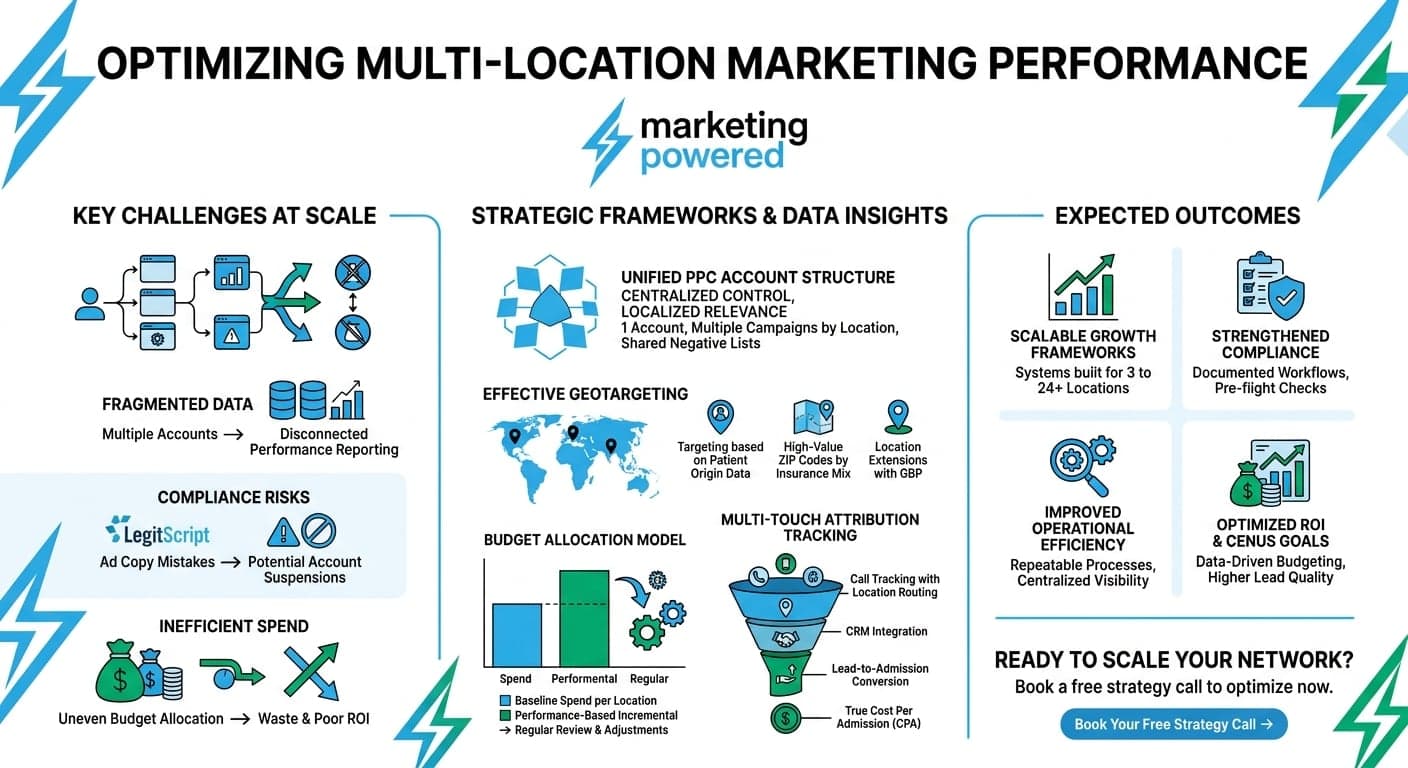
Scaling campaigns across multiple treatment centers surfaces problems that single-location operators never encounter. Understanding these challenges is the first step toward building systems that solve them.
- Budget allocation across locations: How much should each facility receive? Performance-based allocation sounds logical until you realize that newer locations need investment to build momentum, while established sites may be hitting diminishing returns. Without clear frameworks, budget decisions become political rather than strategic.
- Localized content at scale: Each location needs landing pages, ad copy, and creative assets that speak to its specific market. But producing unique content for 10+ locations strains internal teams and creates version control nightmares. The temptation to copy-paste leads to generic messaging that underperforms.
- Fragmented data and attribution: When a prospect searches from one city, clicks an ad, visits your website, then calls a different location, who gets credit? Multi-location attribution requires infrastructure that most treatment centers lack: call tracking with location routing, CRM integration, and admission-level conversion data.
- Compliance consistency: A single ad copy mistake can trigger a Google Ads account suspension that affects all locations. Maintaining LegitScript compliance and behavioral health marketing strategies across a distributed team requires documented approval workflows and regular audits.
- Performance visibility: Leadership needs to compare cost per admission across locations, identify underperformers, and spot trends. But data often lives in silos: Google Ads in one account, Meta in another, call tracking in a third, and admissions data in the EMR. Consolidating this into actionable reporting is a technical and operational challenge.
Effective Strategies for Multi-Location PPC
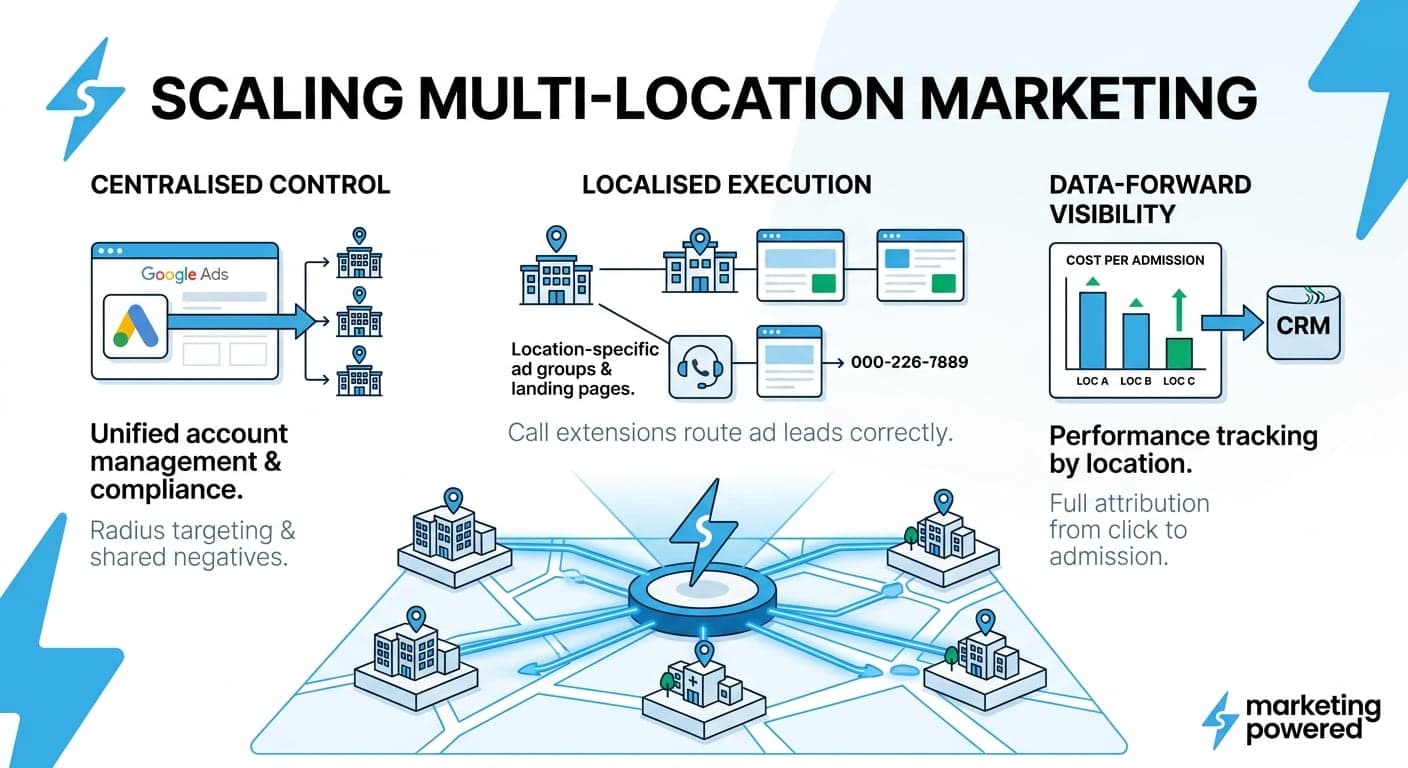
Multi-location PPC requires a different architecture than single-site campaigns. The goal is centralized control with localized execution: one team managing strategy and compliance, with campaigns tailored to each market's competitive dynamics and patient demographics.
Free Audit
Want a straight read on where your budget is leaking?
A campaign structure that scales
The most common mistake is building separate account structures for each location. This creates management overhead, fragments learning data, and makes cross-location optimization nearly impossible. Instead, use a single account with campaign-level segmentation by location and shared negative keyword lists.
According to Google's own documentation on location targeting, radius targeting combined with location-specific ad groups allows granular control without account fragmentation. Layer in location extensions and call extensions that route to the correct facility, and you have a structure that scales through a multi-location expansion without rebuilding.
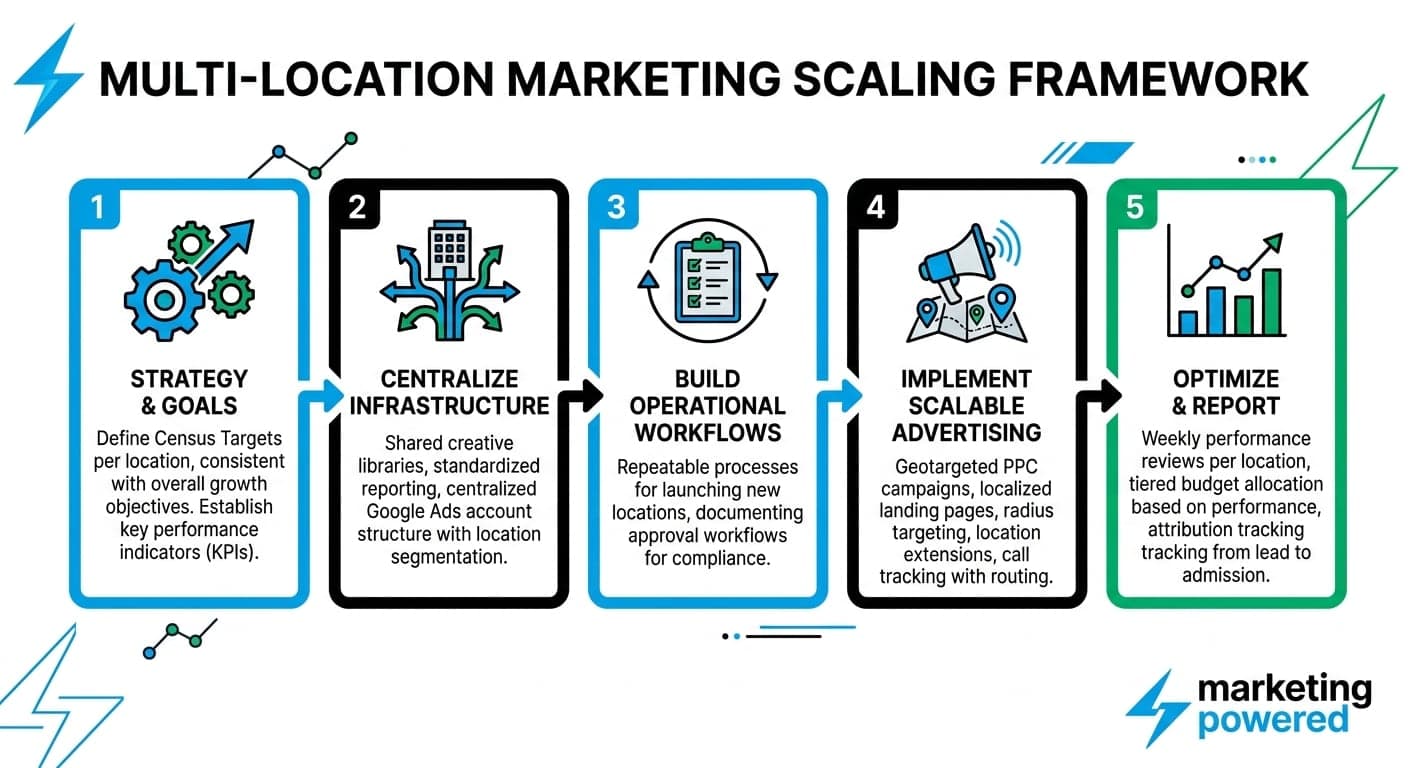
Budget allocation should follow a tiered model. Establish a baseline spend for each location to maintain presence, then allocate incremental budget based on performance metrics like cost per qualified call and cost per admission. Review monthly and adjust quarterly.
Operational discipline for multi-location PPC management
Managing $1.5M to $2M monthly in Google Ads for treatment centers across 11+ accounts requires operational rigor that most agencies lack. Weekly performance reviews by location, bi-weekly creative refreshes, and monthly strategy sessions with facility directors keep campaigns aligned with census goals and local market conditions.
Attribution tracking must extend beyond the click. Implement call tracking with whisper prompts that identify the lead source, integrate with your CRM to track lead-to-admission conversion, and build reporting that shows true cost per admission by location and channel. This is where results-driven marketing separates from vanity metrics.
Leveraging Multi-Location Google Ads
Google Ads remains the primary acquisition channel for most treatment centers, and multi-location campaigns require specific configurations to maximize performance while maintaining compliance.
Strategy
Ready to map a growth plan built for your vertical?
Geotargeting and local extensions
Effective geotargeting goes beyond setting a radius. Analyze where your current patients originate (not just where they search from), identify high-value ZIP codes based on insurance mix and conversion rates, and build targeting that reflects actual patient geography rather than assumptions.
Location extensions connect your ads to Google Business Profiles for each facility, showing address, hours, and distance to the searcher. According to Google's location extension documentation, these extensions can increase click-through rates by making ads more relevant to local searches. For treatment centers, this also builds trust: searchers can see you have a real facility in their area.
Call extensions should route to location-specific numbers with call tracking enabled. This creates the data foundation for attribution while giving prospects a direct line to the facility nearest them.
Compliance in multi-location Google Ads
Google classifies addiction treatment advertising as a sensitive vertical with specific requirements. In the United States, LegitScript certification is mandatory for treatment center advertising. Each location that appears in ads must be covered under your certification.
Beyond certification, ad copy must avoid claims about treatment outcomes, success rates, or comparisons to other providers. Review processes should catch violations before ads go live, not after Google suspends your account. Our approach to multi-location advertising includes pre-flight compliance checks built into the creative workflow.
The no-retargeting restriction in behavioral health means your first-touch campaigns must work harder. You cannot follow prospects around the web with reminder ads. This makes search campaign optimization and landing page conversion rate optimization more important than in verticals where retargeting is allowed.
Choosing a Partner for Multi-Location Marketing
Not every agency can execute multi-location campaigns at scale. The partner you choose should demonstrate specific qualifications that match the complexity of your operations.
Email Us
Prefer to talk it through over email?
The Operational Difference
The right partner feels like an extension of your marketing team, not a vendor sending monthly reports. They understand that census goals vary by location, that new facilities need different strategies than established ones, and that compliance is not a checkbox but an ongoing discipline.
If you are ready to discuss how to grow your treatment center network with multi-location campaigns that scale, Book a discovery call to start the conversation.
Ready to Scale Your Multi-Location Marketing?
Book a discovery call to discuss your multi-location strategy, compliance requirements, lead quality goals, and the channel mix that fits your growth targets. We will share what we have learned scaling treatment center networks through multi-market growth.
Questions, answered.
Multi-location marketing coordinates campaigns across geographically distinct sites while maintaining brand consistency and centralized performance visibility. For treatment centers, this includes location-specific landing pages, geo-targeted ad campaigns, compliance workflows that prevent policy violations, and attribution systems that track leads from first click through admission at each facility.
Use a single Google Ads account with campaign-level segmentation by location rather than separate accounts for each site. Implement radius targeting with location-specific ad groups, call extensions that route to each facility, and shared negative keyword lists. Budget allocation should follow a tiered model with baseline spend per location and performance-based incremental allocation reviewed monthly.
Geotargeting ensures your ads reach prospects in each facility's service area while preventing wasted spend on searchers outside your geographic footprint. Effective geotargeting analyzes actual patient origin data, identifies high-value ZIP codes based on insurance mix and conversion rates, and layers in location extensions that show searchers the nearest facility.
Prioritize vertical experience in behavioral health marketing, including LegitScript and HIPAA awareness. Ask for scale credentials: specific spend amounts managed and locations scaled. Verify attribution sophistication by asking how they track from click to admission. Marketing Powered has managed $50M+ in BH/MH spend and scaled organizations through multi-market growth with admission-level attribution.
Ready to see what AI-native marketing can do for your treatment center?
Request a free audit of your paid media, landing pages, attribution, and compliance posture. You'll get a straight assessment of where the opportunities are.
or email us at info@marketingpowered.ai