Problems We Solve
How to Effectively Reduce CPA for Better Budget Management
Smarter targeting, tighter attribution, and compliance-first execution that protects your margins.
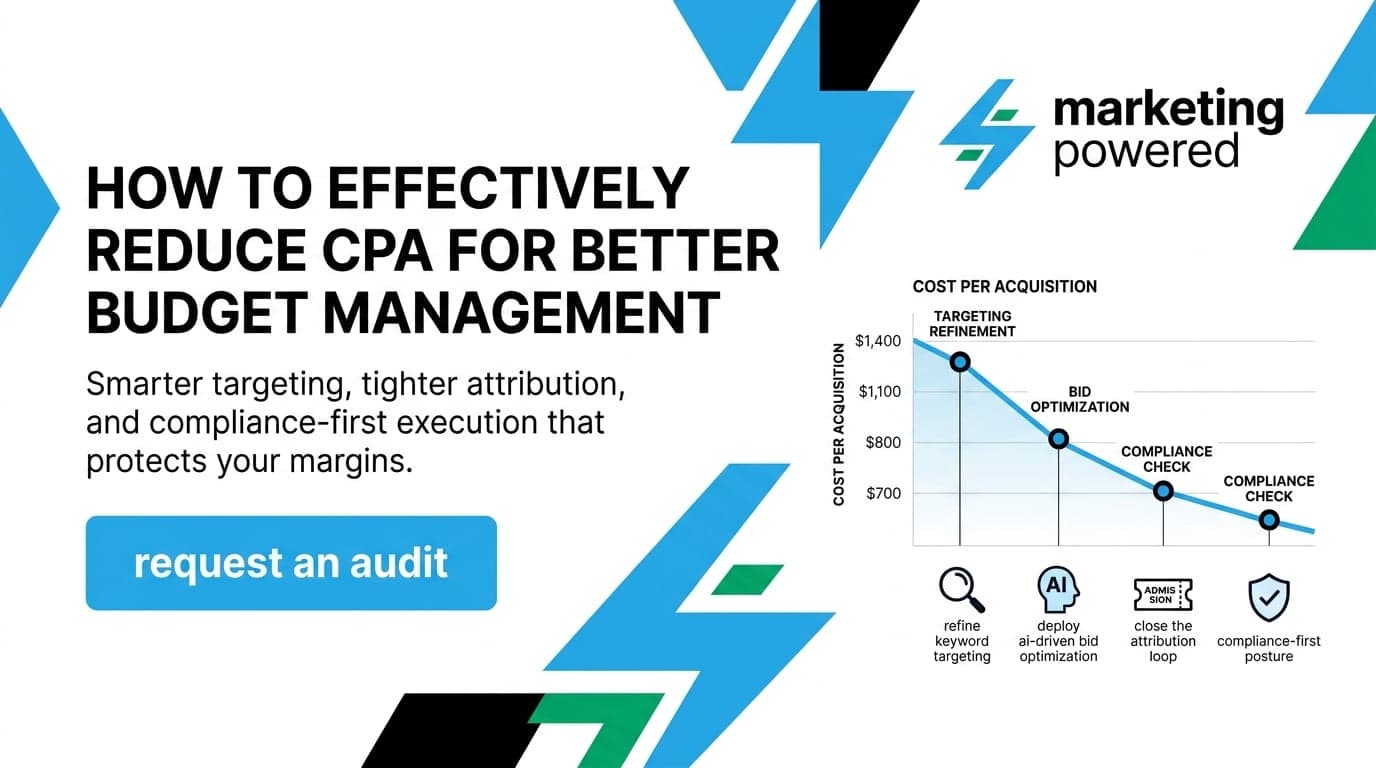
Understanding CPA and Its Impact
Cost per acquisition (CPA) measures exactly what you pay to convert a prospect into a patient admission, booked appointment, or qualified lead. For healthcare marketers, this metric determines whether your advertising budget generates sustainable growth or bleeds money into channels that never convert. When you reduce CPA without sacrificing lead quality, every dollar stretches further, and your census targets become more achievable.
In behavioral health services and mental health marketing, CPA carries additional weight. Google classifies these verticals as sensitive categories, which means retargeting restrictions, tighter ad policies, and higher competition for compliant inventory. According to Google's healthcare and medicines advertising policy, addiction treatment advertising faces certification requirements that many advertisers fail to meet, driving up costs for those who remain compliant.
The math is straightforward: if your CPA is $800 and your average patient lifetime value is $15,000, you have margin to scale. If your CPA creeps to $1,400 while LTV stays flat, your growth model breaks. Every percentage point you shave from CPA compounds across your monthly spend. At $1.5M to $2M in monthly managed Google Ads, a 10% CPA reduction returns six figures annually to reinvest or capture as margin.
Common Challenges in Reducing CPA
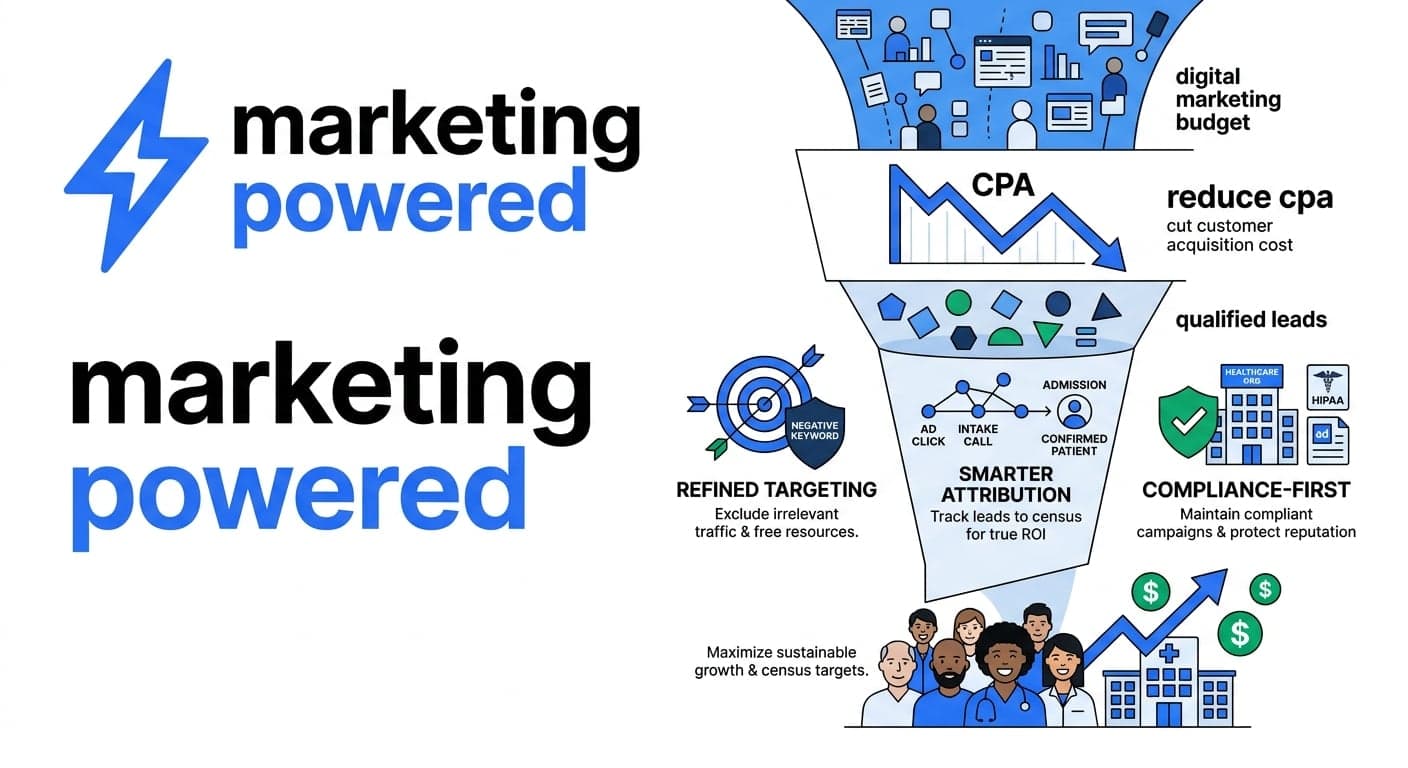
Most healthcare organizations hit the same walls when attempting to lower customer acquisition costs. Understanding these obstacles is the first step toward clearing them.
- Audience targeting that is too broad or too narrow. Broad targeting wastes spend on users who will never convert. Overly narrow targeting starves campaigns of data, preventing machine learning optimization from functioning. The balance requires vertical-specific knowledge of patient demographics and referral patterns.
- An ad creative that fails a compliance review. Disapproved ads mean lost impression share and wasted production time. In behavioral health, a single policy violation can suspend an entire account, forcing you to restart attribution learning from zero.
- Attribution gaps between click and admission. If you cannot trace a lead from ad click through intake call to census, you cannot identify which campaigns actually fill beds. Many treatment centers optimize for form fills when the real goal is admissions. This misalignment inflates the apparent CPA because you are measuring the wrong conversion.
- Inefficient budget allocation across channels. Spreading spend evenly across Google, Meta, and programmatic without understanding channel-specific conversion rates guarantees overpayment somewhere in the mix.
- Ignoring Quality Score and landing page experience. Google's Quality Score documentation confirms that ad relevance, expected CTR, and landing page experience directly affect your cost per click. Poor scores mean you pay more for the same position.
Effective Strategies to Lower CPA
Reducing cost per acquisition requires coordinated action across targeting, creative, bidding, and measurement. Here is how we approach it for healthcare clients managing significant media budgets.
Free Audit
Want a straight read on where your budget is leaking?
Refine Keyword Targeting with Negative Keyword Hygiene
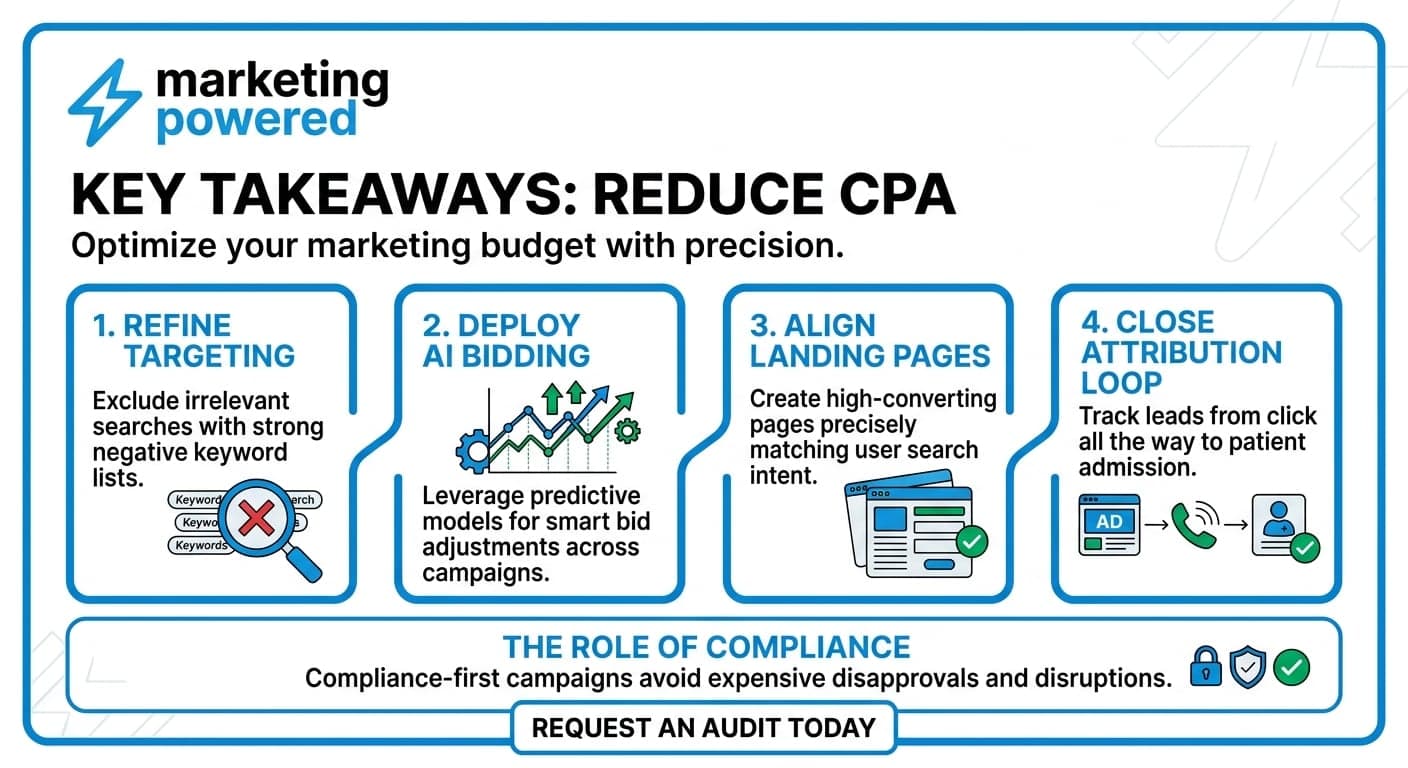
In Google Ads management, negative keywords prevent your ads from appearing on irrelevant searches. For treatment centers, this means excluding searches for free resources, job seekers, competitor employee names, and clinical research queries. A well-maintained negative keyword list can cut wasted spend by 15 to 25% without reducing qualified traffic.
Deploy AI-Driven Bid Optimization
Our AI marketing tools apply predictive models to bid adjustments, reallocating budget toward auctions with higher conversion probability. This is not set-and-forget automation. It is continuous optimization informed by admission data fed back into the bidding algorithm. We have operated AI-native infrastructure since 2022, running local inference on owned hardware rather than relying on third-party API wrappers.
Align Landing Pages with Ad Intent
Every ad group should point to a landing page that matches the searcher's intent precisely. A user searching for 'detox near me' needs a different page than someone searching for 'PHP program for depression.' Multivariant optimization tests headlines, form length, and trust signals at the visitor level, routing traffic to the variant most likely to convert that specific user profile.
Strategy
Ready to map a growth plan built for your vertical?
Close the Attribution Loop to Admission
Tracked attribution through to admission is our standard. When you know which campaigns produce admissions rather than just leads, you can reallocate spend confidently. This discipline alone can reduce CPA by eliminating channels that generate form fills but never convert to census.
These strategies compound. Tighter targeting, smarter bidding, better landing pages, and complete attribution create a feedback loop that improves every month.
The Role of Compliance in Reducing CPA
Compliance failures are expensive. A disapproved ad wastes the creative investment and pauses your campaign while competitors capture your impression share. An account suspension can reset months of conversion learning. In extreme cases, LegitScript certification revocation removes your ability to advertise addiction treatment on Google entirely.
Healthcare advertising operates under HIPAA constraints, Google's sensitive vertical policies, and platform-specific health restrictions. HIPAA awareness means no PHI in ad copy, landing pages, or tracking pixels. Google's policies prohibit certain claims and require certification for addiction treatment advertising. Meta restricts health-related custom audiences entirely.
We build compliance into campaign architecture from day one, not as an afterthought. Ad copy templates are pre-approved against policy. Landing pages avoid prohibited claims. Tracking is configured to exclude PHI from analytics. This compliance-first posture prevents the costly disruptions that inflate CPA for less disciplined advertisers.
According to the HHS Office for Civil Rights HIPAA guidance, covered entities and their business associates must ensure marketing activities comply with privacy rules. Non-compliance creates legal exposure beyond advertising costs.
Anonymized Growth Case Study: Multi-Location Growth
A multi-location behavioral health organization grew from a small regional footprint into a larger multi-market network under our media management. This scale required CPA discipline at every stage. Adding locations means adding geographic targeting, new competitive landscapes, and fresh compliance reviews. We maintained acquisition efficiency while scaling monthly spend into the seven figures. We supported substantial revenue growth during the engagement.
This outcome reflects the compound effect of the strategies outlined above: tight targeting, AI-assisted optimization, landing page testing, full-funnel attribution, and compliance rigor. No single tactic produced the result. The system did.
Email Us
Prefer to talk it through over email?
Portfolio-Wide Results Across Behavioral Health
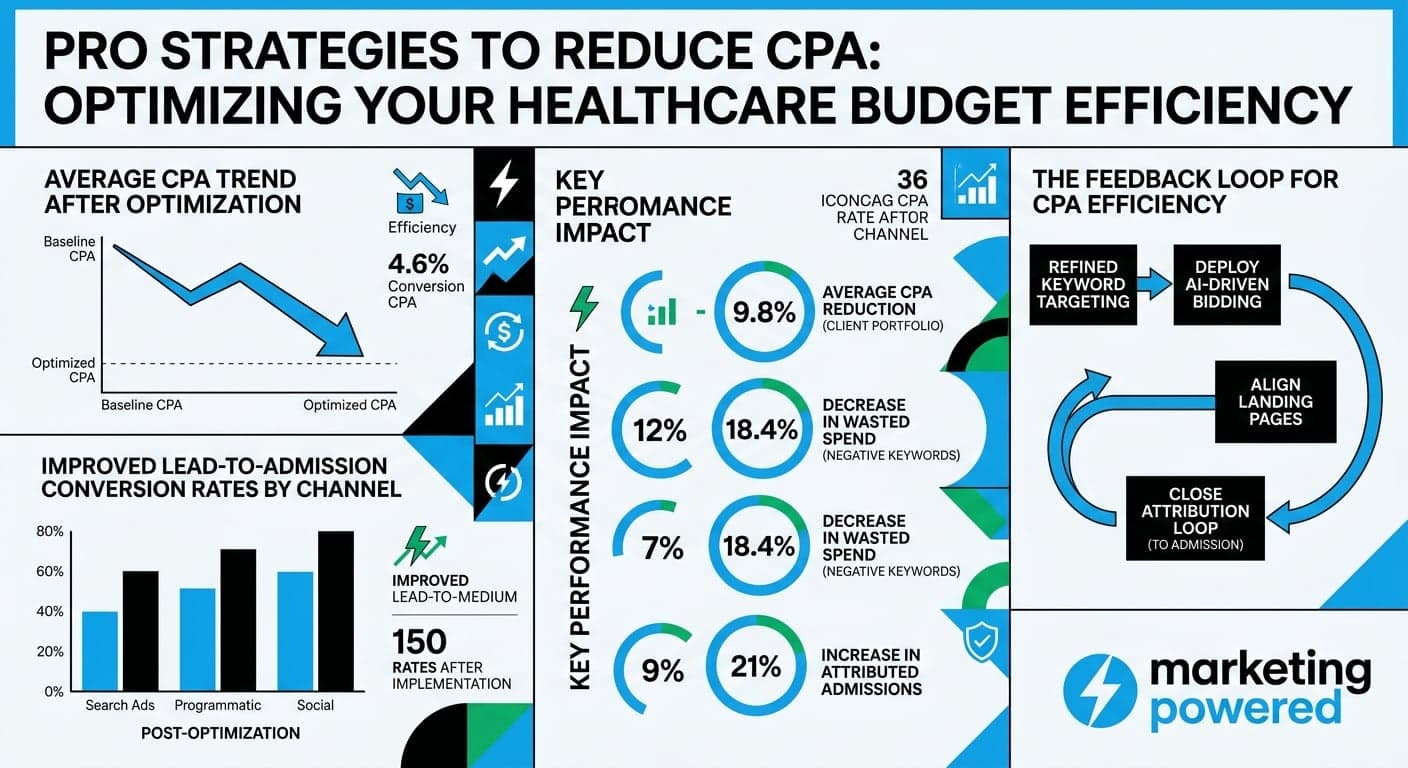
Across $50M+ in managed behavioral health and mental health media spend, we have developed benchmarks that inform new client engagements from day one. Court-certified expert witness status in advertising strategy means our methodology has been tested under legal scrutiny, not just marketing reviews. Explore additional case studies to see how these principles apply across different treatment modalities and market conditions.
Stop Overpaying for Acquisition
If your CPA is higher than it should be, the fix is usually a combination of targeting refinement, attribution clarity, and compliance discipline. We have managed $50M+ in behavioral health and mental health media spend with full-funnel tracking to admission. Let us show you where the waste is hiding.
Questions, answered.
CPA (cost per acquisition) measures the total advertising spend required to generate one conversion, whether that is a form submission, intake call, or patient admission. For healthcare marketers, CPA determines budget sustainability. A CPA that exceeds patient lifetime value makes growth impossible. A CPA that stays well below LTV creates margin for reinvestment and scale.
Effective CPA reduction combines refined keyword targeting with aggressive negative keyword management, AI-driven bid optimization that responds to conversion data, landing pages aligned to search intent, and attribution tracking that connects ad spend to actual admissions. Each element reinforces the others. The compounding effect produces sustained improvement rather than one-time gains.
The most costly mistakes include overly broad audience targeting that wastes spend, ad creative that triggers policy disapprovals, attribution that stops at form fills instead of tracking to admission, and budget allocation that ignores channel-specific performance. In healthcare, compliance failures add account suspensions and certification risks to this list.
Non-compliant advertising creates direct costs through disapproved ads, account suspensions, and potential LegitScript certification loss. Each disruption resets conversion learning and hands impression share to competitors. Indirect costs include legal exposure from HIPAA violations. Building compliance into campaign architecture from the start prevents these expensive interruptions.
Ready to see what AI-native marketing can do for your treatment center?
Request a free audit of your paid media, landing pages, attribution, and compliance posture. You'll get a straight assessment of where the opportunities are.
or email us at info@marketingpowered.ai