Problems We Solve
Strategies to Increase Qualified Calls in Behavioral Health
Turn your intake team's time into admissions, not dead ends.
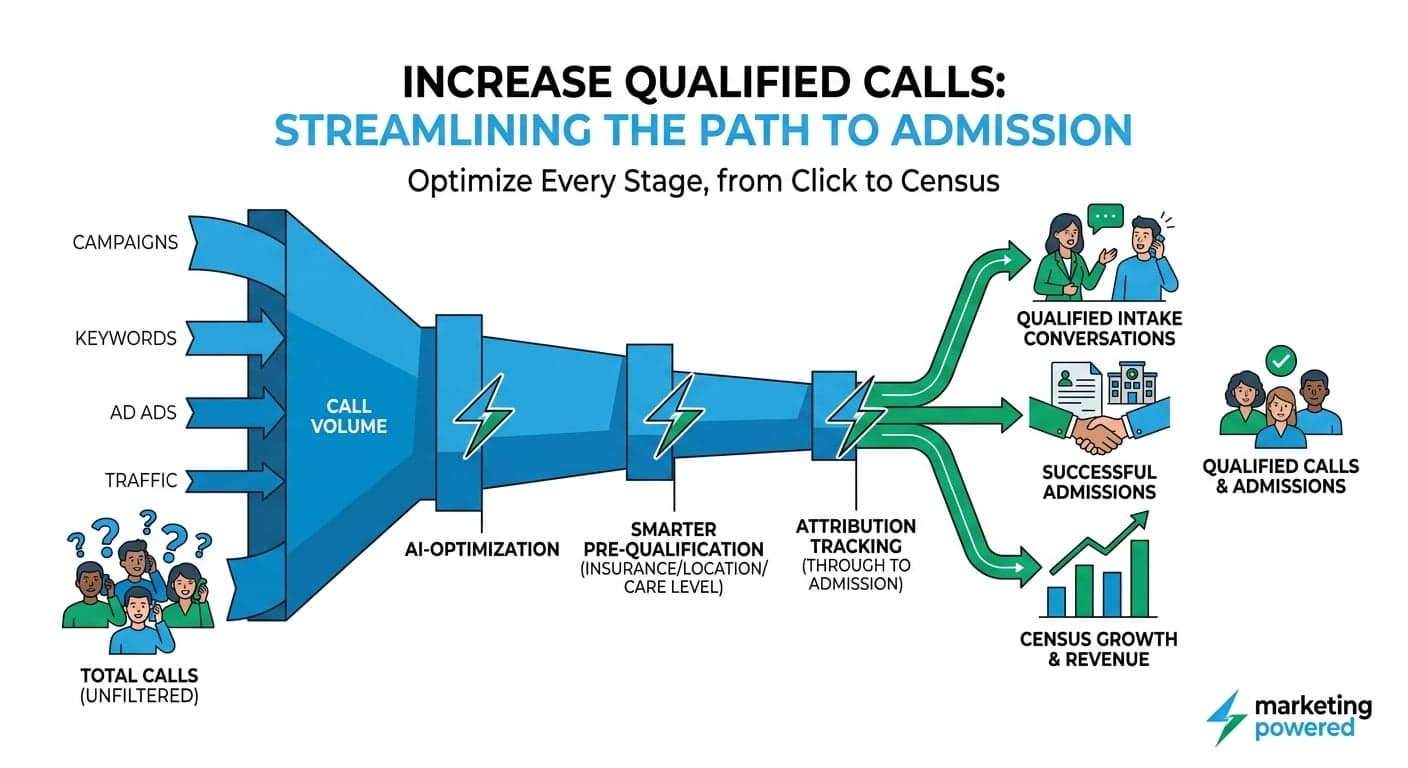
Understanding Qualified Calls
What separates a productive conversation from wasted intake bandwidth
Every call that reaches your intake team costs time, staffing, and emotional labor. A qualified call in behavioral health is one where the caller matches your facility's clinical capabilities, geographic service area, insurance acceptance, and readiness for treatment. When these factors align, your team spends time on conversations that can result in admissions rather than redirecting callers to other providers.
The difference between call volume and call quality determines whether your marketing spend generates revenue or frustration. Treatment centers that focus on increasing qualified leads often see their cost per admission drop significantly, even when total call volume decreases. This is the qualified lead increase that actually moves census.
Qualified call generation in behavioral health requires precision that generic marketing agencies rarely understand. Your facility may specialize in dual diagnosis, adolescent treatment, or specific insurance networks. A call from someone seeking services you do not offer is not a near-miss; it is a resource drain on your intake coordinators and a poor experience for the caller who needs help elsewhere.
When your marketing attracts the right callers, your intake team operates at capacity, doing what they do best: guiding appropriate patients toward admission. This alignment between marketing targeting and clinical capability is the foundation of sustainable census growth.
Common Pitfalls in Call Quality
Free Audit
Want a straight read on where your budget is leaking?
Where most treatment center marketing strategies break down
Many treatment centers invest heavily in lead generation without examining why their intake teams field so many unqualified calls. The problems typically start upstream, in messaging that attracts the wrong audience or targeting that casts too wide a net.
Unclear messaging is the most common culprit. When ad copy and landing pages use broad language like 'get help today' without specifying treatment modality, insurance acceptance, or location, callers arrive with expectations your facility cannot meet. A detox center running ads that do not mention detox will receive calls from people seeking outpatient therapy, PHP programs, or services in other states.
Poor audience targeting compounds the problem. Behavioral health advertisers operating under Google Ads healthcare vertical restrictions cannot use retargeting, which means every impression must count. Targeting strategies that prioritize reach over relevance burn budget on clicks that never convert to qualified conversations.
Another frequent mistake is failing to pre-qualify callers before they reach intake. Landing pages that collect minimal information force your team to discover disqualifying factors (wrong insurance, wrong geography, wrong level of care) during the call itself. This wastes time on both sides and creates friction in the patient journey.
Finally, many centers lack visibility into which campaigns, keywords, and creative variations generate qualified calls versus total calls. Without this attribution discipline, optimization is guesswork. You cannot improve call quality if you cannot measure it at the campaign level.
AI-Driven Strategies to Increase Qualified Calls
How data and automation create precision in behavioral health marketing
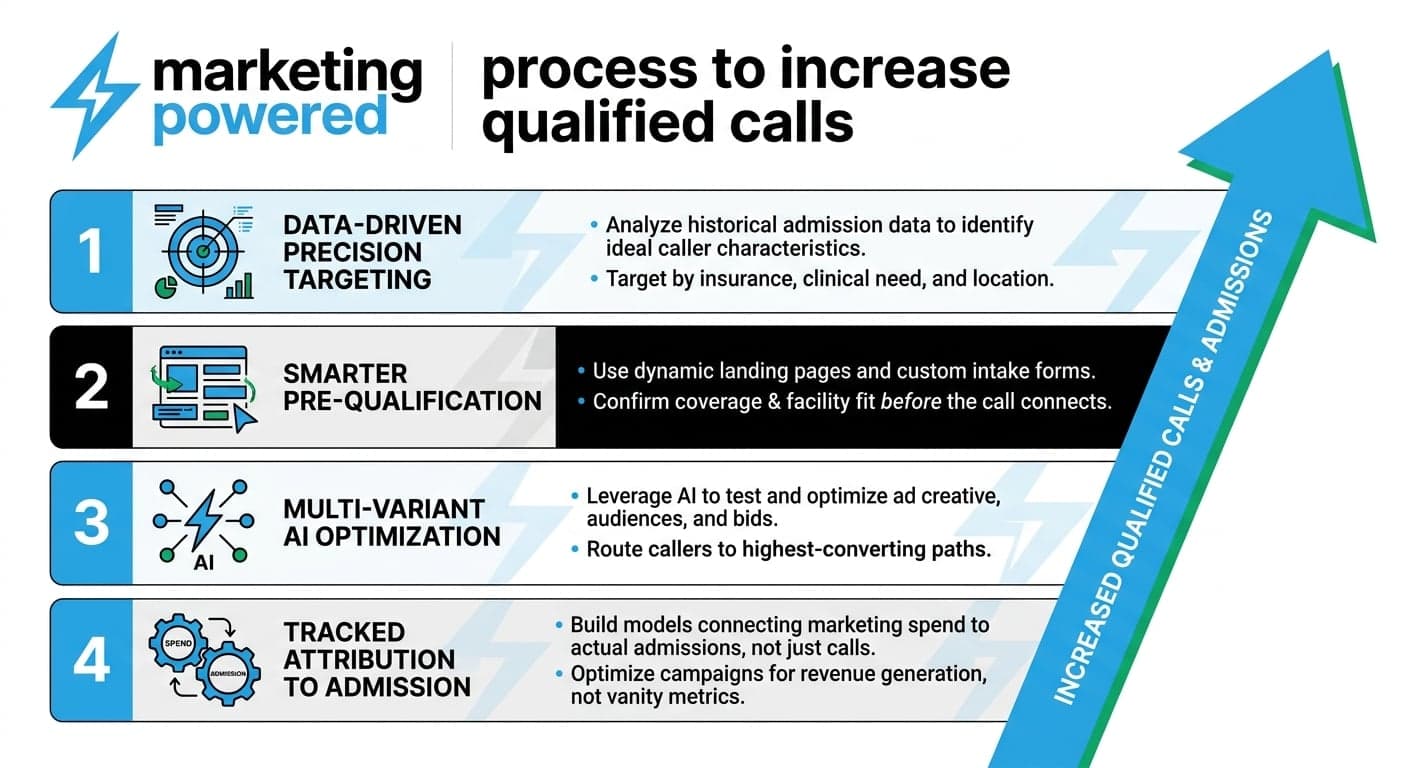
AI and predictive analytics change how treatment centers approach qualified call generation. Rather than relying on broad demographic targeting and hoping for the best, AI systems analyze patterns in your historical admission data to identify the characteristics of callers most likely to convert.
Marketing Powered has been building AI-native marketing systems since 2022. Our approach uses machine learning to optimize multiple variables simultaneously: ad creative, landing page content, audience signals, and bid strategies. This multi-variant optimization routes each visitor to the page variation most likely to generate a qualified call based on their profile and behavior.
Consider how this works in practice. A treatment center specializing in dual diagnosis receives traffic from multiple campaigns. Traditional optimization might favor the campaign with the lowest cost per click. AI-driven optimization identifies that one campaign generates calls with a 40% admission rate while another generates calls with an 8% admission rate, then reallocates the budget accordingly.
The AI systems we deploy also improve call quality through smarter pre-qualification. Dynamic landing pages can adjust intake form fields based on the traffic source, ensuring that callers from insurance-specific campaigns confirm coverage before reaching your team. This reduces time spent on calls that end with 'we don't accept that insurance.'
Attribution tracking through to admission is essential for this optimization to work. We build attribution models that connect marketing spend to actual admissions, not just calls or form fills. This tracked attribution through to admission approach means every dollar of your $50M+ in behavioral health media spend we manage is accountable to revenue, not vanity metrics.
Strategy
Ready to map a growth plan built for your vertical?
Compliance and Ethical Considerations
Maintaining trust while growing the census
Behavioral health marketing operates under scrutiny that most industries never face. LegitScript certification requirements for addiction treatment advertising, HIPAA obligations around patient data, and platform-specific restrictions on healthcare ads create a compliance environment where mistakes carry real consequences.
Marketing Powered maintains rigorous compliance awareness across every campaign. This means understanding that Google Ads treats behavioral health as a sensitive vertical with no retargeting permitted, that Meta has separate restrictions on addiction treatment advertising, and that any claim about treatment outcomes requires careful framing.
HIPAA considerations extend to call tracking and lead management. The systems that improve call quality must also protect caller privacy. We operate with a HIPAA-conscious infrastructure that ensures patient data remains protected throughout the marketing and intake process. This is not a feature; it is a requirement for operating responsibly in this vertical.
Our compliance in marketing approach reflects years of operating at scale in behavioral health. When you have managed $1.5M to $2M monthly in Google Ads across treatment center accounts, you learn which compliance boundaries are firm and which allow room for testing. That experience protects your facility from policy violations that could suspend your advertising accounts.
Case Studies: Success Stories
Email Us
Prefer to talk it through over email?
Real results from behavioral health facilities we have partnered with
The strategies outlined above produce measurable improvements in call quality and admission rates. Here are examples from facilities that partnered with Marketing Powered to increase qualified calls.
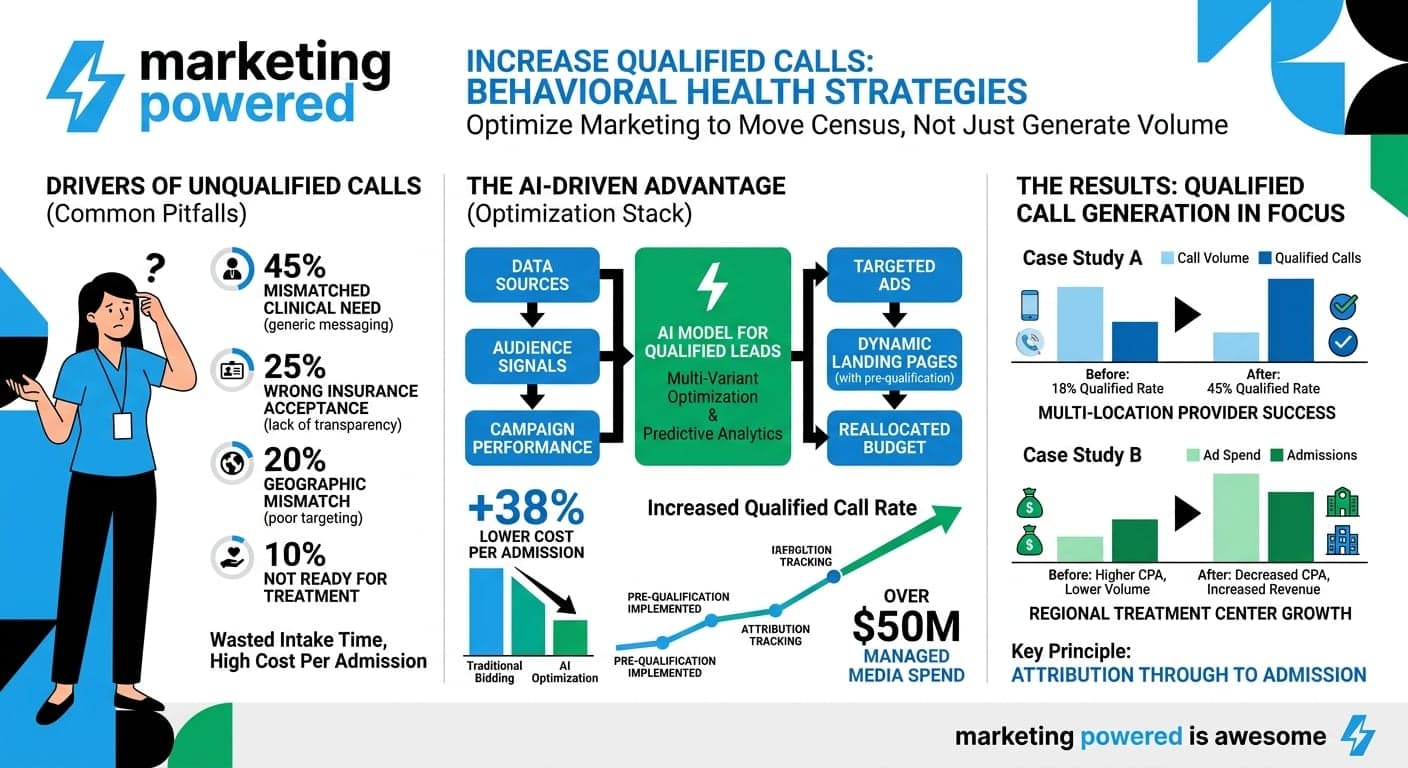
One multi-location treatment provider came to us, managing intake across 3 facilities with inconsistent call quality. Their marketing was generating volume, but intake coordinators reported that fewer than 20% of calls were from appropriate candidates. We rebuilt their campaign structure around specific treatment modalities and insurance networks, implemented pre-qualification forms, and established attribution tracking through to admission. Within six months, the qualified call rate exceeded 45%, and the cost per admission dropped by 38%.
A residential treatment center in the Southwest struggled with geographic mismatch. Their ads attracted callers from across the country, but their facility primarily served patients from three states due to insurance and licensing constraints. We restructured geographic targeting, adjusted messaging to emphasize regional service, and built landing pages that confirmed location early in the funnel. Qualified calls increased while total call volume decreased, exactly the tradeoff that improves intake efficiency.
Our work operator-side multi-market growth demonstrates what happens when qualified call generation aligns with facility expansion. As new locations opened, marketing needed to drive qualified calls to specific facilities based on capacity, specialty, and insurance acceptance. The attribution infrastructure we built allowed real-time optimization across the portfolio, contributing to revenue growth from operator-side growth work.
You can explore additional case studies demonstrating how these strategies translate to specific facility contexts and treatment modalities.
Next Steps for Your Facility
Improving call quality requires examining your current marketing through the lens of qualification, not just volume. If your intake team fields calls that consistently miss on insurance, geography, or level of care, the problem is upstream in your targeting and messaging.
Marketing Powered brings operator-level experience to behavioral health solutions and mental health insights. Our founder's background includes court-certified expert witness testimony in advertising strategy, and our team has managed over $50M in behavioral health and mental health media spend.
A discovery call allows us to discuss your facility's specific challenges: which insurance networks you accept, which treatment modalities you offer, which geographic areas you serve, and where your current call quality breaks down. From there, we can outline a strategy tailored to your census goals and compliance requirements.
Book a Discovery Call
Let's discuss your facility's call quality challenges, compliance requirements, and growth targets. We will walk through how AI-driven strategies and attribution discipline can increase qualified calls while protecting your advertising accounts.
Questions, answered.
Effective strategies combine precise audience targeting with pre-qualification mechanisms and attribution tracking. AI-driven optimization identifies which campaigns, keywords, and creative variations generate calls that convert to admissions, then reallocates budget toward those performers. Landing pages should collect qualifying information (insurance, location, level of care) before callers reach intake, reducing time spent on mismatched conversations.
Every unqualified call consumes intake team bandwidth that could serve appropriate patients. Treatment centers that prioritize call quality over volume typically see lower cost per admission and higher intake team morale. When marketing attracts callers who match your clinical capabilities and insurance acceptance, your team spends time on conversations that result in admissions rather than redirections.
AI systems analyze patterns in historical admission data to identify characteristics of high-converting callers. Machine learning then optimizes targeting, creative, and landing page variations to attract more of those profiles. Multi-variant optimization routes each visitor to the page most likely to generate a qualified call, while predictive models identify which leads deserve priority follow-up from intake.
HIPAA requires that any system handling patient information maintain appropriate safeguards for privacy and security. In call generation, this means call tracking platforms, CRM systems, and attribution tools must be configured to protect caller data. Marketing Powered operates with a HIPAA-conscious infrastructure that ensures patient information remains protected throughout the marketing and intake process.
Marketing Powered has helped treatment centers significantly improve call quality through restructured targeting and pre-qualification. One facility increased qualified call rates from under 20% to over 45% while reducing cost per admission by 38%. Our work operator-side multi-market growth demonstrates how qualified call infrastructure supports multi-facility growth, contributing to revenue expansion from operator-side growth work.
Ready to see what AI-native marketing can do for your treatment center?
Request a free audit of your paid media, landing pages, attribution, and compliance posture. You'll get a straight assessment of where the opportunities are.
or email us at info@marketingpowered.ai