Media
How Syndicated Content Can Boost Your Outreach
A strategic approach to republishing content that expands visibility without compromising compliance or SEO authority.

Understanding Syndicated Content
Syndicated content is original material published on your site and then republished on third-party platforms with your permission. The goal is straightforward: place your expertise in front of audiences who would never find you through organic search alone. For behavioral health treatment center services, this means getting clinical insights, educational resources, and thought leadership onto platforms where referral sources and families actively research treatment options.
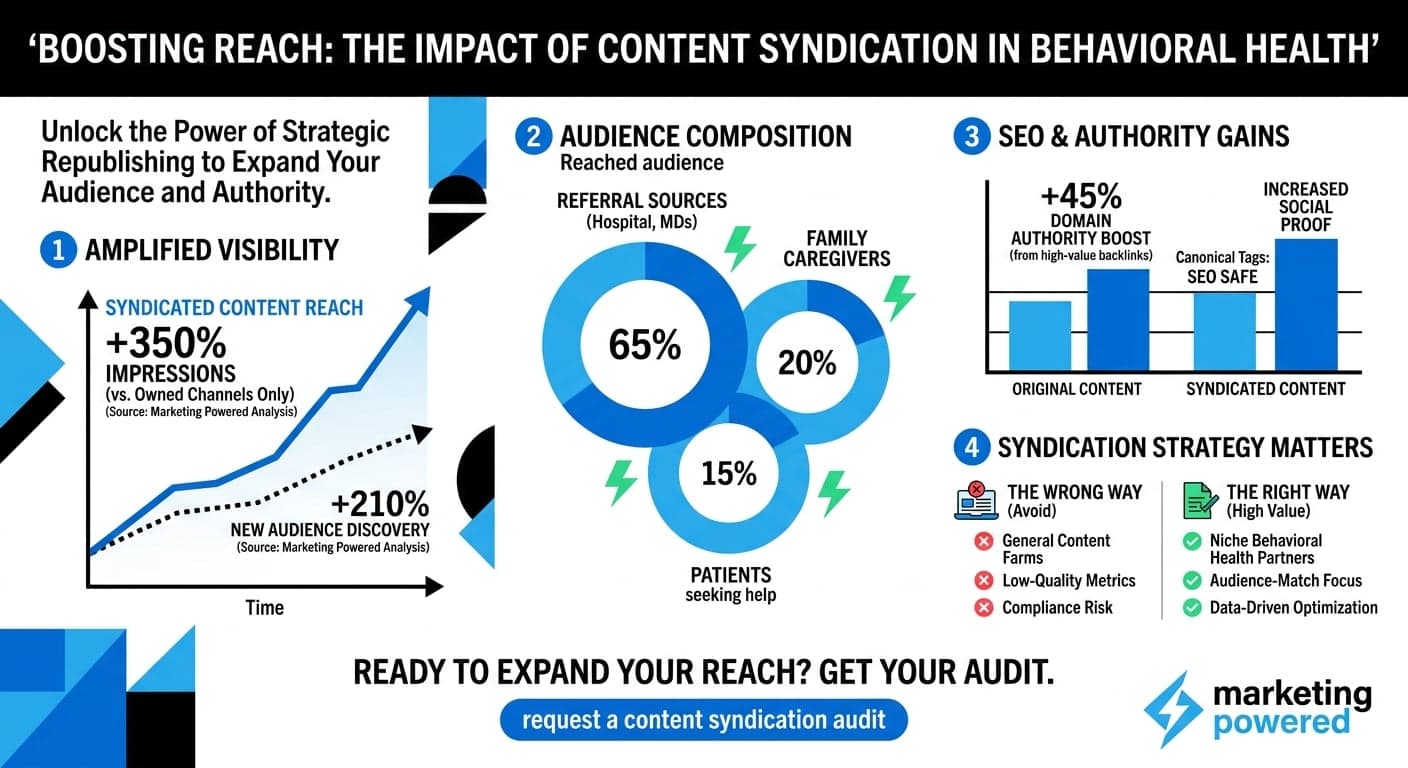
A common misconception is that syndication hurts SEO by creating duplicate content penalties. In practice, proper syndication uses canonical tags that point back to your original article, signaling to search engines which version should rank. The republished version gains exposure; the original retains authority. Another misunderstanding: syndication does not mean you lose ownership. You control licensing terms, attribution requirements, and where your content appears.
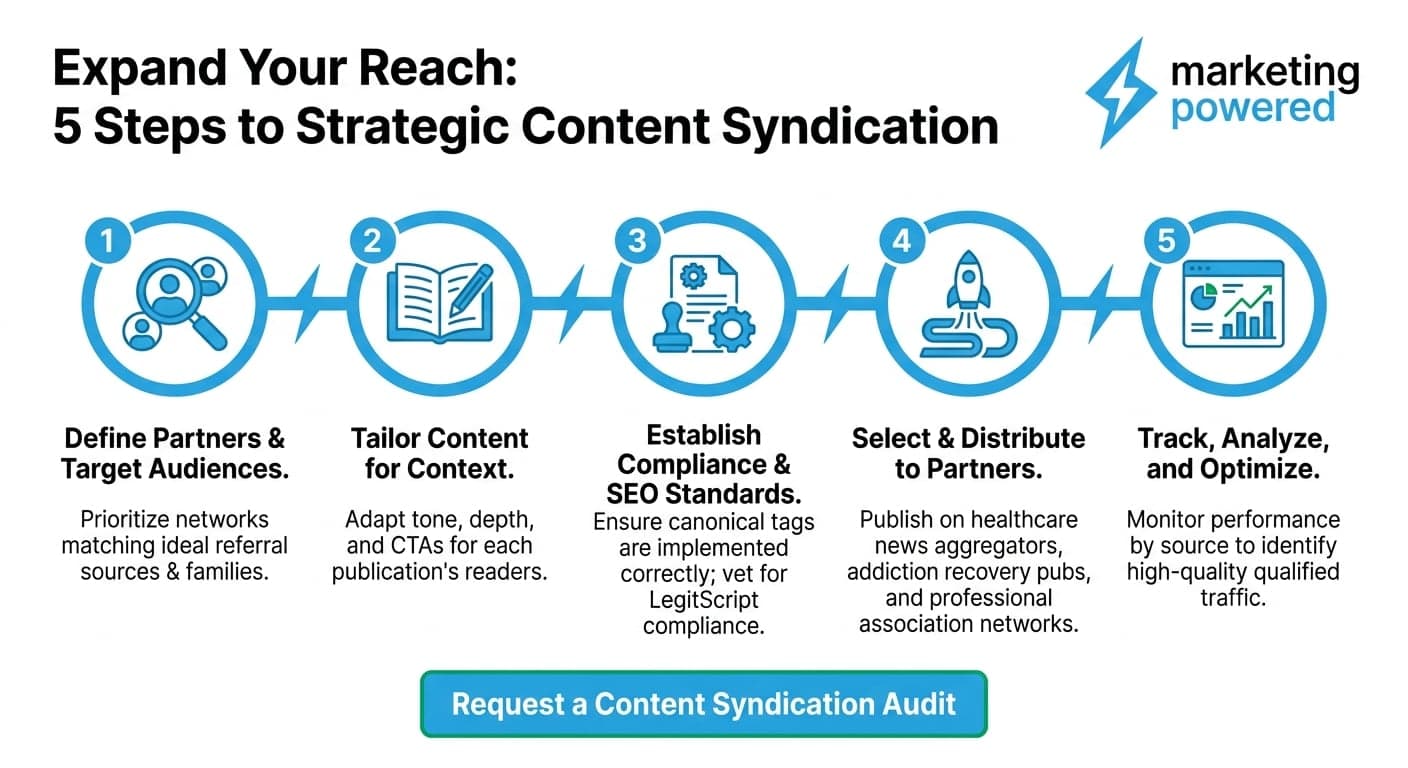
Effective syndication examples include placing clinical education articles on healthcare news aggregators, contributing guest columns to addiction recovery publications, or partnering with professional associations that distribute member content to their networks.
Benefits of Content Syndication
Content syndication delivers reach that owned channels cannot achieve alone. When a treatment center's article appears on a high-authority healthcare publication, it reaches referral coordinators, hospital discharge planners, and families researching options. That exposure compounds over time as republished articles continue generating impressions long after the original publish date.
For behavioral health providers specifically, syndication builds credibility with audiences who may be skeptical of direct advertising. A clinical director's bylined article on a respected platform carries more weight than a paid placement. This authority translates into stronger brand recognition when prospects eventually search for treatment options.
Additional benefits of content syndication include backlink acquisition from authoritative domains, increased social proof through third-party validation, and the ability to reach niche audiences through specialized syndication partners. Each republished article becomes an additional entry point into your brand ecosystem.
Strategies for Successful Syndication
Partner selection determines syndication success. Prioritize platforms with audiences that match your ideal referral sources: healthcare professional networks, addiction medicine publications, family caregiver resources, and mental health advocacy organizations. Avoid general content farms that promise volume but deliver low-quality traffic with no conversion potential.
Content tailoring matters as much as placement. An article written for your blog may need adjustment for a professional audience in a clinical publication. Review content tailoring tips to adapt tone, depth, and calls-to-action for each syndication partner's readership. The core message stays consistent; the framing shifts to match context.
Establish clear agreements with syndication partners covering attribution, canonical implementation, and editorial control. Track performance by source to identify which partners drive qualified traffic versus vanity metrics. Not all republished content performs equally, and ongoing optimization requires data.
Free Audit
Want a straight read on where your budget is leaking?
Potential Pitfalls and How to Avoid Them
Duplicate content concerns are real but manageable. Without proper canonical tags, search engines may index the syndicated version instead of your original, diluting your domain authority. Work with partners who implement rel=canonical correctly, and audit placements quarterly to catch technical drift. For duplicate content solutions and broader technical SEO support, a structured approach prevents long-term damage.
Compliance risk increases when content appears on platforms you do not control. Behavioral health content must meet LegitScript standards and avoid claims that violate Google's healthcare advertising policies. Vet syndication partners for their editorial standards and audience quality before signing agreements.
Low-quality syndication networks can associate your brand with spam or misleading content. If a partner's other syndicated articles include questionable health claims or aggressive lead generation tactics, that association reflects on your treatment center. Quality over quantity protects your reputation.
How Marketing Powered Can Help
Marketing Powered brings operator-level experience to content syndication for behavioral health. With $50M+ in managed media spend across the behavioral health and mental health verticals, we understand which platforms deliver qualified attention and which waste resources. Our founder's background includes scaling organizations through multi-market growth, giving us perspective on what syndication strategies actually move census numbers.
Our approach combines Marketing Powered's expertise in AI-native content systems with hands-on compliance awareness. We handle partner vetting, canonical implementation, performance tracking, and ongoing optimization. The result is syndication that expands reach without creating SEO problems or compliance exposure. Book a call with an expert to discuss how syndicated content fits your broader marketing strategy.
Ready to Expand Your Content Reach?
A content syndication audit identifies the right partners, surfaces technical risks, and builds a distribution strategy aligned with your compliance requirements and growth goals.
Ready to see what AI-native marketing can do for your treatment center?
Request a free audit of your paid media, landing pages, attribution, and compliance posture. You'll get a straight assessment of where the opportunities are.
or email us at info@marketingpowered.ai