Company
Understanding Data Sovereignty in Healthcare
Why data residency, ownership, and control matter for healthcare organizations navigating compliance requirements
What is Data Sovereignty?
Data sovereignty refers to the principle that data is subject to the laws and governance structures of the nation or jurisdiction where it is collected or stored. For healthcare organizations, this means patient information, operational data, and marketing analytics must comply with the legal frameworks of specific geographic regions.
The concept extends beyond a simple data storage location. Data sovereignty encompasses three interconnected elements: data residency (where data physically resides), data ownership (who controls access and usage rights), and client data control (the mechanisms that allow organizations to manage their information assets).
In healthcare contexts, data sovereignty intersects directly with regulations like HIPAA in the United States, GDPR in the European Union, and provincial health information acts in Canada. According to the U.S. Department of Health and Human Services, covered entities must ensure that protected health information remains within a compliant infrastructure, which makes geographic and jurisdictional awareness foundational to any data strategy.
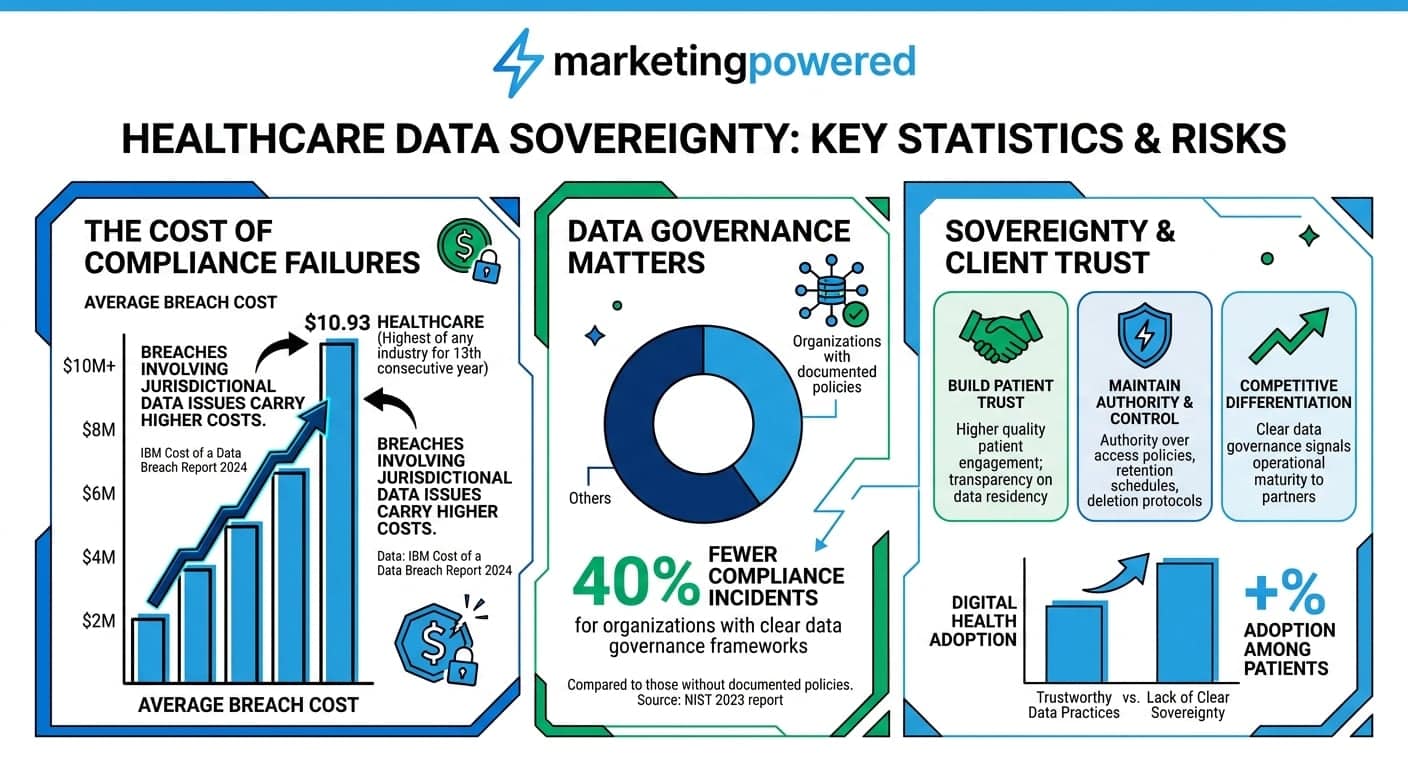
For healthcare startups and established providers alike, understanding these principles is not optional. A 2023 report from NIST highlighted that organizations with clear data governance frameworks experience 40% fewer compliance incidents than those without documented policies.
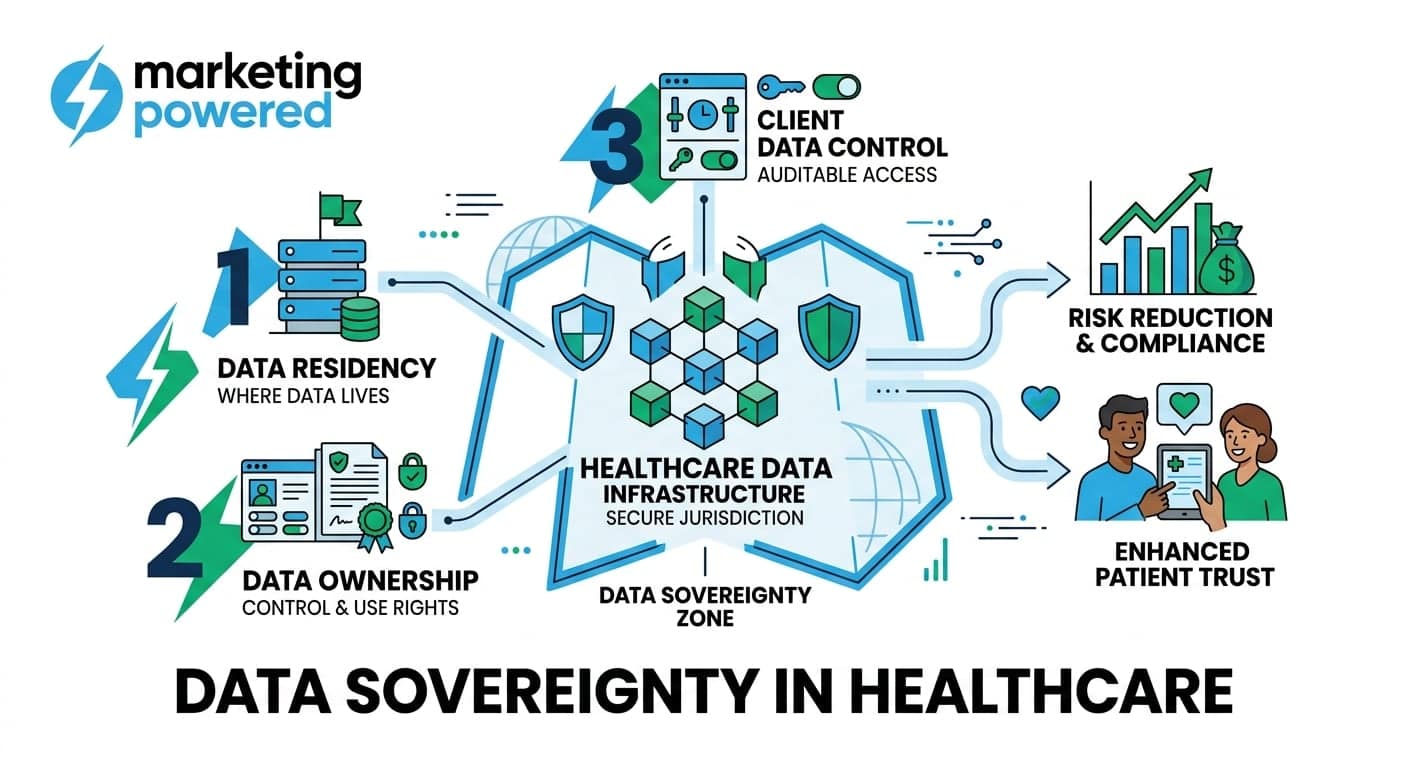
Importance of Data Sovereignty in Healthcare
Healthcare data carries unique sensitivity. Patient records, treatment histories, and billing information all fall under strict regulatory oversight. When this data crosses jurisdictional boundaries without proper controls, organizations face exposure to compliance violations, financial penalties, and reputational damage.
The stakes are measurable. According to the IBM Cost of a Data Breach Report 2024, healthcare organizations face an average breach cost of $10.93 million, the highest of any industry for the 13th consecutive year. Data sovereignty practices directly reduce this risk by ensuring information remains within compliant, auditable environments.
Beyond financial exposure, healthcare data sovereignty affects patient trust. When patients understand that their information is stored within their home jurisdiction and subject to familiar legal protections, they are more likely to engage openly with providers. This trust translates into better clinical relationships and, for healthcare marketers, higher quality patient engagement.
Organizations working with HIPAA-aware marketing solutions must consider how their data practices affect both compliance posture and patient perception. The two are inseparable in modern healthcare marketing.
Client Benefits of Data Sovereignty
For healthcare organizations, implementing proper data sovereignty practices delivers tangible benefits beyond compliance checkbox completion.
Client data sovereignty gives your patients and partners clarity about where their information lives and who can access it. This transparency builds trust that compounds over time. When a patient knows their data remains within a controlled, auditable environment, they engage more freely with digital health tools, marketing communications, and care coordination platforms.
The control aspect matters equally. Healthcare data sovereignty ensures your organization, not a third-party vendor or cloud provider in an unfamiliar jurisdiction, maintains authority over access policies, retention schedules, and deletion protocols. This control becomes particularly relevant when working with data control strategies for marketing campaigns that touch patient information.
Privacy-conscious data practices also create competitive differentiation. In a market where patients increasingly research providers before making contact, demonstrating clear data governance signals operational maturity that influences decision-making.
Free Audit
Want a straight read on where your budget is leaking?
Navigating Data Sovereignty Challenges
Implementing healthcare data sovereignty is not without friction. Organizations face legal complexity, technological requirements, and operational adjustments that require careful planning.
Legal hurdles vary by jurisdiction. A healthcare startup operating across multiple states or countries must track differing requirements for data residency, breach notification timelines, and consent mechanisms. The Office for Civil Rights enforces HIPAA at the federal level, but state-level regulations often add additional requirements. Working with partners who understand compliance requirements reduces the burden of tracking these overlapping frameworks.
Technological requirements present their own challenges. True data sovereignty often requires infrastructure investments: local storage solutions, encryption protocols that meet jurisdictional standards, and audit logging that can satisfy regulatory inquiries. For organizations without internal IT depth, these requirements can feel overwhelming.
The path forward typically involves three elements: mapping your current data flows to understand where information actually resides, identifying gaps between current practices and regulatory requirements, and partnering with vendors and service providers who share your compliance posture. Organizations that approach data sovereignty as an ongoing practice rather than a one-time project maintain stronger compliance positions over time.
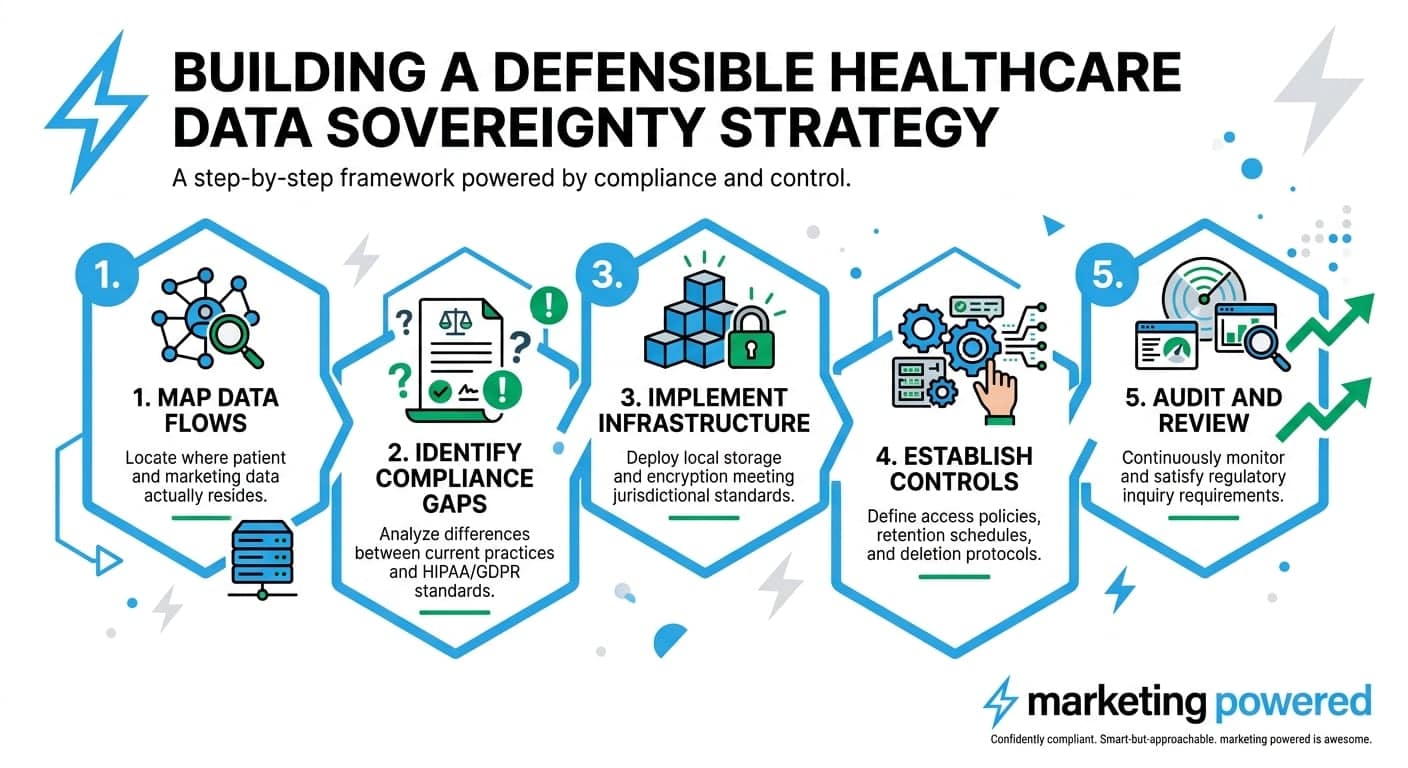
Partnering with Experts in Data Sovereignty
Healthcare data sovereignty is not a problem you need to solve alone. Working with partners who understand the intersection of healthcare compliance, marketing technology, and data governance accelerates your path to a defensible position.
Marketing Powered brings operator-level experience to this challenge. With $50M+ managed in behavioral health and mental health marketing, LegitScript and HIPAA awareness built into our infrastructure, and AI-native technology developed since 2022, we understand how data sovereignty affects every layer of healthcare marketing. Our founder's credentials include court-certified expert witness status in advertising strategy, reflecting the depth of compliance knowledge embedded in our approach.
We work with healthcare data marketing experts and have helped organizations scale through multi-market growth while maintaining compliant, attribution-tracked marketing operations. When you need a partner who understands both the regulatory environment and the marketing performance requirements of healthcare organizations, that combination of experience matters.
Discuss Your Data Sovereignty Strategy
Healthcare data sovereignty affects every aspect of your marketing and operations. Whether you are evaluating compliance gaps, planning infrastructure investments, or seeking a marketing partner who understands regulated healthcare verticals, a conversation is the right starting point. We will discuss your current data practices, compliance requirements, lead quality goals, and channel mix to identify where Marketing Powered can add value.
Questions, Answered.
Data sovereignty is the principle that data is subject to the laws of the jurisdiction where it is collected or stored. This means organizations must comply with local regulations governing data privacy, storage, retention, and access. For healthcare organizations, data sovereignty determines which legal frameworks apply to patient information and how that data can be used, transferred, or deleted.
Healthcare data carries heightened sensitivity due to HIPAA requirements, state-level health information laws, and patient expectations around privacy. Proper data sovereignty ensures patient information remains within compliant environments, reduces breach risk, and maintains the trust necessary for effective care delivery and marketing engagement. Organizations that neglect data sovereignty face average breach costs exceeding $10 million and potential regulatory penalties.
Healthcare startups should begin by mapping current data flows to understand where information actually resides. From there, identify gaps between current practices and applicable regulations like HIPAA. Implement infrastructure that keeps data within compliant jurisdictions, establish clear access controls and audit logging, and partner with vendors who maintain equivalent compliance standards. Treat data sovereignty as an ongoing practice rather than a one-time project.
Common challenges include navigating overlapping federal and state regulations, implementing technical infrastructure for compliant data storage, managing vendor relationships where data may cross jurisdictional boundaries, and maintaining audit trails that satisfy regulatory inquiries. Multi-state or international operations face additional complexity as requirements vary by jurisdiction. Partnering with compliance-aware service providers helps reduce this burden.
Ready to see what AI-native marketing can do for your treatment center?
Request a free audit of your paid media, landing pages, attribution, and compliance posture. You'll get a straight assessment of where the opportunities are.
or email us at info@marketingpowered.ai