Company
Understanding Our AI Systems Policy
Transparent governance, accountable practices, and a framework built for regulated industries.
Introduction to AI Systems Policy
An AI system's policy defines how an organization develops, deploys, and governs artificial intelligence across its operations. For companies working with AI technologies, this document establishes the rules of engagement: what AI can and cannot do, how decisions are made, and who is accountable when something goes wrong.
At Marketing Powered, our AI systems policy reflects the reality that we operate in regulated healthcare verticals. We have managed over $50M in behavioral health and mental health media spend, and that experience taught us that governance is not optional. It is the foundation that makes everything else possible.
Sound AI governance starts with clear principles: transparency in how AI influences decisions, accountability for outcomes, and privacy protection that meets the standards of industries where mistakes carry real consequences. These are not aspirations. They are operational requirements we build into every system we deploy.
Key Elements of Our AI Use Policy
Our ai use policy addresses three areas that matter most to compliance-conscious organizations: user guidelines, data privacy commitments, and alignment with recognized standards.
User guidelines specify who can access AI systems, what tasks those systems can perform, and the human oversight required for sensitive decisions. Every AI application we deploy has defined boundaries and documented approval workflows.
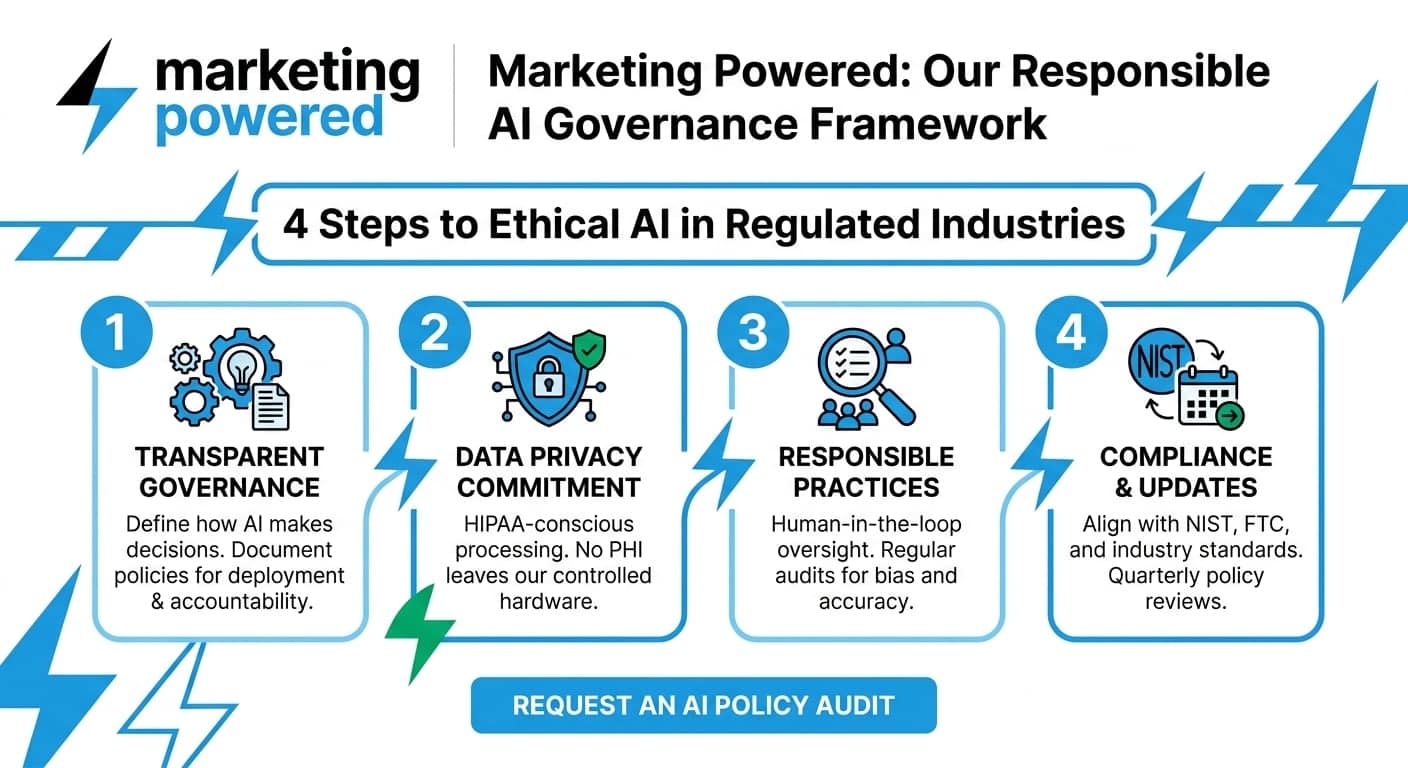
Data privacy commitments are non-negotiable in healthcare-adjacent work. Our infrastructure is built for HIPAA-conscious processing, with data sovereignty maintained on controlled hardware rather than third-party cloud environments. PHI does not leave our systems.
Compliance alignment means we do not treat regulatory requirements as checkboxes. We operate with awareness of LegitScript certification standards, Google Ads sensitive vertical restrictions, and the no-retargeting rules that govern behavioral health advertising. Our AI tools are configured to respect these boundaries by default.
Ensuring Responsible AI Practices
Responsible AI policy requires more than documentation. It requires operational discipline.
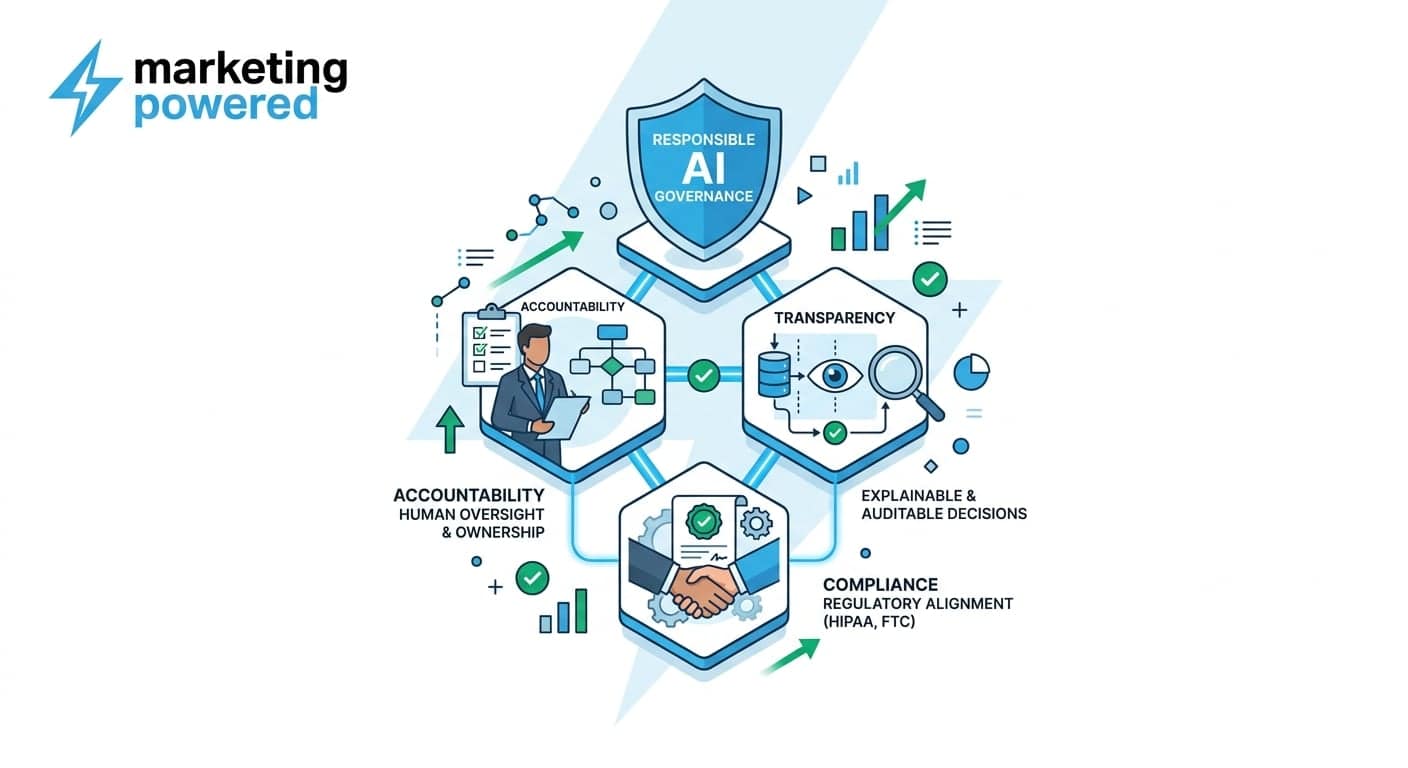
Accountability means every AI-assisted decision has a human owner. When our systems generate recommendations, optimize campaigns, or surface insights, a person reviews the output before it affects client outcomes. We have been AI-native since 2022, long enough to know that automation without oversight creates risk.
Fairness in our context means AI does not introduce bias into targeting, messaging, or budget allocation. We audit model outputs against known demographic and geographic patterns to catch drift before it affects performance.
Transparency is how we build trust with clients and regulators. We document what AI does in our workflows, explain its role in specific deliverables, and provide clear answers when asked how a decision was made. Our founder has served as a court-certified expert witness in advertising strategy, which reinforces why we treat auditability as a core requirement.
If your organization needs clarity on how AI governance translates to operational practice, we can help you map out a framework that fits your risk profile.
Free Audit
Want a straight read on where your budget is leaking?
Compliance and Governance Framework
Our governance framework draws from multiple regulatory and industry sources. We do not operate in a single compliance silo.
The legal structures that guide our AI policy include HIPAA requirements for protected health information, FTC guidance on AI transparency and advertising claims, and platform-specific rules from Google, Meta, and Microsoft for healthcare advertising. We also track emerging frameworks from NIST on AI risk management and international standards as they develop.
Enforcement procedures include quarterly policy reviews, incident documentation protocols, and defined escalation paths when AI behavior deviates from expected parameters. We treat policy violations the same way we treat campaign performance issues: document, diagnose, fix, and prevent recurrence.
Regular updates are built into our governance cycle. AI capabilities change quickly, and policies written for 2022 technology do not address 2025 realities. We revise our framework at least annually, or sooner when significant regulatory guidance emerges.
Future of AI Policies
AI governance is moving from voluntary best practice to a regulatory requirement. The EU AI Act, state-level legislation in the US, and sector-specific guidance from healthcare regulators all point toward a more structured compliance environment.
We expect AI policies to become more specific about model documentation, bias testing, and human oversight thresholds. Organizations that build governance infrastructure now will adapt more easily than those who treat it as a future problem.
Marketing Powered is committed to staying ahead of these requirements. Explore our services to see how we integrate responsible AI practices across paid media, analytics, and campaign optimization for regulated industries.
Ready to Build Your AI Governance Framework?
Whether you need a formal AI systems policy, an audit of existing practices, or guidance on compliance requirements for regulated industries, we can help you build a framework that protects your organization and supports responsible growth.
Questions, Answered.
An AI systems policy is a formal document that defines how an organization develops, deploys, and governs artificial intelligence. It typically includes user access guidelines, data handling requirements, accountability structures, and compliance standards. For organizations in regulated industries, this policy establishes the boundaries that keep AI applications within legal and ethical limits.
We maintain compliance through quarterly policy reviews, documented incident protocols, and defined escalation paths when AI behavior deviates from expected parameters. Our team conducts regular audits of AI outputs against fairness and accuracy benchmarks. We also track regulatory developments from NIST, the FTC, and healthcare-specific authorities to update our framework as requirements change.
Transparency builds trust with clients, regulators, and end users. When people understand how AI influences decisions, they can evaluate whether those decisions are fair and appropriate. Our transparency measures include documentation of AI roles in specific workflows, clear explanations of how recommendations are generated, and audit trails that support regulatory inquiries.
An acceptable AI use policy typically includes authorized user definitions, permitted use cases, data handling and privacy requirements, security measures, human oversight protocols, and incident response procedures. These components establish who can use AI, what they can use it for, how data is protected, and what happens when something goes wrong.
Ready to see what AI-native marketing can do for your treatment center?
Request a free audit of your paid media, landing pages, attribution, and compliance posture. You'll get a straight assessment of where the opportunities are.
or email us at info@marketingpowered.ai